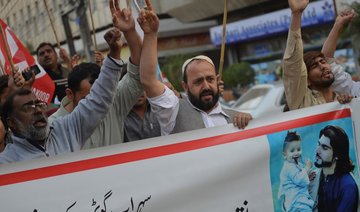
LAHORE/ISLAMABAD: A Pakistani ethnic rights group drew over 8,000 people to a rally in Lahore on Sunday, despite pressure from security officials to call off the event focusing on human rights violations in areas bordering Afghanistan.
The leader of the Pashtun Tahafuz Movement (PTM), student activist Manzoor Pashteen, delivered an address criticizing the country’s powerful military and its actions in the majority ethnic Pashtun Federally Administered Tribal Areas (FATA).
“I urge professional soldiers not to follow the command of the generals and brigadiers. Refuse to obey their orders because they (generals) can get you killed like they did with people of Waziristan and other parts of the country,” Pashteen said.
The North and South Waziristan areas of FATA were the site of large military operations in 2009 and 2014 after the Pakistan Taliban took control of swathes of territory in the region.
Waziristan is still affected by media restrictions, limiting the ability of journalists to travel there, and activists say that has contributed to portrayal of the Pashtun population as wedded to backward tribal customs and maintaining close ties to militant groups.
On Saturday, five PTM members were taken from their hotel by Lahore police and told they did not have permission to hold a rally, organization leader Ali Wazir told Reuters.
“We have come to Lahore so we can share our pain and suffering with people,” Wazir said.
“No one here knows what is happening in FATA.”
Police confirmed five activists were picked up but did not give any reasons for their detention.
PTM emerged after the January killing by police of Pashtun youth Naqeebullah Mehsud in Karachi sparked nationwide condemnation and demonstrations attracting several thousand people.
The organization has drawn the ire of the country’s armed forces.
Pakistan’s army chief Qamar Javed Bajwa said at an April 12 meeting with dignitaries that “no anti-state agenda in the garb of engineered protests” will not be allowed to succeed, the military’s public relations department said in a statement.
He did not name PTM when making the comments.
At least two universities in Pakistan canceled talks related to Pashtun rights last week after receiving calls from security officials, faculties at both institutions said.
A faculty member at Lahore’s Punjab University was fired after being criticized for participating in an event attended by Pashteen and promoting left-leaning ideas with students, associate professor Ammar Ali Jan said.
The university has said Jan was removed after failing to complete employment paperwork, despite teaching there for over a semester.
Midway through the rally, sewage water was released onto the grounds of Lahore’s Mochi Gate where the protest was being held but participants remained undeterred.
Local government officials declined to comment on how the wastewater was released.


Pakistani rights group attracts 8,000 to rally despite state pressure

Pakistani rights group attracts 8,000 to rally despite state pressure
- PTM came into prominence after the killing of Pashtun youth Naqeebullah Mehsud by police in Karachi
- “I urge professional soldiers not to follow the command of the generals and brigadiers,” says rights group leader Manzoor Pashteen


Fourth Palestine Action activist ends hunger strike in UK prison
- Amy Gardiner-Gibson began eating again after 49 days of protest
- Govt rejects claims it ignored prison safety protocols
LONDON: A fourth Palestine Action activist imprisoned in the UK has ended her hunger strike.
Amy Gardiner-Gibson, who also uses the name Amu Gib, began eating again after 49 days of fasting, the campaign group Prisoners for Palestine said.
Qesser Zuhrah, another activist, ended her hunger strike last week after 48 days but said she might resume it next year, Sky News reported.
Four Palestine Action activists have now ended their hunger strikes while in prison, while four others are continuing to fast.
All of them are in prison on remand, awaiting trial for a series of high-profile alleged break-ins and criminal damage.
Palestine Action was proscribed as a terrorist organization and banned earlier this year.
On Tuesday, Swedish climate activist Greta Thunberg was arrested in central London at a rally in support of the hunger strikers.
The protesters are demanding that weapons factories in Britain with ties to Israel be shut down, as well as the removal of Palestine Action’s proscription.
They are also calling for immediate bail to be given to imprisoned pro-Palestine activists and an end to the alleged mistreatment of prisoners in custody.
Seven imprisoned members of Palestine Action have been transferred to hospital over the course of the hunger strike campaign. Doctors have highlighted concerns about the long-term impact of fasting on the activists.
Lawyers representing the group on Monday initiated legal action against the government over its alleged failure to follow prison safety regulations.
The government, however, has rejected this accusation, Sky News reported.
A Ministry of Justice spokesperson said: “Ministers do not intervene in individual cases. Where individuals are on remand, doing so would risk prejudicing ongoing legal proceedings and undermine the independence of the justice system.
“Concerns about welfare and process can be raised through established legal and administrative channels, including prison governors and ultimately the prison and probation ombudsman.
“Healthcare decisions are taken independently by qualified NHS professionals and appropriate care and oversight frameworks remain in place.”
The activists still on hunger strike include Heba Muraisi and Teuta Hoxha. Hoxha has been on remand for 13 months and her family told Sky News they feared she would die in prison.
Another of the activists, Kamran Ahmad, is believed to have been on hunger strike for 45 days and hospitalized three times.
Lewie Chiaramello, who has Type 1 diabetes, is on day 31 of his strike and taking part by fasting every other day.


