EU backs off from new sanctions against Iran — for now

1 / 2
European Union foreign policy chief Federica Mogherini speaks with the media as she arrives for a meeting of EU foreign ministers at the EU Council building in Luxembourg on April 16, 2018. (AP Photo/Virginia Mayo)
2 / 2
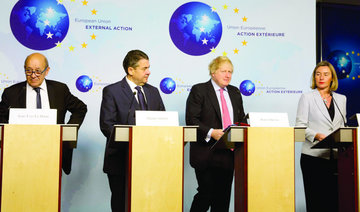
France's Foreign Minister Jean-Yves Le Drian (C), UK's Foreign Secretary Boris Johnson (R), EU foreign policy chief Federica Mogherini (L) and Germany's Foreign Minister Heiko Maas attend an EU foreign affairs council in Luxembourg on April 16, 2018. (AFP / Emmanuel Dunand)
Updated 17 April 2018
Follow

EU backs off from new sanctions against Iran — for now

  • Irish FM stressed need to send a strong signal to Iran about its activities
  • Targets for new sanctions could include both Iranians and non-Iranian militias in Syria

JEDDAH: EU foreign ministers met on Monday for talks on how they could persuade the US not to pull out of the Iran nuclear deal, but stopped short of imposing new sanctions on Tehran.
Britain, France and Germany used a meeting of the EU’s 28 foreign ministers to try to build support for expanding sanctions against Iran to punish it for its regional expansionism and its role in the conflict in Syria.
They hope that by doing so they will persuade US President Donald Trump not to follow through on his threat to abandon the 2015 deal to curb Iran’s nuclear ambitions.
Danish Foreign Minister Anders Samuelson said there was “a very broad majority” in favor of expanding sanctions, as the clock ticks down to a May 12 deadline imposed by Trump to “fix” the agreement.
Simon Coveney, the Irish foreign minister, said there was a need to “send a strong signal to Iran that we’re concerned in relation to some of their activity, particularly in Syria.
“But also to send a message to Washington that we share their concerns in some of those areas,” Coveney said after the talks in Luxembourg.
Targets for new sanctions could include both Iranians and non-Iranian militias in Syria. But any decision would have to have unanimous support, and countries such as Italy and Sweden are not convinced.
“There is no consensus at the moment,” EU diplomatic chief Federica Mogherini said.
“I don’t exclude that this will happen in the future but it’s not the case today.”


Elderly Palestinian shot dead in Rafah

Updated 5 sec ago
Follow

Elderly Palestinian shot dead in Rafah

  • Death toll from Israel’s aggression on Gaza rises to 71,795 since start of assault in October 2023

GAZA: An elderly Palestinian man was killed by Israeli fire in Rafah on Sunday afternoon, bringing the number of fatalities since morning to two, according to local and medical sources.

The sources reported that Khaled Hammad Dahleez, 63, was shot dead by an Israeli drone northwest of Rafah.

Earlier in the day, another man was killed and several others injured in a drone strike north of Wadi Gaza, in the central Gaza Strip, the Palestinian News Agency reported.

BACKGROUND

On Saturday, at least 31 Palestinians, including children and women, were slaughtered in a series of Israeli airstrikes on several locations across the enclave — one of the deadliest days since the start of the ceasefire agreement on Oct. 11, 2025.

On Saturday, at least 31 Palestinians, including children and women, were slaughtered in a series of Israeli airstrikes on several locations across the war-ravaged enclave — one of the deadliest days since the start of the ceasefire agreement on Oct. 11, 2025.

Since the ceasefire took effect on Oct. 11, the number of people killed has risen to 523, with 1,433 injuries recorded, while 715 bodies have been recovered during the same period.

Medical sources said on Sunday the death toll from Israel’s aggression on the Gaza Strip had risen to 71,795 Palestinians killed and 171,551 injured since the start of the assault in October 2023.

The sources reported that 26 fatalities and 68 injuries were brought to Gaza hospitals over the past 48 hours, noting that numerous victims were trapped under rubble or in the streets, with ambulance and rescue crews unable to reach them.

The ceasefire’s first phase called for the exchange of all hostages held in Gaza for hundreds of Palestinians held by Israel, a surge in humanitarian aid and a partial pullback of Israeli troops.

The second phase is more complicated. It calls for installing a new Palestinian committee to govern Gaza, deploying an international security force, disarming Hamas, and taking steps to begin rebuilding.

Hamas has so far ‌rejected disarmament and Israel has repeatedly indicated that if the Islamist militant group is not disarmed peacefully, it will use force to make it do so.