Turkey walks political tightrope

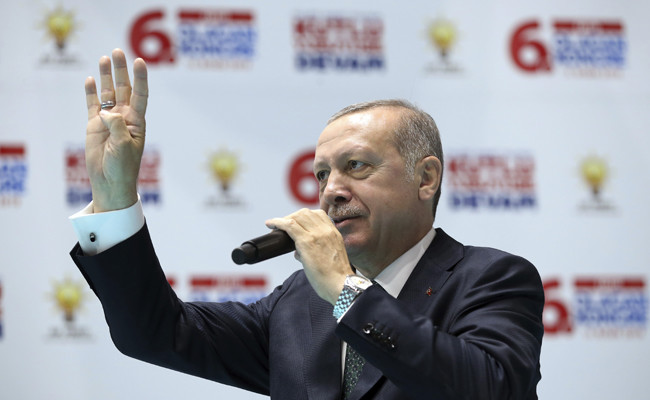
Turkey's President Recep Tayyip Erdogan talks to supporters during a rally in Istanbul on April 14, 2018. (Yasin Bulbul/Pool Photo via AP)
Updated 15 April 2018
Follow

Turkey walks political tightrope

  • Erdogan welcomeS coalition air strikes in response to Assad’s “inhumane attacks”
  • Turkey also wants to push ahead with Astana talks on Syria

ANKARA: The coalition strike against Syrian targets has made Turkey’s policy of balancing Russia and the Western powers more challenging. 

Having welcomed the airstrikes, Turkey’s Foreign Ministry released a statement saying that Ankara considers the operation by the US, Britain and France to be an appropriate response. 

“We welcome this operation which has eased humanity’s conscience in the face of the attack in Douma, largely suspected to have been carried out by the regime,” the statement said, adding that crimes involving the use of chemical weapons should not go unpunished. 

Turkish Chief of the General Staff Hulusi Akar spoke to his US counterpart Jim Mattis before the strikes. 

Turkish President Recep Tayyip Erdogan also welcomed the coalition’s air strikes in response to Assad’s “inhumane attacks.”

Galip Dalay, research director at Al-Sharq Forum in Istanbul, described Turkey’s response as “more of a moral reaction ... than a political reaction with practical consequences.” 

“Under normal circumstances, Turkey would have supported any anti-Assad action wholeheartedly and would have sought to take part in it. Yet it isn’t sure of the US commitment as regards the regime change agenda,” he told Arab News. 

Nevertheless, experts believe the airstrikes will not disrupt the Astana de-escalation process in Syria that was brokered last year between Ankara, Moscow and Tehran. 

Dalay said Turkey seems reluctant to part ways with its Astana agreement partners over any action that would not have a dramatic impact on the regime’s hold of Syria.

Oytun Orhan, a Syria expert at Orsam, an Ankara-based think-tank, agreed. “Turkey will manage the situation diplomatically as long as the scope of the operation remains limited. If the conflict turns into one between the US on the one hand and Iran and Russia on the other, then it will become more difficult for Turkey to maintain this position. In such a case, Turkey will need to take a more clear stance,” he told Arab News. 

According to Orhan, the current level of the operations is in Turkey’s interest by sending a message to Assad and Iran, creating pressure on them for a political settlement and counter-balancing Tehran. 

Turkey’s Deputy Prime Minister, Bekir Bozdag, announced on Saturday that the Incirlik air base, which also holds US nuclear weapons, was not used in the airstrikes on Syria. 


Lebanon PM says IMF wants rescue plan changes as crisis deepens

Updated 4 sec ago
Follow

Lebanon PM says IMF wants rescue plan changes as crisis deepens

  • “We want to engage with the IMF. We want to improve. This is a draft law,” Salam said
  • “They wanted the hierarchy of claims to be clearer. The talks are all positive”

DAVOS, Switzerland: The International Monetary Fund has demanded amendments to a draft rescue law aimed at hauling Lebanon out of its worst financial crisis on record and giving depositors access to savings frozen for six years, Prime Minister Nawaf Salam said.
The “financial gap” law is part of a series of reform measures required by the IMF in order to access its funding and aims to allocate the losses from Lebanon’s 2019 crash between the state, the central bank, commercial banks and depositors.
Salam told Reuters the IMF wants clearer provisions in the hierarchy of claims, which is a core element of the draft legislation designed to determine how losses are allocated.
“We want to engage with the IMF. We want to improve. This is a draft law,” Salam said in an interview at the World Economic Forum annual meeting in ⁠the Swiss mountain resort of Davos.
“They wanted the hierarchy of claims to be clearer. The talks are all positive,” Salam added.
In 2022, the government put losses from the financial crisis at about $70 billion, a figure that analysts and economists forecast is now likely to be higher.
Salam stressed that Lebanon is still pushing for a long-delayed IMF program, but warned the clock is ticking as the country has already been placed on a financial ‘grey list’ and risks falling onto the ‘blacklist’ if reforms stall further.
“We want an IMF program and we want to continue our discussions until we get there,” he said, adding: “International pressure is real ... The longer we delay, the more people’s money will evaporate.”
The draft law, which was passed by Salam’s government in December, is under parliamentary review. It aims to give depositors a guaranteed path to recovering their funds, restart bank lending, and end a financial crisis that has left nearly a million accounts frozen and confidence in the system shattered.
The roadmap would repay depositors up to $100,000 over four years, starting with smaller accounts, while launching forensic audits to determine losses and responsibility.
Lebanon’s Finance Minister Yassine Jaber, who is driving the reform push with Salam, told Reuters it was ⁠essential to salvage a hollowed-out banking system, and to stop the country from sliding deeper into its cash-only, paralyzed economy.
The aim, Jaber said, is to give depositors clarity after years of uncertainty and to end a system that has crippled Lebanon’s international standing.
He framed the law as part of a broader reckoning: the first time a Lebanese government has confronted a combined collapse of the banking sector, the central bank and the state treasury.
Financial reforms have been repeatedly derailed by political and private vested interests over the last six years and Jaber said the responsibility now lies with lawmakers.
Failure to act, he said, would leave Lebanon trapped in “a deep, dark tunnel” with no way back to a functioning system.
“Lebanon has become a cash economy, and the real question is whether we want to stay on the grey list, or sleepwalk into a blacklist,” Jaber added.