

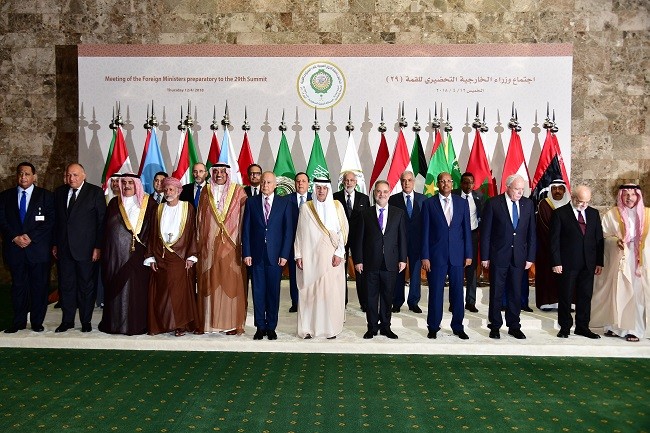

RIYADH: Leaders of the 22-nation Arab League, who will meet in the Saudi city of Dhahran on Sunday, are expected to stress continuity in their efforts to find a solution to the Syrian conflict. It follows airstrikes by the US, UK and France against the Assad regime on Saturday. The leaders are likely to seek Arab and international support to increase  pressure on the regime to find a solution to the conflict.
Their push for a tough stand against Iran is expected to dominate the Arab League Summit as regional tensions grow over the wars in Syria and Yemen.
The fate of Jerusalem will also be on the agenda as the US prepares to move its embassy there from Tel Aviv after declaring it Israel’s capital.
“All key regional issues are on the agenda, with Syria, Yemen and Palestine at the top,” Ali Al-Kayed, Jordanian ambassador to Saudi Arabia, told Arab News.
Dr. Ibrahim Al-Qayid, founding member of the National Society for Human Rights (NSHR), said Saturday’s airstrikes are “largely welcomed by Western and Arab nations, which condemn (the regime’s) crimes against humanity by repeatedly using chemical weapons against civilians.”
He added: “There is an urgent need to defuse the crisis in Syria, where more than half of the population has either fled the country or become homeless.”
He asked: “Should the world sit and watch as an arrogant ruler (Syrian President Bashar Assad) commits genocide in his own country?”
Al-Qayid urged Arab leaders to take “stern and decisive action” to resolve the conflict once and for all.
He commended the US, UK and France for Saturday’s attack, saying when a ruthless regime commits war crimes, the international community has the right to take action and save innocent civilians.
Arab leaders and heads of delegations started arriving in Dhahran on Saturday to take part in the summit, SPA reported.
They were received by Prince Saud bin Naif bin Abdulaziz, governor of Eastern Region; Prince Ahmed bin Fahad bin Salman, deputy governor, Ahmed Aboul-Gheit, secretary general of the Arab League, and a number of officials.
Iran’s interference
Thursday’s preparatory meeting of Arab foreign ministers said there could be “no peace and security in the region as long as Iran continues to interfere in the domestic affairs of Arab states.”
The meeting was led by Saudi Foreign Minister Adel Al-Jubeir, who received the Arab League’s rotating chairmanship from his Jordanian counterpart Ayman Safadi in the presence of the secretary-general.
Addressing the meeting, Aboul-Gheit said the decline of Arab influence on the situation in Syria had led to the “domination of foreign powers” there, paving the way for the country’s eventual disintegration. “The crisis in Syria can only be resolved through a political solution,” he added.
Saudi Arabia is likely to seek Arab support to pile the pressure on Iran, an analyst told AFP.
“Saudi Arabia is going to push for a much harsher stance on Iran — not necessarily on the nuclear dossier per se, but on Iranian influence in the Arab countries, particularly Iraq, Syria, Lebanon and Yemen,” said Karim Bitar of the Paris-based Institute of International and Strategic Affairs.


