With new CEO, Volkswagen shifts focus from scandal to future tech

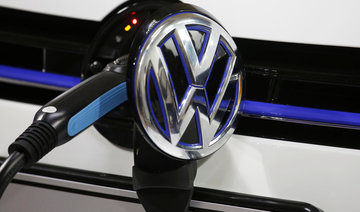
Volkswagen’s Strategy 2025 involves adding 30 battery-powered vehicles by 2025 and tapping new revenue possibilities by focusing on offering temporary use of autos as a service. (AP)
Updated 13 April 2018
Follow

With new CEO, Volkswagen shifts focus from scandal to future tech

FRANKFURT: Volkswagen’s new CEO said Friday that the automaker must “significantly step up the pace” as it develops electric and self-driving vehicle technologies and offers transportation as a digitally driven service.
Herbert Diess said a new management structure bundling the company’s dozen brands in just three divisions would mean faster decisions as the company keeps up with sweeping change in how people use cars. And it will help make decisions more transparent to avoid a repeat of the disastrous diesel emissions scandal that has cost Volkswagen billions in fines.
The 59-year-old Diess was named Thursday as the German automaker’s new CEO, replacing Matthias Mueller. The handover carries some symbolism as Mueller had been the executive tasked in September 2015 to lead the company through its scandal over cheating on US diesel car emissions tests.
As CEO, Diess will also be responsible for the company’s mass market brands Volkswagen, SEAT and Skoda, as well as digital services and vehicle software. Luxury group Audi will be placed in a separate premium division and high-end brands Porsche, Bentley, Bugatti and Lamborghini in a super-premium group.
Chairman Hans Dieter Poetsch said Diess would have a chief operating officer to oversee day to day issues at the volume segment so that he would not lose focus on the company has a whole. That executive has not been named.
Speaking at a news conference at the company’s headquarters in Wolfsburg, Germany, Diess said the company’s goal would be “to forcefully and with focus press ahead” with the company’s Strategy 2025. The plan involves adding 30 battery-powered vehicles by 2025 and tapping new revenue possibilities by focusing on offering temporary use of autos as a service.
The strategy also includes building a more open, values-based culture to avoid the cheating that took place under Martin Winterkorn, who resigned when the scandal broke in 2015. Eight managers were charged with criminal offenses in the United States and the company paid more than $20 billion in fines, settlements and penalties. In Europe, the scandal dealt a serious blow to sales of cars with diesel engines, as the heightened scrutiny revealed that other manufacturers also sold cars that polluted far more during regular driving than during testing, although not necessarily using the same illegal methods that Volkswagen did.
Despite the high costs in reputation and fines, the company under Mueller’s two-year stewardship achieved record sales of 10.74 million vehicles in 2017 and made 11.6 billion euros ($14.3 billion) in profit.
Poetsch said that the company has “to a great extent put the diesel crisis behind us.”
As an outsider who didn’t come up through the Volkswagen ranks as did Mueller, Diess must master the company’s unique and sometimes unwieldy corporate culture, which includes a major government stakeholder in the state of Lower Saxony and strong employee representation that has tended to hinder cost-cutting.
Diess came to Volkswagen in 2015 as head of the core nameplate from competitor BMW, where he was head of vehicle development. His first job was hammering out a 2016 cost-cutting agreement with the company’s powerful labor representatives. The deal foresees raising German factory productivity by 25 percent and dropping 23,000 jobs through attrition but expressly rules out layoffs.
The management shakeup included appointing an employee representative, Gunnar Kilian, as chief human resources manager. Analyst Max Warburton at Sanford C. Bernstein said the Kilian appointment had the appearance of concession to powerful employee representatives in return for agreeing to naming investor-friendly cost-cutter Diess as CEO.
Warburton said, however, that despite fears that Volkswagen’s insular culture might reject Diess’s hardnosed approach, “instead of being squeezed out he has been pushed upward and made CEO,” calling that “a sign of real change at VW.”


First EU–Saudi roundtable on critical raw materials reflects shared policy commitment

Updated 16 January 2026
Follow

First EU–Saudi roundtable on critical raw materials reflects shared policy commitment

RIYADH: The EU–Saudi Arabia Business and Investment Dialogue on Advancing Critical Raw Materials Value Chains, held in Riyadh as part of the Future Minerals Forum, brought together senior policymakers, industry leaders, and investors to advance strategic cooperation across critical raw materials value chains.

Organized under a Team Europe approach by the EU–GCC Cooperation on Green Transition Project, in coordination with the EU Delegation to Saudi Arabia, the European Chamber of Commerce in the Kingdom and in close cooperation with FMF, the dialogue provided a high-level platform to explore European actions under the EU Critical Raw Materials Act and ResourceEU alongside the Kingdom’s aspirations for minerals, industrial, and investment priorities.

This is in line with Saudi Vision 2030 and broader regional ambitions across the GCC, MENA, and Africa.

ResourceEU is the EU’s new strategic action plan, launched in late 2025, to secure a reliable supply of critical raw materials like lithium, rare earths, and cobalt, reducing dependency on single suppliers, such as China, by boosting domestic extraction, processing, recycling, stockpiling, and strategic partnerships with resource-rich nations.

The first ever EU–Saudi roundtable on critical raw materials was opened by the bloc’s Ambassador to the Kingdom, Christophe Farnaud, together with Saudi Deputy Minister for Mining Development Turki Al-Babtain, turning policy alignment into concrete cooperation.

Farnaud underlined the central role of international cooperation in the implementation of the EU’s critical raw materials policy framework.

“As the European Union advances the implementation of its Critical Raw Materials policy, international cooperation is indispensable to building secure, diversified, and sustainable value chains. Saudi Arabia is a key partner in this effort. This dialogue reflects our shared commitment to translate policy alignment into concrete business and investment cooperation that supports the green and digital transitions,” said the ambassador.

Discussions focused on strengthening resilient, diversified, and responsible CRM supply chains that are essential to the green and digital transitions.

Participants explored concrete opportunities for EU–Saudi cooperation across the full value chain, including exploration, mining, and processing and refining, as well as recycling, downstream manufacturing, and the mobilization of private investment and sustainable finance, underpinned by high environmental, social, and governance standards.

From the Saudi side, the dialogue was framed as a key contribution to the Kingdom’s industrial transformation and long-term economic diversification agenda under Vision 2030, with a strong focus on responsible resource development and global market integration.

“Developing globally competitive mineral hubs and sustainable value chains is a central pillar of Saudi Vision 2030 and the Kingdom’s industrial transformation. Our engagement with the European Union through this dialogue to strengthen upstream and downstream integration, attract high-quality investment, and advance responsible mining and processing. Enhanced cooperation with the EU, capitalizing on the demand dynamics of the EU Critical Raw Materials Act, will be key to delivering long-term value for both sides,” said Al-Babtain.

Valere Moutarlier, deputy director-general for European industry decarbonization, and directorate-general for the internal market, industry, entrepreneurship and SMEs at European Commission, said the EU Critical Raw Materials Act and ResourceEU provided a clear framework to strengthen Europe’s resilience while deepening its cooperation with international partners.

“Cooperation with Saudi Arabia is essential to advancing secure, sustainable, and diversified critical raw materials value chains. Dialogues such as this play a key role in translating policy ambitions into concrete industrial and investment cooperation,” she added.