

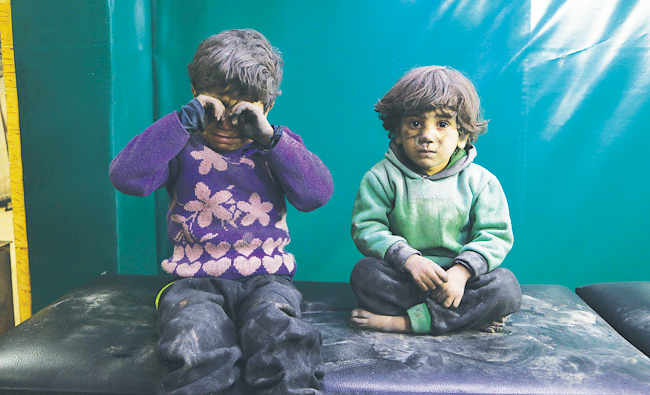

JEDDAH: The attack was savage, brutal and callous. The response from the international community was swift, damning — and aimed directly at Syria’s president Bashar Assad.
As women and children gasped for breath after the Douma chemical gas attack that killed at least 70 people, world leaders were united in calling for the Assad regime to be held to account.
US President Donald Trump described Assad as “an animal,” The Turkish leader Recep Tayyip Erdogan condemned “war crimes and crimes against humanity” and French foreign minister Jean-Yves Le Drian said the attack was “a gross violation of international humanitarian law.”
British Foreign Secretary Boris Johnson said it was “truly horrific to think that many of the victims were families seeking refuge from airstrikes in underground shelters.”
He described the attack as “yet another appalling example of the Assad regime’s brutality and blatant disregard for both the Syrian people and its legal obligations not to use chemical weapons.”
UN Secretary-general Antonio Guterres said he was “deeply concerned about renewed and intensive violence in Douma” and called on all parties to cease fighting. “It is critical that civilians be protected,” he said. “Any use of chemical weapons, if confirmed, is abhorrent, and requires a thorough investigation,” he said.
Guterres called on all sides to ensure respect for international humanitarian and human rights law, including humanitarian access across Syria to all people in need.
It was in the Arab world, however, that the condemnation was most intense.
Dr. Hamdan Al-Shehri, a Saudi political analyst and international relations scholar in Riyadh, said he was devastated by what he had seen.
“The footage on TV of Syrian children and women in Douma turning blue for lack of oxygen, writhing in pain and gasping for breath should rattle the conscience of the world,” he said.
“This is not the first time that Bashar Assad has attacked his own people with deadly gas. He has done this repeatedly and with impunity. It is as if he is mocking the international community.”
Condemnation from world leaders was no longer enough and action must be taken to prevent such attacks, Al-Shehri said.
“We hear words of condemnation from the world community,” he said. “We hear that Bashar Assad will not go unpunished. We hear that he will be held accountable for all that he has done.
“All these are mere words. Words are empty if they are not backed by action. Strong action. Exemplary action. Actions speak louder than words.”
Al-Shehri in particular criticized the international community for failing to live up to its promises on Syria.
“Not so long ago did we hear Barack Obama calling a chemical attack a ‘red line’ — and when that line was crossed by Bashar Assad, nothing was done,” he said. “In the post-Obama period, the Syrian people were promised that action would be taken.
“It has been seven years since hell was let loose on the Syrian people by Assad, Russia and Iran. The innocent people of Syria have nothing with which to defend themselves from these gas attacks, these chemical weapon attacks. There has to be a solution to this problem. Why is the devil of Damascus being allowed to continue his rampage?
“Mere condemnation of Russia, Iran and Assad will not suffice. They need to be stopped. The world community needs to do something, and do some something fast.”
Oubai Shahbandar, a Syrian-American analyst and fellow at the New America Foundation’s International Security Program, also said the attack in Douma showed that action was needed now.
“This is a chemical attack launched by the Assad regime with the explicit purpose of killing civilians and terrorizing the populace,” he said.
Images of the bodies of women and children in bunkers, foaming at the mouth, had been independently verified and “there is no doubt” that their deaths were caused by a chemical agent, Shahbandar said.
“Chemical-weapon watchdog the OPCW (Organization for the Prohibition of Chemical Weapons) itself blamed Assad for prior use of nerve agents and other chemical weapons last year, and now in Douma the Assad regime believes that it can continue to use these horrific weapons of mass destruction with impunity.”
Shahbandar said the administration of US President Donald Trump needed to act decisively, along with the international community.
“The only real, viable solution to ending Assad’s chemical campaign is the complete and total neutralization of his chemical-weapon and ballistic-missile production facilitates — which Iran and Hezbollah have been actively aiding,” he said. The Syrian scientific research center is the central organization that Assad uses to make and weaponize chemical weapons, and unless this center and its affiliated military bases are taken out once and for all, the Syrian chemical genocide is going to continue unabated,” said Shahbandar.


