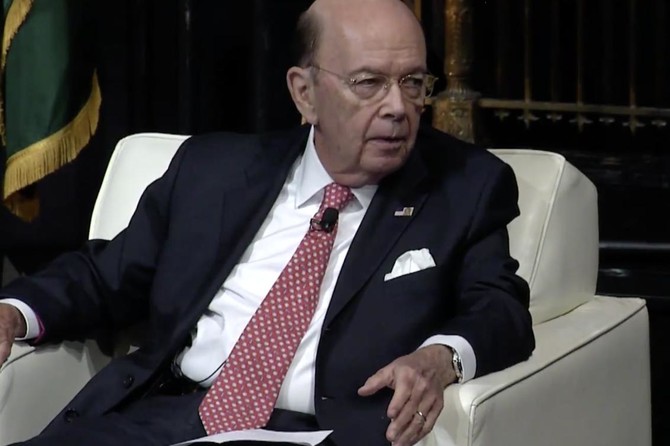
NEW YORK: Wilbur Ross, the US commerce secretary, urged American businesses to support Saudi Arabia in its Vision 2030 strategy to transform the Kingdom and help it achieve the ambitious program.
Speaking at the opening plenary of the Saudi-US CEO Forum in New York, Ross said: “I believe Saudi Arabia has a very high probability of succeeding in its transformation, and to the extent that people here in this room get involved, Saudi will have a far higher chance of success.”
Ross said the Vision 2030 strategy was potentially more far-reaching than the US-Saudi partnership in the 1930s, which led to the discovery of oil and the beginning of the modern Saudi economy.
“Our partnership with Saudi Arabia is not new. We did it in 1938, and now we are standing with them as they seek to transform their economy,” he said, identifying three key planks of the transformation strategy: Diversifying away from oil; exploitation of other natural resources in addition to fossil fuels; and the giga-projects that have been set up as flagships of the transformation projects.
“Neom (the high-tech city on the Egypt and Jordan borders) will be the smartest city in the world; the Red Sea Resort will be an incredible tourist place; and Qidiya (the leisure resort outside Riyadh) will be Walt Disney on steroids, a really amazing project,” Ross said.
Dina Powell, former deputy national security adviser to President Trump, told the gathering that Saudi Arabia and the US had already cooperated closely on security in the Middle East, through the terrorism finance targeting centers and the anti-terrorism recruitment initiatives. “The Iranians are trying to cause mischief and chaos in the area. We won’t get to achieve the Vision 2030 goals if we do not support our friends,” she added.
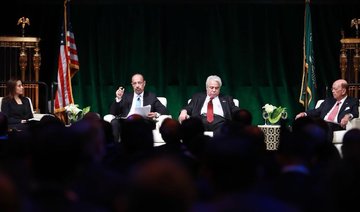
She was speaking on a panel entitled “An Era of Transformation: From Vision to Implementation,” alongside Saudi Energy Minister Khalid Al-Falih and Majid Al-Qassabi, the Kingdom’s commerce secretary.
Al-Falih told the gathering of 200 CEOs that Saudi Arabia’s largest natural resource was oil, adding: “There is a lot more oil and gas that has not been tapped in the first 80 years of our existence. Diversifying away from oil does not mean we will be overlooking our investment in oil and gas. Aramco (the national oil company of which he is chairman) will go global with its initial public offering, and while there is no rush to get away from oil, there are big areas of diversification in petrochemicals and mining,” he said.
Al-Qassabi said that two years into the Vision 2030 plan there had been implementation on several fronts: Organizing government and regulatory procedures, and enhancing the business and investment ecosystem to ensure the rule of law would be protected and conform with international best practice.
He also said there had been a big progress in speeding up business procedures, for example in container traffic and visa issues, and on unlocking new industry sectors, such as mining, tourism, entertainment and culture.
Ross told the plenary that Saudi Arabia had the biggest and best-educated population in the region, and was a country that the US was familiar with. There are already three commercial offices of the US government in the Kingdom.


![]()
America must help KSA transform its economy: US official
America must help KSA transform its economy: US official


Latest updates


© 2026 SAUDI RESEARCH & PUBLISHING COMPANY, All Rights Reserved And subject to Terms of Use Agreement.