Pakistan to set Rs 4.5 trillion revenue collection target for next fiscal year

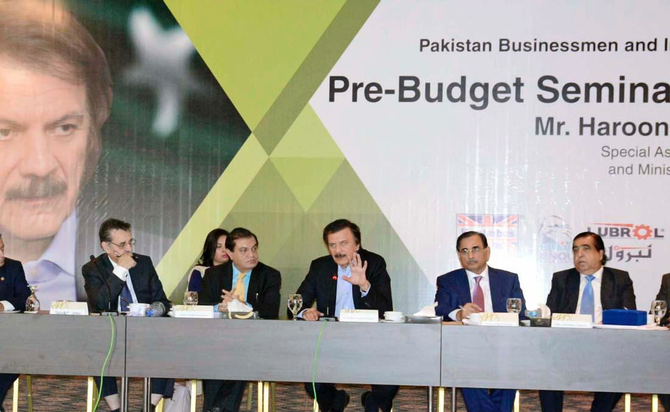
Haroon Akhtar Khan, special assistant to the Prime Minister for revenue and minister of state addressing a pre-budget 2018-19 seminar in Karachi on March 26, 2018. (AN photo)
Updated 26 March 2018
Follow

Pakistan to set Rs 4.5 trillion revenue collection target for next fiscal year

KARACHI: The Pakistan government plans to increase the revenue collection target by Rs 500 billion to Rs 4.5 trillion ($38.9 billion) for the next fiscal year in the forthcoming budget to be announced on April 27, said Haroon Akhtar Khan, special assistant to the Prime Minister for revenue and minister of state.
Khan addressed a pre-budget 2018-19 seminar on Monday.
Pakistan tax collection body the Federal Board of Revenue (FBR) had projected a revenue collection target of Rs 4 trillion for the current fiscal year 2017-18.
The government has collected Rs 2.26 trillion, up by 17.5 percent, revenue in the first eight months of the current fiscal year and hopes to achieve the target by the end of the fiscal year on June 30, 2018.
“The tax-to-GDP rate has increased to 12.5 percent from 9.5 percent,” Khan told participants of the seminar organized by the Pakistan Businessmen and Intellectuals Forum.
“For revenue collection we have set standards which will not be possible for the next leadership of the country to reverse,” he said, giving credit to FBR officials.
He assured that existing super tax, bonus share tax and dividend tax would be reviewed in the forthcoming budget. “The loss due to tax abolition would be arranged from other sources,” he said, without identifying the other sources.
He said the government wants to increase the individual income tax threshold from Rs 400,000. “We don’t want to lower the number of tax return filers,” he added.
Pakistan has devalued its national currency by 10 percent in the past four months in two phases which has depreciated against greenback from Rs 106 to Rs 115.
“It was very important,” Khan said, “because our imports were increasing by 26 percent per year and the government did its best to reduce them but could not succeed.”
He conceded that the government could not manage the rupee in a better way.
Responding to the concerns of the business community about the impact of the devaluation of the Pak rupee, he assured them that “there would be no shock to the economy,” mainly in the backdrop of historical low inflation and interest/policy rates. “If we do not adjust the currency as per the trends, our exports with the passage of time will be rendered uncompetitive in the international market,” he said.
Khan, whose government’s term ends in June, assured that the rupee would not be further devalued in the coming “several months” and the next government will be in a position to decide a future course of action.
He said the country’s foreign exchange reserves had declined from $19 billion to $12 billion because of the current account deficit.
Responding to the misgivings of businessmen about the free trade agreements (FTAs) with China and other countries, the state minister assured that the government has now decided not to sign any FTA without guarding national interests and taking the relevant sector on board.
Pakistan also plans to introduce a tax amnesty scheme for declaring offshore assets. “People from every sector have demanded the scheme. The government has prepared its draft with input from the court,” Khan said, adding that the amnesty scheme would be announced before the budget.
The state minister categorically denied that the government was moving away with regulatory duty imposed on the imports of some 356 goods to discourage imports. “The government will defend the case in court because Rs 80-90 billion are at stake,” he noted.
On the imminent placement of Pakistan on the grey list of the Financial Action Task Force in June, he said Pakistan has sacrificed too much and succeeded in defeating terrorism which could have spilled over from its borders. “We are a resilient nation and have fought with determination,” he said, adding that Pakistan’s sacrifices should not be downplayed.


First EU–Saudi roundtable on critical raw materials reflects shared policy commitment

Updated 16 January 2026
Follow

First EU–Saudi roundtable on critical raw materials reflects shared policy commitment

RIYADH: The EU–Saudi Arabia Business and Investment Dialogue on Advancing Critical Raw Materials Value Chains, held in Riyadh as part of the Future Minerals Forum, brought together senior policymakers, industry leaders, and investors to advance strategic cooperation across critical raw materials value chains.

Organized under a Team Europe approach by the EU–GCC Cooperation on Green Transition Project, in coordination with the EU Delegation to Saudi Arabia, the European Chamber of Commerce in the Kingdom and in close cooperation with FMF, the dialogue provided a high-level platform to explore European actions under the EU Critical Raw Materials Act and ResourceEU alongside the Kingdom’s aspirations for minerals, industrial, and investment priorities.

This is in line with Saudi Vision 2030 and broader regional ambitions across the GCC, MENA, and Africa.

ResourceEU is the EU’s new strategic action plan, launched in late 2025, to secure a reliable supply of critical raw materials like lithium, rare earths, and cobalt, reducing dependency on single suppliers, such as China, by boosting domestic extraction, processing, recycling, stockpiling, and strategic partnerships with resource-rich nations.

The first ever EU–Saudi roundtable on critical raw materials was opened by the bloc’s Ambassador to the Kingdom, Christophe Farnaud, together with Saudi Deputy Minister for Mining Development Turki Al-Babtain, turning policy alignment into concrete cooperation.

Farnaud underlined the central role of international cooperation in the implementation of the EU’s critical raw materials policy framework.

“As the European Union advances the implementation of its Critical Raw Materials policy, international cooperation is indispensable to building secure, diversified, and sustainable value chains. Saudi Arabia is a key partner in this effort. This dialogue reflects our shared commitment to translate policy alignment into concrete business and investment cooperation that supports the green and digital transitions,” said the ambassador.

Discussions focused on strengthening resilient, diversified, and responsible CRM supply chains that are essential to the green and digital transitions.

Participants explored concrete opportunities for EU–Saudi cooperation across the full value chain, including exploration, mining, and processing and refining, as well as recycling, downstream manufacturing, and the mobilization of private investment and sustainable finance, underpinned by high environmental, social, and governance standards.

From the Saudi side, the dialogue was framed as a key contribution to the Kingdom’s industrial transformation and long-term economic diversification agenda under Vision 2030, with a strong focus on responsible resource development and global market integration.

“Developing globally competitive mineral hubs and sustainable value chains is a central pillar of Saudi Vision 2030 and the Kingdom’s industrial transformation. Our engagement with the European Union through this dialogue to strengthen upstream and downstream integration, attract high-quality investment, and advance responsible mining and processing. Enhanced cooperation with the EU, capitalizing on the demand dynamics of the EU Critical Raw Materials Act, will be key to delivering long-term value for both sides,” said Al-Babtain.

Valere Moutarlier, deputy director-general for European industry decarbonization, and directorate-general for the internal market, industry, entrepreneurship and SMEs at European Commission, said the EU Critical Raw Materials Act and ResourceEU provided a clear framework to strengthen Europe’s resilience while deepening its cooperation with international partners.

“Cooperation with Saudi Arabia is essential to advancing secure, sustainable, and diversified critical raw materials value chains. Dialogues such as this play a key role in translating policy ambitions into concrete industrial and investment cooperation,” she added.