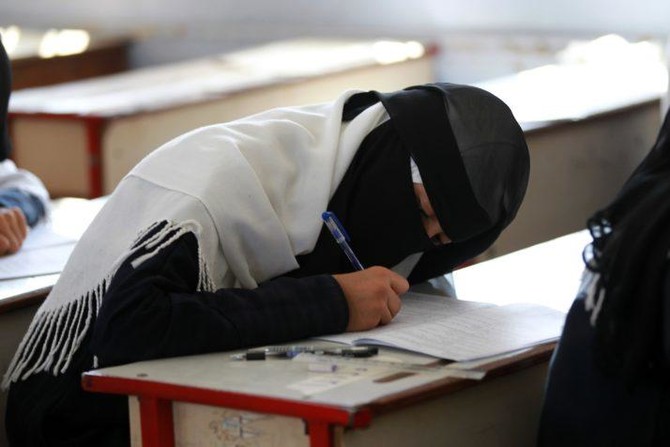
OSLO: The Norwegian government proposed on Friday a nationwide ban on the wearing of full-face veils, such as the burqa and the niqab, in universities, schools, and kindergartens.
France, the Netherlands, Belgium, Bulgaria and the German state of Bavaria have all imposed restrictions on wearing full-face veils in public places.
If passes by parliament, Norway could become the first Nordic country to introduce such ban in the education sector, Finance Minister Siv Jensen said in a statement. Denmark plans to fine people who cover their face in public.
Jensen, who is also the leader of the anti-immigrant right-wing Progress Party, said the ban would send a strong signal that Norway is “an open society where we are going to see the face of each other.”
The government amended an initial proposal, first presented in June, to allow the wearing of full-face veils during breaks and staff meetings in schools and universities, but it would have to apply throughout working hours at kindergartens.
“A ban on face-covering garments will ensure open communication with children, students and newly arrived immigrants in educational situations,” Jan Tore Sanner, minister of knowledge and integration said in the statement. Sanner belongs to the center-right Conservatives.
Full and partial face veils such as burqas and niqabs divide opinion across Europe, setting advocates of religious freedom against secularists and those who argue that such garments are culturally alien or a symbol of the oppression of women.
The niqab covers everything but the eyes, while the burqa also covers the eyes with a transparent veil.
Under the Norwegian proposal, employees who broke the rule several times would risk losing their jobs, and students would face expulsion, the government said. The ban would not apply to headgear like the hijab or hats.
Local bans on wearing burqa and niqab have been already introduced in some upper secondary schools in Norway.
Norway’s minority government, a coalition of the Conservatives, the Progress Party and the centrist Liberals, said in June it was confident it would find enough support for the move in parliament. If it does, the ban would start in August.
Separately, Oslo police said in a report that the capital had seen the highest reported number of hate crimes last year, with 198 incidents considered, against 175 in 2016.
“The biggest increase we see among are women insulted in the category of religion, and more specifically Islam,” said the police in a statement.

Norway proposes bill to ban full-face veils in education

Trump targets non-white immigrants in renewed xenophobic rants
- During a rally in Pennsylvania on Wednesday, Trump doubled down on his tirade against Somali migrants
- "Why is it we only take people from shithole countries,’ right? Trump told his cheering audience
WASHINGTON: Back in 2018, President Donald Trump disputed having used the epithet “shithole” to describe some countries whose citizens emigrated to the United States.
Nowadays, he embraces it and pushes his anti-immigrant and xenophobic tirades even further.
Case in point: during a rally in the northeastern state of Pennsylvania on Wednesday that was supposed to focus on his economic policy, the 79-year-old Republican openly ranted and reused the phrase that had sparked an outcry during his first term.
“We had a meeting and I said, ‘Why is it we only take people from shithole countries,’ right? ‘Why can’t we have some people from Norway, Sweden?’” Trump told his cheering audience.
“But we always take people from Somalia,” he continued. “Places that are a disaster. Filthy, dirty, disgusting, ridden with crime.”
Recently, he called Somali immigrants “trash.”
These comments are “more proof of his racist, anti-immigrant agenda,” Massachusetts Senator Ed Markey responded on X.
The Trump megaphone
Florida Republican lawmaker Randy Fine, on the other hand, defended Trump.
“Not all cultures are equal and not all countries are equal,” he said on CNN, adding “the president speaks in language that Americans understand, he is blunt.”
University of Albany history professor Carl Bon Tempo told AFP this type of anti-immigrant rhetoric has long thrived on the far-right.
“The difference is now it’s coming directly out of the White House,” he said, adding “there’s no bigger megaphone” in American politics.
On the campaign trail in 2023, Trump told a rally in New Hampshire that immigrants were “poisoning the blood of our country” — a remark that drew comparisons to Nazi dictator Adolf Hitler.
Now back in power, Trump’s administration has launched a sweeping and brutal deportation campaign and suspended immigration applications from nationals of 19 of the poorest countries on the planet.
Simultaneously, the president ordered white South African farmers to be admitted to the US, claiming their persecution.
No filter left
“Any filter he might have had is gone,” Terri Givens, a professor at the University of British Columbia in Canada and immigration policy expert, told AFP.
For Trump, it doesn’t matter whether an immigrant obeys the law, or owns a business, or has been here for decades, according to Syracuse University political science professor Mark Brockway.
“They are caught in the middle of Trump’s fight against an invented evil enemy,” Brockway told AFP.
By describing some immigrants as “killers, leeches, and entitlement junkies” — as Secretary of Homeland Security Kristi Noem did earlier this month — the White House is designating a target other than itself for American economic ire at a time when the cost of living has gone up and fears are growing over job security and loss of federal benefits.
But, Bon Tempo noted, “when immigration spikes as an issue, it spikes because of economics sometimes, but it also spikes because of these larger sort of foundational questions about what it means to be an American.”
On November 28, after an Afghan national attacked two National Guard soldiers in Washington, Trump took to his Truth Social network to call for “REVERSE MIGRATION.”
This notion, developed by European far-right theorists such as French writer Renaud Camus, refers to the mass expulsion of foreigners deemed incapable of assimilation.
Digging into the “Make America Great Again” belief system, many experts have noted echoes of the “nativist” current of politics from the 1920s in the US, which held that white, Anglo-Saxon, Protestant culture was the true American identity.
That stance led to immigration policies favoring Northern and Western Europe.
As White House senior adviser Stephen Miller recently wrote on X: “This is the great lie of mass migration. You are not just importing individuals. You are importing societies...At scale, migrants and their descendants recreate the conditions, and terrors, of their broken homelands.”