

Moscow slams UK ‘Russophobia’ and ‘island mentality’ over spy attack

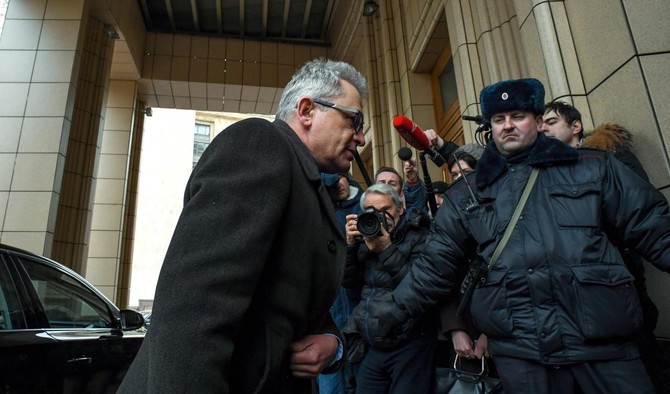
Poland’s Ambassador to Russia Wlodzimierz Marciniak arrives at the Russian Foreign Ministry headquarters to attend a meeting with the ministry’s experts on the poisoning of former double agent Sergei Skripal in an English city this month, Mar 21, 2018. (AFP)
Updated 21 March 2018
Follow

Moscow slams UK ‘Russophobia’ and ‘island mentality’ over spy attack

SALISBURY: Inspectors from the Organization for the Prohibition of Chemical Weapons (OPCW) have begun work at the scene of the nerve agent attack on former Russian agent Sergei Skripal in the English city of Salisbury, a Reuters photographer said.
The inspectors were seen arriving at the Mill pub in Salisbury where Skripal and his daughter Yulia had a drink on March 4.
The pair were later found unconscious on a bench outside The Maltings shopping center. They remain critically ill in hospital.

But a senior Foreign Ministry official indicated that Russia won’t recognize results of the OPCW investigation.
Vladimir Yermakov, deputy head of the Foreign Ministry’s department for non-proliferation, was asked during a briefing whether Moscow would accept the results of the OPCW probe.
Yermakov said that “unscrupulous efforts” to investigate the attack without sharing the case files with Moscow “is not going to work for us.”
Yermakov went on to slam Britain for refusing to cooperate in a probe into the poisoning of a Russian ex-spy on English soil, criticizing its “Russophobia” and “island mentality.”
“Pull yourselves away a little bit from your Russophobia, your island mentality,” Vladimir Yermakov, told a briefing of representatives of foreign diplomatic missions.

Britain said Wednesday that its ambassador in Moscow has snubbed the meeting.
The Kremlin slammed the absence of British ambassador Laurie Bristow, saying it showed London’s unwillingness to cooperate.
On Tuesday, Moscow had invited all ambassadors to Russia to a meeting with foreign ministry experts to hear its views on the poisoning of former double agent Sergei Skripal in an English city earlier this month. Several western diplomatic missions said their chiefs did not attend the meeting in solidarity with the UK.

Chancellor Angela Merkel of Germany has called for “transparency from Russia” over the nerve agent attack on a former Russian spy in Britain.
Merkel emphasized Germany’s solidarity with Britain in a speech to lawmakers in Berlin on Wednesday. She said that “a lot of evidence points to Russia and so transparency from Russia is required to quell the suspicion.”
Merkel added: “I would be happy if I didn’t have to name Russia here, but we can’t disregard evidence because we don’t want to name Russia.”



India, EU agree on trade deal slashing tariffs on 99.5% of Indian exports

Updated 5 sec ago
Follow

India, EU agree on trade deal slashing tariffs on 99.5% of Indian exports

  • Agreement expected to be signed later this year and come into force in early 2027
  • Duty cuts on 99.5% Indian exports to EU unlikely to offset US tariff impact, expert says

NEW DELHI: India and the EU have concluded negotiations on a deal creating a free trade zone of 2 billion people, European Commission President Ursula von der Leyen and Indian Prime Minister Narendra Modi said on Tuesday.

Talks for the pact, referred to by both leaders as the “mother of all deals,” started in 2007 and stalled repeatedly over the years, with the negotiation process only speeding up last year, following new US tariff polices.

The agreement is expected to be signed later this year and may come into force in early 2027.

“People around the world are calling it the ‘mother of all deals.’ This agreement brings huge opportunities for India’s 1.4 billion people and for millions of people across European countries,” Modi said during a joint press conference with Von der Leyen and European Council President Antonio Costa in New Delhi.

“It represents 25 percent of the global GDP and one-third of global trade.”

The deal paves the way for India to open its vast market to free trade with the EU, its biggest trading partner, and gain preferential access for almost all of its exports to the 27-nation European bloc.

“We have created a free trade zone of 2 billion people, with both sides set to gain economically,” Von der Leyen said. “We have sent a signal to the world that rules-based cooperation still delivers great outcomes.”

The conclusion of negotiations comes as US President Donald Trump slapped India with 50 percent tariffs and has threatened to impose new duties on several EU countries unless they support his efforts to take over Greenland.

“This is a signal to the US that like-minded entities, EU and India, are willing to come together and work together,” Prof. Harsh V. Pant, vice president of the Observer Research Foundation, told Arab News.

“Here are two countries that are bringing in a greater predictability and less volatility in their relationship, and they will move ahead irrespective of what the US does.”

The deal is expected to double EU goods exports to India by 2032 as tariffs on 96.6 percent of EU goods exports — from automobiles and industrial goods to wine and chocolates — will be eliminated or reduced, saving up to $4.75 billion per year in duties on European products, according to a European Commission press release on Tuesday.

At the same time, the EU will eliminate or reduce tariffs on 99.5 percent of goods imported from India over seven years, India’s Ministry of Commerce and Industry said in a statement, projecting gains mainly in labor-intensive sectors like textiles, leather, marine products, gems and jewelry.

“Indian services will also benefit from the trade deal. But, more than just export growth, the deal is part of a broader EU-India alliance on green tech, critical raw materials, digital rules and other aspects, which should channelize higher FDI (foreign direct investment) into India,” said Dr. Anupam Manur, professor of economics at the Takshashila Institution.

“India can potentially have a welfare and income gain of 0.5 percent of its GDP in the long run. It would also boost Indian exports to the EU by about $5 billion from the current level of about $76 billion.”

The agreement is unlikely to fully compensate for a slowdown in trade with the US.

“In the near term, this will partially offset the loss of exports to the US due to tariffs but cannot be expected to entirely mitigate it. Shifting supply chains and exports take time,” Manur said.

“The implementation of the FTA would take about a year’s time. The deal is expected to come into force by early 2027.”