

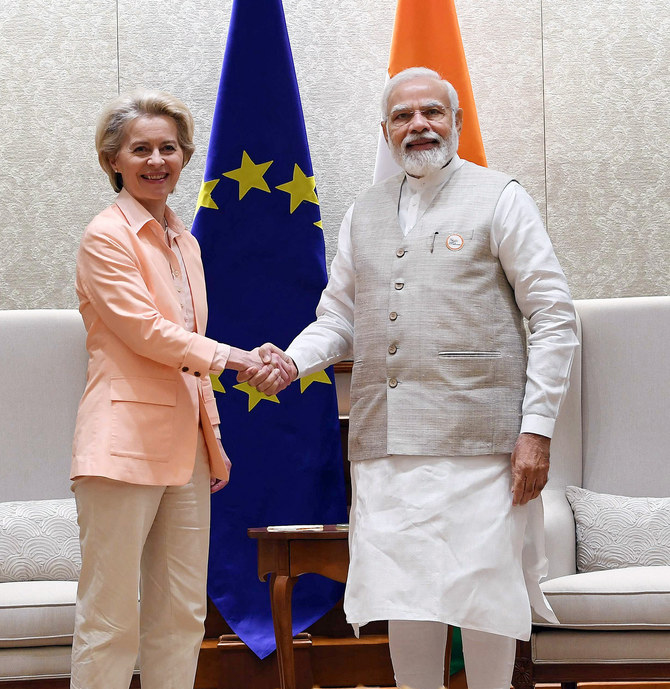
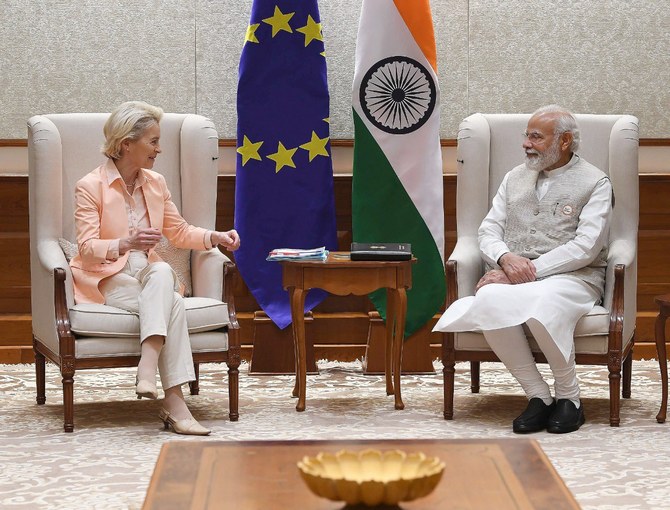

NEW DELHI: India and the EU on Monday launched a trade and technology council to boost cooperation as both sides face “a challenging global landscape,” with a visit from the bloc’s chief coming after a stream of high-level visits to New Delhi since Russia’s invasion of Ukraine.
European Commission President Ursula von der Leyen’s two-day trip is widely seen as part of the West’s continued efforts to encourage India to reduce ties to Russia, its main weapons supplier.
India has called for an immediate end to violence but refrained from explicitly condemning the Russian invasion.
Prime Minister Narendra Modi said in a tweet that Monday’s meeting with Von der Leyen, where the leaders discussed efforts to deepen strategic engagement, was “fruitful.”
“Today, our relationship is more important than ever,” Von der Leyen said during the meeting.
“We have so much in common … and we are both facing a challenging global landscape.”
In a joint statement, India and the EU said they had agreed on how “rapid changes in the geopolitical environment highlight the need for joint in-depth strategic engagement.” The newly established council is set to provide them with a mechanism for strategic coordination.
India is the second country to have this technical agreement with the EU, the first being the US.
The EU chief said in a series of tweets that the bloc and India will start negotiations on trade and investment agreements, while highlighting their cooperation on energy security and the fight against climate change.
The flurry of top visits to New Delhi following the war in Europe is part of an ongoing effort to have world democracies stand together against Russia, according to Dr. Ummu Salma Bava, professor at the Centre for European Studies of Jawaharlal Nehru University in New Delhi.
“No doubt there’s a concerted effort to bring India to the democracy camp … The West would like to see India in their grouping and that would add to their collective weight,” Bava told Arab News.
Von der Leyen’s visit comes days after that of British Prime Minister Boris Johnson, who agreed to increase bilateral defense and business cooperation with Modi’s government.
Ukraine did not appear to feature prominently during Von der Leyen’s talks with Modi, though Indian Foreign Minister Dr. S. Jaishankar said in a tweet that he and the EU chief had “exchanged views on the economic and political implications of the Ukraine conflict.”
“They want India to take one kind of a stand which of course would mean anti-Russia, which India will be very, very cautious about. India does not want to be projected in this kind of binary,” Bava said.


