Russian FM: Russia 'not guilty' in spy poisoning case

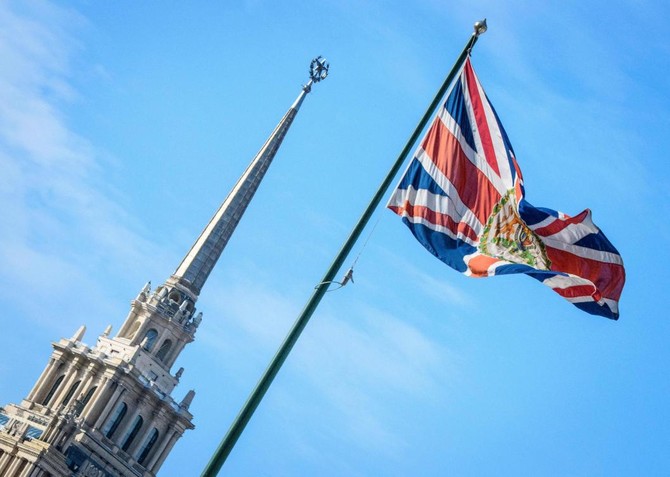
A picture taken on March 6, 2018 shows the United Kingdom flag flying in the wind outside its embassy, with a Stalin-era skyscraper seen in the background, in Moscow. The Kremlin said on March 6, 2018 it had no information on a former Russian double agent who fell ill in Britain after exposure to an unknown substance, calling the incident "tragic." (AFP)
Updated 13 March 2018
Follow

Russian FM: Russia 'not guilty' in spy poisoning case

MOSCOW: Moscow on Tuesday denied it was behind the poisoning of a former double agent in Britain as a midnight deadline loomed to explain how a suspected Russian-made nerve agent was used in the attack.
"Russia is not guilty," said Foreign Minister Sergei Lavrov of the attack on Sergei Skripal and his daughter in Salisbury on March 4.
The United States, NATO and the European Union have all backed Britain in the deepening diplomatic crisis.
Lavrov said Russia was "ready to cooperate", but complained Britain had rejected its requests for "access" to the nerve agent samples.
German Foreign Minister Sigmar Gabriel also said on Tuesday that any Russian connection to the poisoning in Britain of a former double agent would be a “very serious matter.”
“We stand in solidarity on this issue with our British friends and are in close contact with the British government,” Gabriel said in a statement after speaking with his counterpart Boris Johnson.

“It is clear, the perpetrators must be brought to justice. If it should be confirmed that Russia is behind it, it would be a very serious matter.”
Meanwhile, British police investigating the poisoning will not at this stage name any potential suspects as their enquiries continue, a senior police officer said on Tuesday.
“At this stage, we are not declaring a person of interest or a suspect at this time,” Neil Basu, Senior National Co-ordinator for counter terrorism policing, told reporters.
Police say investigation into nerve agent attack on ex-Russian spy will continue for many weeks.
However, Moscow has called Britain’s accusations of its involvement in the poisoning of a former double agent an attempt to “discredit” Russia and vowed to retaliate against any sanctions.
“The incident is yet another dirty attempt by British authorities to discredit Russia,” the Russian foreign ministry said in a statement, adding that threats of sanctions “will not be left without a response.”


DR Congo’s amputees bear scars of years of conflict

Updated 2 sec ago
Follow

DR Congo’s amputees bear scars of years of conflict

GOMA: They survived the bombs and bullets, but many lost an arm or a leg when M23 fighters seized the city of Goma in the eastern Democratic Republic of Congo nearly a year ago.
Lying on a rug, David Muhire arduously lifted his thigh as a carer in a white uniform placed weights on it to increase the effort and work the muscles.
The 25-year-old’s leg was amputated at the knee — he’s one of the many whose bodies bear the scars of the Rwanda-backed M23’s violent offensive.
Muhire was grazing his cows in the village of Bwiza in Rutshuru territory, North Kivu province, when an explosive device went off.
He lost his right arm and right leg in the blast, which killed another farmer who was with him.
Fighting had flared at the time in a dramatic escalation of a decade-long conflict in the mineral-rich region that had seen the M23 seize swathes of land.
The anti-government M23 is one of a string of armed groups in the eastern DRC that has been plagued by internal and cross-border violence for three decades, partly traced back to the 1994 Rwanda genocide.
Early this year, clashes between M23 fighters and Congolese armed forces raged after the M23 launched a lightning offensive to capture two key provincial capitals.
The fighting reached outlying areas of Muhire’s village — within a few weeks, both cities of Goma and Bukavu had fallen to the M23 after a campaign which left thousands dead and wounded.
Despite the signing in Washington of a US-brokered peace deal between the leaders of Rwanda and the DRC on December 4, clashes have continued in the region.
Just days after the signing, the M23 group launched a new offensive, targeting the strategic city of Uvira on the border with the DRC’s military ally Burundi.
More than 800 people with wounds from weapons, mines or unexploded ordnance have been treated in centers supported by the International Committee of the Red Cross (ICRC) in the eastern DRC this year.
More than 400 of them were taken to the Shirika la Umoja center in Goma, which specializes in treating amputees, the ICRC said.
“We will be receiving prosthetics and we hope to resume a normal life soon,” Muhire, who is a patient at the center, told AFP.


- ‘Living with the war’ -


In a next-door room, other victims of the conflict, including children, pedalled bikes or passed around a ball.
Some limped on one foot, while others tried to get used to a new plastic leg.
“An amputation is never easy to accept,” ortho-prosthetist Wivine Mukata said.
The center was set up around 60 years ago by a Belgian Catholic association and has a workshop for producing prostheses, splints and braces.
Feet, hands, metal bars and pins — entire limbs are reconstructed.
Plastic sheets are softened in an oven before being shaped and cooled. But too often the center lacks the materials needed, as well as qualified technicians.
Each new flare-up in fighting sees patients pouring into the center, according to Sylvain Syahana, its administrative official.
“We’ve been living with the war for a long time,” he added.
Some 80 percent of the patients at the center now undergo amputation due to bullet wounds, compared to half around 20 years ago, he said.
“This clearly shows that the longer the war goes on, the more victims there are,” Syahana said.