MY LAI, Vietnam: Talk of peace dominated the 50th anniversary commemoration of the My Lai massacre in Vietnam, but among the hundreds in the audience were survivors and a former US Army photographer whose gruesome images galvanized anti-war opinion.
Their disturbing tales were a sharp rejoinder to the ceremony’s peaceful sentiments.
Friday’s memorial events were held at the site of the 1968 massacre by American troops of 504 unarmed Vietnamese villagers, mostly women, children and elderly men.
A provincial official addressing the crowd mentioned the killings but scrupulously avoided naming the United States as the two nations steadily improve their relations.
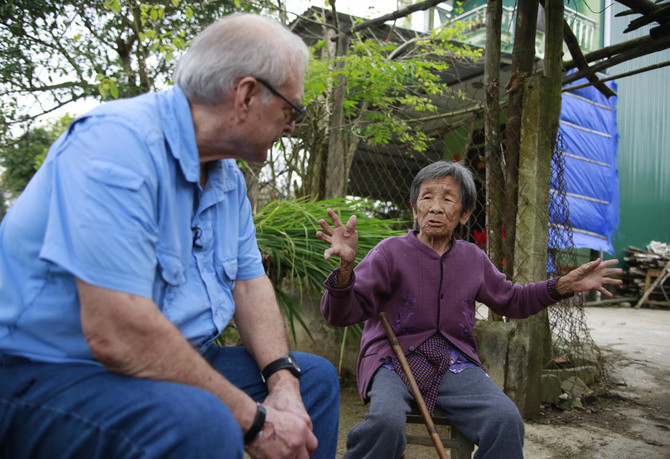
The audience included Sgt. Ron Haeberle, who photographed the aftermath in My Lai, and survivor Tran Van Duc, who was 6 at the time and whose slain mother was photographed by Haeberle
The two men bonded after they met in 2011. Duc lives in Remscheid, Germany, and a German cinematographer, curious about the connection, put him in touch by a message on Facebook to Haeberle in Ohio.
Duc recalled some US soldiers appearing at his family’s house soon after landing by helicopter, who then herded him, his four siblings, and their mother out onto a trail, where American troops began shooting at them.
“The American soldiers set up machine guns at the bridge, then started to fire at us,” Duc told The Associated Press. “At that point I had to witness the most painful moment in my life — the cries, the screams of terror. My mother pushed me into the rice field, so I survived.”
Duc’s mother, wounded in the stomach and thigh, tried to cover him and his 14-month-old sister. After the shooting, the soldiers moved along to the village. Duc’s sister began to cry, and their mother, fearful she would draw the soldiers to return, told him to take her to his grandmother’s house, 7 kilometers (4 miles) away.
“Take Ha to grandma, if you stay here, US soldiers will kill you when they come back,” were the last words Duc heard from her.
Clutching his sister, Duc looked back to see his mother try to grab a bag to get something to staunch her bleeding, but he knew she was in desperate condition.
By the time his grandmother and other villagers returned to recover the remains of their loved ones, they had already been buried. Baby Ha and another sister survived, but two of Duc’s other sisters were killed.
Duc and Haeberle on Thursday visited the trail where the three, along with about three dozen other people, were shot down.
Haeberle’s shocking photos were published first in November 1969 in The Plain Dealer, the biggest newspaper in his home state of Ohio, and then in Life magazine and all around the world. He had been using his Army-issue camera to take photos of fellow soldiers to be dispatched to their hometown papers, a standard military public relations practice which, he acknowledged, did not work so well that day.
It was a technicality that brought the pictures of the carnage to public view; he also carried his personal camera, a Nikon F, for which he had one roll of color film, which meant he did not have to turn in photos to the army’s Public Information Office.
The photo which disturbs him most, he said, was “the woman with the brains lying beside her head. Because later on in life I found out it was Duc’s mother. That to me was upsetting.”
Haeberle came upon the killing scene after being dropped off by a helicopter in the second wave entering the village. With no enemy — the Viet Cong, the VC — in the area firing at them, he had an unmolested view of the atrocities.
“We started going toward the highway and I noticed over my left shoulder that there were a group of people being, like they were guarded there, about three or four soldiers around and they were all squatted down and OK, I walked about another 10, 15 yards I hear firing.
“I turn around, look over my shoulder. People get up trying to run and I figure that something’s wrong. And we heard, you know, a lot of shooting in the village — nobody was shooting at us. We all heard all rapid fire automatic — you know it’s just, we’re trying to figure out what’s going on. Then we got down near the trail, there were three people coming toward us their hands up: ‘No VC, no VC.’ Two children and an old man.
“I thought the soldiers around me, there’s only about three or four, they were going to go ahead and search them or question them. We’re standing there and all of the sudden this guy opens up, and shoots them.”
It was just one of several such shootings he witnessed.
The coldblooded killing was mindboggling to Haeberle, who was 26 at the time, about six years older than the average troops in Charlie Company.
Later, he concluded that the American soldiers were badly trained, scared, bitter, and since they couldn’t understand why the Vietnamese villagers seemed hostile, they considered them to be just like the Viet Cong guerrillas they were fighting.
“You know, ‘They’re all VC, everybody’s VC.’ And I ask myself, are babies VC, or little children VC? B-------, they’re not. It’s just a frame of mind they were in.”
Haeberle gave his camera, the one he shot his famous photos with, what he called his My Lai camera, to Duc, who he says installed it on an altar in his home in Germany.
“The camera captured the image of his mother,” Haeberle said. “That was the last photograph, even as horrific as it was, he had a photograph. He had the camera.”
___
Peck reported from Bangkok.


![]()
![]()

My Lai ceremony highlights peace, but dark memories recalled
My Lai ceremony highlights peace, but dark memories recalled


Latest updates




© 2026 SAUDI RESEARCH & PUBLISHING COMPANY, All Rights Reserved And subject to Terms of Use Agreement.