

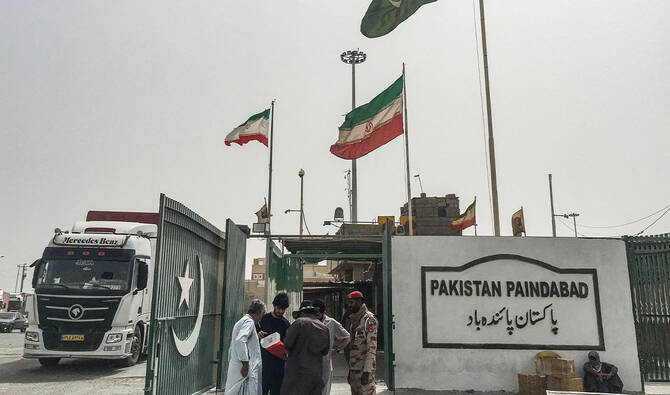

ISLAMABAD: Pakistan Customs on Wednesday rejected reports that trade through a major border crossing with Iran had been suspended and that liquefied petroleum gas (LPG) supplies were being disrupted, saying border operations remained functional and imports continued without interruption.
The statement follows a report carried by Pakistan’s Dawn newspaper on Tuesday citing the Gwadar Chamber of Commerce and Industry (GCCI), which said trade at the Gabd-Rimdan crossing had come to a halt, leaving LPG tankers stranded and raising concerns about shortages and price increases in parts of the country.
The Gabd-Rimdan crossing, located in Pakistan’s southwestern Balochistan province, is one of the country’s key overland trade routes with neighboring Iran. It is particularly important for imports of LPG as well as for exports of agricultural products and other goods.
“Recent media reports regarding an alleged halt in trade activities at the Gabd-Rimdan border crossing and disruption of LPG supplies are incorrect,” Pakistan Customs said in a statement.
The agency said border operations remained functional and that the movement and clearance of essential commodities, including LPG, were continuing without interruption.
According to Customs, 748 LPG Goods Declarations (GDs) involving approximately 17,353 metric tons of LPG were cleared through the Gabd-Rimdan crossing between June 1 and June 8.
“These figures prove that LPG imports remain active and clearance operations continued smoothly during the period in which disruption of trade and LPG shortages were reported in the media,” the statement said.
Customs said the controversy followed the introduction of a revised clearance regime at the Gabd-Rimdan crossing under Pakistan’s Customs Rules, 2001. The agency did not detail the specific procedural changes but said the measures were introduced after consultations with local chambers of commerce and were intended to improve documentation, strengthen compliance with customs regulations and curb under-declaration, concealment of goods and revenue losses. The revised procedures were accompanied by a one-month transition period to help traders adapt.
The agency said essential commodities, including LPG and bitumen, continued to be processed through expedited clearance mechanisms, including a “Green Channel” system that allows faster clearance for designated shipments.
Customs also said the new procedures had improved documentation and revenue collection. It reported collecting Rs12.07 billion ($42.8 million) against 8,245 Goods Declarations during April-June 2026, compared with Rs7.86 billion ($27.9 million) against 6,909 declarations during the corresponding period last year.
Pakistan Customs said it remained committed to facilitating lawful trade, expediting the clearance of legitimate consignments, safeguarding government revenue and maintaining efficient border operations.
In its report published Tuesday, Dawn quoted GCCI President Jiand Hoot as saying trade through the crossing had effectively stopped because of customs-related delays. According to the newspaper, he said hundreds of LPG tankers had remained stranded awaiting clearance and warned that shortages could emerge if the situation persisted.
Dawn also reported that the chamber had raised concerns about exports of perishable products, including rice and mangoes, and had urged federal authorities to intervene to ensure the smooth movement of commercial traffic through the crossing.



