JEDDAH: Saudi Arabia called on the Syrian regime to halt its bombardment of Eastern Ghouta where the death toll on Thursday passed 400 since the devastating assault began.
As international condemnation grew, aid agencies and doctors told Arab News of the dire conditions they are facing and pleaded for access to reach the injured.
But the outcry appeared to be falling on deaf ears as the regime rained rockets and bombs on the opposition-held territory on the edge of Damascus for the fourth consecutive straight day.
“We stress the need for the Syrian regime’s violence to end, and to have humanitarian aid and relief to enter Syria,” the Saudi Foreign Ministry said on Twitter.
“The political path to the crisis solution must be taken seriously, in accordance with the agreed principles of the Geneva Declaration 1 and the UN Security Council Resolution 2254.”
The UAE likewise “expressed its deep concern at the escalation of violence and its repercussions on the humanitarian situation and the safety of civilians.”
Warplanes pounded the last rebel enclave near the Syrian capital for a fifth straight day on Thursday, as the UN pleaded for a halt to one of the fiercest air assaults of the seven-year civil war.
The Syrian Observatory for Human Rights said Thursday night that the bombardment had killed 403 civilians, including 95 children.
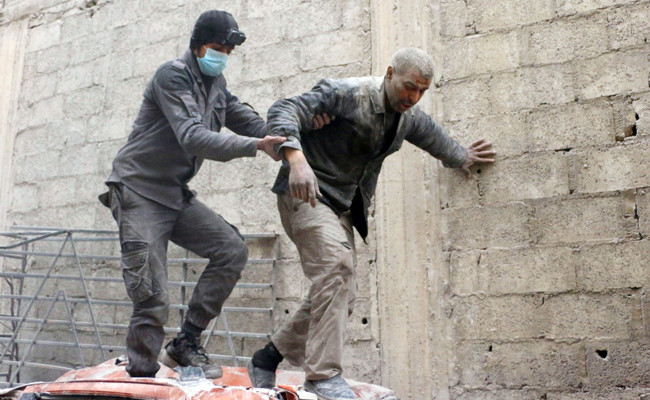
Forty-six people were killed in strikes and rocket fire on Thursday and the bodies of victims killed earlier in the week were also retrieved from the wreckage of destroyed buildings.Human rights monitors and aid agencies said Russian and Syrian planes have struck hospitals and other civilian targets.
“This is really a systematic slaughtering of the Syrian people in front of the eyes of the international community,” Dr. Ghanem Tayara, chairman of the Union of Medical Care and Relief Organizations, told Arab News. “There’s no access at all, not even the birds can fly over Ghouta now.”
As the regime intensified its operations, residents huddled in basements as bombs flattened buildings, even hitting hospitals, AFP reported.
Medicins Sans Frontieres said 13 of the facilities it supports in Eastern Ghouta were damaged or destroyed in three days, leaving remaining staff with very little to save the hundreds of wounded brought to them every day.
In the hospital mortuary in Douma, the main town in the enclave where 400,000 people live, bodies wrapped in white shrouds were lined up on the floor, two of them children.
Residents of Douma described plumes of black smoke billowing from residential areas after planes dropped bombs from high altitude.
Searches were under way for bodies amid the rubble in the town of Saqba and elsewhere, said rescuers.
Syrian Army helicopters dropped fliers over Eastern Ghouta districts that included instructions for civilians wanting to leave the enclave safely, according to a media unit run by Assad’s Lebanese Hezbollah ally.
The fliers called on civilians to hand themselves over to the Syrian Army in order to save their own lives, with a passage highlighted on a map for a safe journey out of Eastern Ghouta.
Residents and opposition figures say the Syrian government and its allies are deliberately destroying infrastructure and paralyzing life in what they describe as a “scorched earth policy” to force rebels to surrender.
The Syrian army accuse the rebels of causing deaths by firing mortars on the heavily defended capital.
“They want to break our will and turn Ghouta into another Aleppo but this is their dream,” said Yusef Dughmi, a resident in the devastated eastern Ghouta town of Arbin overnight.
Many residents have been sheltering in basements.
“Why is the regime targeting us we are civilians and the regime and Russia are only targeting civilians?” Khaled Shadid, a resident of Douma told Reuters by telephone as sounds of explosions could be heard.
Basema Abdullah, a widow who was huddled in a basement with her four children in Douma said: “We are in desperate need for your prayers,” before the connection was cut off.
Rescue workers said at least 40 people were killed during Wednesday’s heavy bombing of Kafr Batna, Saqba, Zamalka and Arbin and other towns in the opposition enclave. In the town of Haza, the bombing targeted a field hospital and a bakery, rescuers said.
UN Syria envoy Staffan de Mistura said he hoped the Security Council would agree to a resolution calling for a ceasefire in eastern Ghouta, but warned it would not be easy.
President Bashar Assad’s main ally Russia, which wields a veto on the Security Council, said it could support a 30-day truce, but not one that included the militants it says the onslaught on Eastern Ghouta is meant to target.
The council was considering a resolution, drafted by Kuwait and Sweden, that demands “a cessation of hostilities throughout Syria for all military operations except those directed at Daesh ... Al-Qaeda and Al-Nusra Front” for 30 days to allow aid deliveries and medical evacuations.
Swedish UN Ambassador Olof Skoog said he hoped the council could vote on the resolution on Thursday. But Russian Ambassador Vassily Nebenzia said he would propose amendments to the text for “it to be realistic.”
Deputy US Ambassador to the UN Kelley Currie accused Russia of “appearing to be intent on blocking any meaningful effort” to halt the bloodshed in Eastern Ghouta.
“The United States is ready to vote on this resolution right here and right now. There is no reason to delay,” Currie told the council.
“What we need is a sustained cessation of hostilities and we need it desperately,” UN aid chief Mark Lowcock told the gathering. “Millions of battered and beleaguered children, women and men depend on meaningful action by this council.”


![]()
![]()

Saudi Arabia, UAE call on Syria to end Ghouta massacre
Saudi Arabia, UAE call on Syria to end Ghouta massacre
Latest updates


Recommended


© 2026 SAUDI RESEARCH & PUBLISHING COMPANY, All Rights Reserved And subject to Terms of Use Agreement.