

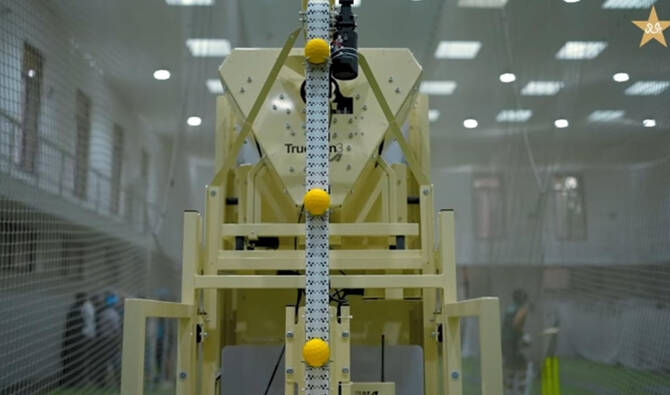

ISLAMABAD: Pakistan’s cricket authorities have introduced an artificial intelligence-powered bowling machine for the first time to train batsmen, saying the technology will help players prepare for a wider range of bowling styles and improve match readiness ahead of international competitions.
Pakistan’s batting has come under intense scrutiny following a string of disappointing performances in recent international tournaments, with repeated top-order collapses, an inability to accelerate the run rate and failures in run chases, contributing to early exits.
Former players and analysts have frequently criticized the team’s conservative approach and a lack of adaptability against high-quality bowling attacks, and called for changes in batting strategy and player development.
The new AI-powered system features a high-contrast LED animation of a bowler on the front screen, which is synchronized with the release of the ball to replicate real-time bowling action and improve batter timing and decision-making, according to the Pakistan Cricket Board (PCB).
“The Trueman 3 machine is the latest technology, and we are the first cricket board to use it. In traditional bowling machines, it is often difficult for players to adjust to the release point of the bowler, their trigger movements, and the timing of when to get ready,” the PCB quoted its High-Performance Director Aqib Javed as saying.
“The advantage of this machine is that the batter can see the bowler’s video on the screen and synchronize himself accordingly. At the same time, the machine can be programmed according to a batter’s requirement, which helps in preparing the player very close to a match situation.”
The animation is based on realistic bowling actions that will allow batters to better read triggers, adjust their footwork, and respond to match-like scenarios.
The PCB has increasingly integrated modern tools into training in recent years, including the Decision Review System (DRS) with Hawk-Eye ball tracking, Ultra Edge, and advanced replay technology to improve umpiring accuracy.
Player tracking systems, automated no-ball detection, and real-time analytics are also being used to support performance analysis and enhance the spectator experience, reflecting a broader shift toward data-driven cricket aligned with international standards.
Pakistani all-rounder Salman Ali Agha, who faced deliveries from the new machine at the academy, highlighted its value in modern batting preparation.
“As cricket is moving toward the modern day, new shots and new methods are being introduced, and this machine helps us prepare for those challenges,” he was quoted as saying.
“It feels like a bowler is running in and bowling. The ball comes with an action, so you have to match your timing like you do in a match. I think this technology will help batters improve further and we will benefit even more from it in future.”


