BEIRUT: Desperate residents trapped in Eastern Ghouta waited for their “turn to die” on Wednesday beneath one of the most intense bombardments of the Syrian war.
UN human rights chief Zeid Ra'ad Al-Hussein described the assault by Syrian regime forces as a “monstrous campaign of annihilation” against the opposition-held territory on the edge of Damascus.
At least 310 people have been killed in the district since Sunday night and more than 1,550 injured, the Syrian Observatory for Human Rights said. At least 38 people died on Wednesday.
UN Secretary-General Antonio Guterres called for an immediate halt to the fighting to allow aid to reach those in need and for the injured to be evacuated.
The bombing meant the 400,000 people trapped in the area “live in hell on Earth,” Guterres told the Security Council.
“We are waiting our turn to die. This is the only thing I can say,” said Bilal Abu Salah, 22, whose wife is five months pregnant in the biggest Eastern Ghouta town Douma.
“Nearly all people living here live in shelters now. There are five or six families in one home. There is no food, no markets,” he told Reuters.
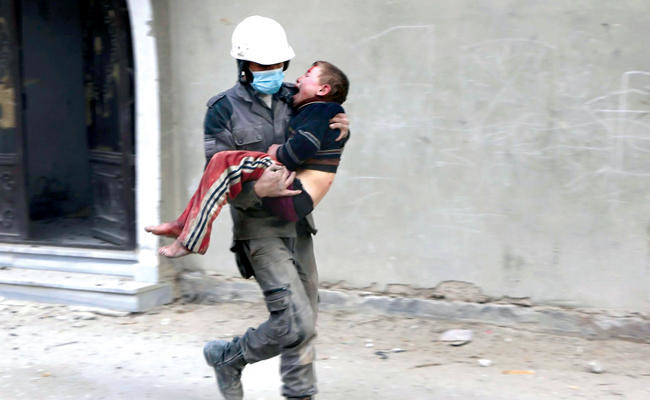
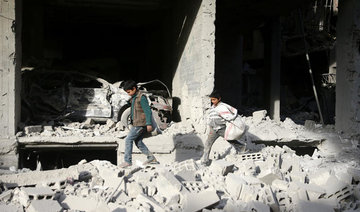
Images from inside the area showed men searching through the rubble of smashed buildings, carrying blood-smeared people to hospital and cowering in debris-strewn streets.
A doctor working in the area told the BBC that the situation is “catastrophic.” “We don't have anything — no food, no medicine, no shelter,” Dr. Bassam said.
“Maybe every minute we have 10 or 20 airstrikes ... I will treat someone — and after a day or two they come again, injured again.”
He said the international community had abandoned the people living there.
Eastern Ghouta, a densely populated agricultural district, is the last major area near the capital still under rebel control. It has been besieged by regime forces for years.
The bombardment of rocket fire, shelling, airstrikes and helicopter-dropped barrel bombs escalated rapidly on Sunday. The assault has devastated the area, indiscriminately ending lives of men, women and children and inflicting horrific injuries. After one airstrike on Wednesday, rescuers pulled four children from the building, but their father was killed, leaving them as orphans, Reuters reported.
Guterres expressed support for a Swedish and Kuwaiti push for the Security Council to demand a 30-day cease-fire in Syria.
Diplomats said the council could vote on a draft resolution in the coming days.
Russia, an ally of President Bashar Assad has called the proposal “not realistic,” but called for a meeting of the council on Thursday to discuss the situation.
A commander in the coalition fighting on behalf of Assad's government told Reuters the bombing aims to prevent the rebels from targeting the eastern neighborhoods of Damascus with mortars.
“The offensive has not started yet. This is preliminary bombing,” the commander said.
Eastern Ghouta is one of a group of “de-escalation zones” under a diplomatic cease-fire initiative agreed by Assad's allies Russia and Iran with Turkey which has backed the rebels.
Mohammad Alloush, the political chief of Jaish Al-Islam, one of the main rebel factions in Eastern Ghouta, said: “There are attempts from some international and local sides for a truce process in Eastern Ghouta and they have not succeeded so far.”


400,000 trapped in Assad’s ‘monstrous campaign of annihilation’ in Eastern Ghouta
400,000 trapped in Assad’s ‘monstrous campaign of annihilation’ in Eastern Ghouta


Iran FM tells UN all military bases of ‘hostile forces’ legitimate targets
- UN chief condemns escalation, calls for immediate return to negotiating table
- Emergency session of Security Council set to convene on Saturday in New York
NEW YORK: Iran will use “all necessary defensive capabilities and means” to confront attacks by the US and Israel, and will treat “all bases, facilities, and assets of the hostile forces in the region” as legitimate military targets under its right to self-defense, Foreign Minister Abbas Araghchi said on Saturday.
In a letter to UN Secretary-General Antonio Guterres and the president of the Security Council, Araghchi said US and Israeli airstrikes are “a clear violation” of the UN Charter and amount to “an open armed aggression” against Iran.
Tehran is exercising its “inherent and lawful right of self-defense” under the UN Charter, he added.
The letter, seen by Arab News, accused the US and Israel of launching coordinated, large-scale attacks on Iranian territory, targeting defensive facilities and civilian sites in several cities.
Araghchi said Iran will continue to act “decisively and without hesitation until the aggression ceases fully and unequivocally,” adding that the US and Israel “shall bear full and direct responsibility for all ensuing consequences, including any escalation arising from their unlawful actions.”
He called on the 15-member Security Council to convene an emergency meeting to address a “breach of peace which is a real and serious threat to international peace and security,” and urged UN member states to “unequivocally condemn this act of aggression.”
An emergency session of the council is set to convene in New York on Saturday, requested by France, Bahrain, Colombia, China and Russia.
The Russian mission at the UN said in a statement that during the meeting, Moscow will demand that the US and Israel “immediately cease their illegal and escalatory actions and embark on a path toward a political and diplomatic settlement.” It added that “Russia is willing to provide all necessary assistance in this process.”
Meanwhile, Guterres condemned the military escalation, saying “the use of force by the United States and Israel against Iran, and the subsequent retaliation by Iran across the region, undermine international peace and security.”
The UN Charter clearly prohibits “the threat of the use of force against the territorial integrity or political independence of any state, or in any other manner inconsistent with the Purposes of the United Nations,” Guterres said in a statement.
He called for an immediate cessation of hostilities and de-escalation, and an immediate return to the negotiating table, adding that “failing to do so risks a wider regional conflict with grave consequences for civilians and regional stability.”
UN human rights chief Volker Turk also deplored the escalation and warned that civilians are the ones who end up paying “the ultimate price.”
He said: “Bombs and missiles are not the way to resolve differences but only result in death, destruction and human misery.”
Turk called for restraint and implored the parties “to see reason, to de-escalate, and (return) to the ‘negotiating table’ where they had been actively seeking a solution only hours earlier.”