FRANKFURT: The increasing strength of the euro against other currencies such as the dollar does not threaten to slow mounting growth in the euro area, Germany’s central bank chief said.
“The recent appreciation in the euro seems unlikely to jeopardize the expansion,” Bundesbank head Jens Weidmann said in a speech.
“It is, at least in part, rather a reaction to the brighter growth prospects of the euro area,” he said.
Weidmann’s response to the stronger single currency is more relaxed than the common position of the European Central Bank, where he sits on the governing council.
“Downside risks” to growth in the euro zone “relate primarily to global factors, including developments in foreign exchange markets,” ECB President Mario Draghi said last month.
Since mid-December, the euro has gained around 4 percent against the dollar and 1 percent against the yen.
Looking back further over the past year, the single currency’s gains amount to 15 percent against the greenback and 10 percent against the Japanese unit.
As in the ECB’s common position, Weidmann acknowledges that policymakers must “monitor closely” developments on currency markets for their potential impact on the central bank’s efforts to push inflation toward just under 2 percent.
A stronger euro directly saps inflation by making imports cheaper.
By also making euro area products more expensive abroad it can indirectly slow price growth by limiting economic expansion.
But “recent research suggests the impact of exchange rate movements on inflation has declined,” Weidmann noted.
The Bundesbank chief also took the opportunity to burnish his credentials as a so-called “hawk” in favor of reducing ECB support to the economy — in the shape of mass bond purchases and low interest rates — as it strengthens.
Frankfurt policymakers have waved through more than €2.3 trillion ($2.8 trillion) of government and corporate bond purchases since March 2015, with the program currently slated to end in September once it hits around €2.5 trillion.
“If the expansion progresses as currently expected, substantial net purchases beyond the announced amount do not seem to be required,” Weidmann said.
In a question-and-answer session on Twitter, ECB chief economist Peter Praet downplayed differences on the governing council about the bond-buying scheme, saying members agree on their objectives and “discussions are more on tactics.”


![]()
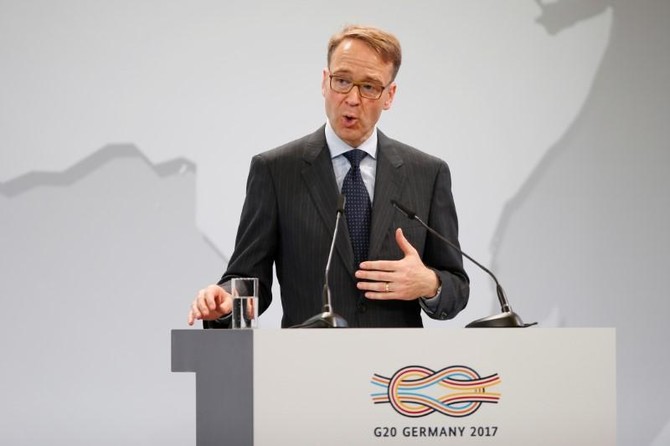
Stronger euro holds no threat to euro zone growth: Bundesbank
Stronger euro holds no threat to euro zone growth: Bundesbank


Latest updates


© 2026 SAUDI RESEARCH & PUBLISHING COMPANY, All Rights Reserved And subject to Terms of Use Agreement.