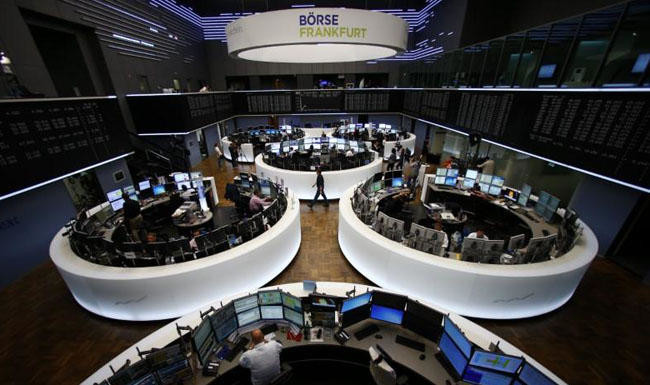
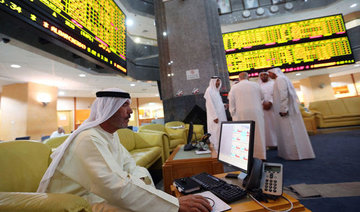
LONDON: A European recovery rally dissipated on Thursday with benchmarks across the region weighed down by commodities and technology stocks, while acquisition approaches sent Danish telecoms group TDC and Swiss insurer Swiss Re flying.
Europe’s STOXX 600 share index fell 0.2 percent by 0830 GMT, pulled lower by a 1.1 percent fall in basic resources and weaker industrials stocks. The index was still down 2.5 percent year-to-date after equities worldwide took a battering this week.
Financials limited the damage, with eurozone banks gaining 0.5 percent after strong earnings from UniCredit and Societe Generale.
Merger and acquisition activity drove the top European gainers.
Danish telecoms company TDC led the STOXX 600, shooting up 16 percent and on track for its best day since June 2007, after a takeover approach from Macquarie and three Danish pension funds, which it rejected.
Swiss Re shares jumped 6 percent after the reinsurer said it was in talks with Japan’s SoftBank to sell a minority stake.
Strong results also boosted some stocks as investors’ focus turned back to the European earnings season.
Societe Generale shares jumped 5.5 percent after the bank reported forecast-beating results despite a quarterly drop in profits.
Compass Group, the world’s biggest catering firm, jumped 6.2 percent after it raised its expectations for revenue growth.
Chipmaker AMS gained 4 percent, with traders citing an upgrade to ‘overweight’ by JP Morgan. Schibsted sank 5.6 percent after traders said its third-quarter earnings missed forecasts.

M&A activity brightens lackluster European stock markets

Lebanese social entrepreneur Omar Itani recognized by Schwab Foundation
- FabricAID co-founder among 21 global recipients recognized for social innovation
DAVOS: Lebanon’s Omar Itani is one of 21 recipients of the Social Entrepreneurs and Innovators of the Year Award by the Schwab Foundation for Social Entrepreneurship.
Itani is the co-founder of social enterprise FabricAID, which aims to “eradicate symptoms of poverty” by collecting and sanitizing secondhand clothing before placing items in stores in “extremely marginalized areas,” he told Arab News on the sidelines of the World Economic Forum in Davos, Switzerland.
With prices ranging from $0.25 to $4, the goal is for people to have a “dignified shopping experience” at affordable prices, he added.
FabricAID operates a network of clothing collection bins across key locations in Lebanon and Jordan, allowing people to donate pre-loved items. The garments are cleaned and sorted before being sold through the organization’s stores, while items that cannot be resold due to damage or heavy wear are repurposed for other uses, including corporate merchandise.
Since its launch, FabricAID has sold more than 1 million items, reached 200,000 beneficiaries and is preparing to expand into the Egyptian market.
Amid uncertainty in the Middle East, Itani advised young entrepreneurs to reframe challenges as opportunities.
“In Lebanon and the Arab world, we complain a lot,” he said. Understandably so, as “there are a lot of issues” in the region, resulting in people feeling frustrated and wanting to move away. But, he added, “a good portion of the challenges” facing the Middle East are “great economic and commercial opportunities.”
Over the past year, social innovators raised a combined $970 million in funding and secured a further $89 million in non-cash contributions, according to the Schwab Foundation’s recent report, “Built to Last: Social Innovation in Transition.”
This is particularly significant in an environment of geopolitical uncertainty and at a time when 82 percent report being affected by shrinking resources, triggering delays in program rollout (70 percent) and disruptions to scaling plans (72 percent).
Francois Bonnici, director of the Schwab Foundation for Social Entrepreneurship and a member of the World Economic Forum’s Executive Committee, said: “The next decade must move the models of social innovation decisively from the margins to the mainstream, transforming not only markets but mindsets.”
Award recipients take part in a structured three-year engagement with the Schwab Foundation, after which they join its global network as lifelong members. The program connects social entrepreneurs with international peers, collaborative initiatives, and capacity-building support aimed at strengthening and scaling their work.