Cyprus votes in close presidential run-off

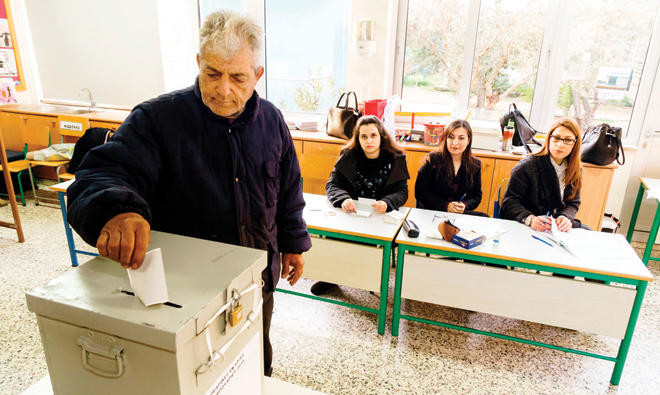
A Greek Cypriot voter casts his ballot on Sunday during the second round of the Cyprus presidential elections in Tseri, a suburb south of the capital Nicosia. (AFP)
Updated 04 February 2018
Follow

Cyprus votes in close presidential run-off

NICOSIA: Voters in Cyprus cast ballots Sunday in a presidential run-off, with incumbent Nicos Anastasiades and his leftist challenger sparring over who is best placed to reunify the island and boost a fragile economic recovery.
In a first round on Jan. 28, conservative Anastasiades garnered 35.5 percent of the ballots, while Communist-backed opponent Stavros Malas came second with 30 percent.
Sunday's head-to-head showdown is a rerun of the 2013 vote that saw Anastasiades cruise into office amid a financial meltdown in the Greek-majority European Union member.
But, with last week's losing candidates refusing to back either hopeful and apathy rising, it looks set to be closer — even though the former lawyer remains favorite to secure a second and final five-year term.
"I warmly appeal to every citizen, do not abandon the right to choose who will be the next president," Anastasiades said as he voted in his home town Limassol.
"To abstain is like letting someone else decide for you."
After making his choice on Sunday, Malas insisted "today is the day that young people decide on their future", and pledged support for those still suffering from the economic crisis.
At a polling station in Nicosia the focus was firmly on reunification efforts and the economy.
"I voted for Anastasiades as I think he is the perfect choice to run the country at this time," petrol station owner George Souglis, 73, told AFP.
"In the future he will continue to do a lot on the economy and Cyprus problem."
Not everyone appeared so convinced by the incumbent.
"We need a change," said Nikolas Petros, 67, who had to close his business due to the economic troubles.
"In politics, especially the Cyprus issue, it has just been promises, promises. On the economy we have had too many problems."
As always, the nearly 44-year division of the eastern Mediterranean island between the internationally recognized Republic of Cyprus in the south and a Turkish-backed statelet in the north looms large.
Anastasiades, 71, has pledged fresh talks with Turkish Cypriot leader Mustafa Akinci despite the acrimonious collapse last July of UN-backed negotiations that came closer than ever to sealing a deal.
Dovish former health minister Malas, 50, is one of the loudest proponents for finally reunifying the island and has slammed his opponent for not doing enough to reach an agreement.
The first-round success of the candidates seen as most keen on a deal has sparked hope that progress can be made.
But there remain major obstacles, including over the future of some 40,000 Turkish troops in the north, and deep scepticism that Nicosia or a nationalist government in Ankara are willing to compromise.
"The wider political framework in which this president comes to power is not conducive for a settlement," said University of Nicosia professor Hubert Faustmann.
This time around the economy has been a dominant issue for the roughly 550,000-strong Greek Cypriot electorate as the island recovers from a 2013 financial crisis.
Anastasiades has claimed credit for an impressive recovery since agreeing a harsh 10-billion euro (more than $12-billion) bailout just weeks after taking power.
But major challenges remain despite record numbers of tourists.
The economy is still smaller than before 2013, employment remains around 11 percent and banks are awash with bad loans.
AKEL -- the left-wing party backing Malas -- was in charge ahead of the crisis and is widely held responsible for tanking the economy.
After a lacklustre race, no candidate has captured the imagination of voters -- especially young Greek Cypriots.
There was a record low turnout of just over 71 percent in the first round.
After the first three hours of voting Sunday 10.9 percent of registered voters had cast their ballots.


Switzerland mourns Crans-Montana fire tragedy

Updated 09 January 2026
Follow

Switzerland mourns Crans-Montana fire tragedy

  • All of Switzerland will mark a national day of mourning Friday for the dozens of mostly teenagers killed when fire ravaged a ski resort bar crammed with New Year revellers

CRANS MONTANA: All of Switzerland will mark a national day of mourning Friday for the dozens of mostly teenagers killed when fire ravaged a ski resort bar crammed with New Year revellers.
Just over a week after the tragedy at the Le Constellation bar in Crans-Montana, which left 40 dead and 116 injured, the wealthy Alpine nation will come to a standstill for a minute of silence at 2:00 p.m. (1300 GMT).
A chorus of church bells will then ring throughout the country.
The moment of silence will stand as a “testament to the shared grief felt by the entire nation with all the families and friends directly affected,” the Swiss government said in a statement.
At the same time, a memorial ceremony for the victims will be held in Martigny, a town about 50 kilometers (31 miles) down the valley from Crans-Montana, which had been rendered all but inaccessible by a large snowstorm.
Inhabitants of the plush ski resort town will meanwhile be able to watch the ceremony as it is livestreamed to large screens, including at the congress center that for days after the tragedy accommodated families seeking news of missing loved ones.
Among ‘worst tragedies’ 
A memorial that has sprung up in front of the bar, loaded with flowers, candles and messages of grief and support, was covered in an igloo-like tarp Thursday to protect it from the heavy snowfall.
Swiss President Guy Parmelin, who has declared the fire “one of the worst tragedies that our country has experienced,” will be joined for the ceremony by his French and Italian counterparts, whose countries lost nine and six nationals respectively in the fire.
Top officials from Belgium, Luxembourg, Serbia and the European Union were also due to participate in the ceremony.
Most of those impacted by the inferno at Le Constellation were Swiss, but a total of 19 nationalities were among the fatalities and the wounded.
Half of those killed in the blaze were under 18, including some as young as 14.
Of those injured, 83 remain in hospital, with the most severely burned airlifted to specialist centers across Switzerland and abroad.
Prosecutors believe the blaze started when champagne bottles with sparklers attached were raised too close to sound insulation foam on the ceiling in the bar’s basement section.
Experts have suggested that what appeared to be highly flammable foam may have caused a so-called flashover — a near-simultaneous ignition of everything in an enclosed space, trapping many of the young patrons.
Video footage which has emerged from the tragedy shows young people desperately trying to flee the scene, some breaking windows to try to force their way out.
On Tuesday, municipal authorities acknowledged that no fire safety inspections had been conducted at Le Constellation since 2019, prompting outrage.
‘Staggering’ 
The investigation underway will seek to shed light on the responsibilities of the authorities, but also of bar owners Jacques and Jessica Moretti.
The French couple, facing charges of manslaughter by negligence, bodily harm by negligence and arson by negligence, have been called in for questioning on Friday, sources close to the investigation told AFP.
The pair, who have not been detained, said in a statement Tuesday that they were “devastated and overwhelmed with grief,” and pledged their “full cooperation” with investigators.
They will need to answer numerous questions about why so many minors were in the bar, and whether fire safety standards were adhered to.
There has been much focus on the soundproofing foam, which, according to photos taken by the owners, had been added during renovations in 2015.
A video filmed by a member of the public, screened Monday by Swiss broadcaster RTS, showed that the danger was known years ago.
“Watch out for the foam!,” a bar employee said during 2019 New Year’s Eve celebrations, as champagne bottles with sparklers were brought out.
“This video is staggering,” Romain Jordan, a lawyer representing several affected families, told AFP, saying it showed “there was an awareness of this risk — and that possibly this risk was accepted.”