Turkish Cypriots set for coalition after PM’s party wins polls

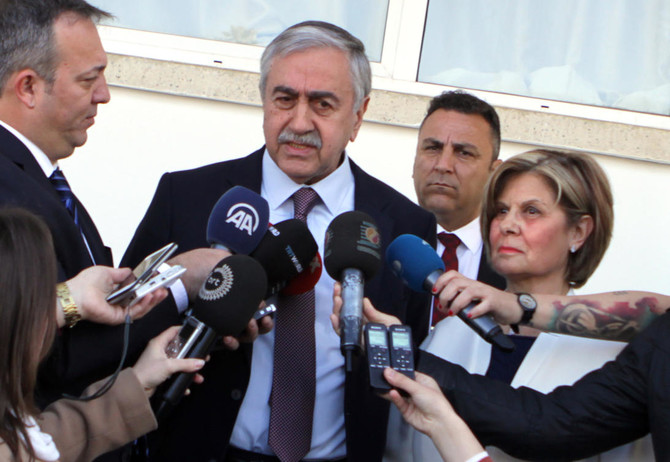
Turkish-Cypriot President Mustafa Akinci (C) speaks to the press as he arrives to cast his ballot for the parliamentary election at a polling station in the northern part of Nicosia in the self-proclaimed Turkish Republic of Northern Cyprus (TRNC), which is only recognized by Turkey, on January 7, 2018. (AFP)
Updated 08 January 2018
Follow

Turkish Cypriots set for coalition after PM’s party wins polls

NICOSIA: The party of the prime minister of northern Cyprus, a statelet recognized only by Turkey, has won parliamentary elections but will need to form a coalition after falling short of a majority, results showed Monday.
The Turkish Republic of Northern Cyprus (TRNC), established in the wake of Turkey's 1974 invasion of the island in response to an Athens-backed coup, voted Sunday in snap polls forced by tensions in the previous coalition.
The vote comes ahead of presidential polls later this month in the internationally recognized Greek-majority Republic of Cyprus, with peace efforts on hold until both sets of elections are over.
The National Unity Party (UBP) of Prime Minister Huseyin Ozgurgun came out on top with 36 percent of the vote, ahead of the socialist Republican Turkish Party (CTP) at 21 percent, Turkish Cypriot media reports said, based on an unofficial near complete count.
Projections show that this should give the UBP 21 seats, short of the 26 seats needed for a majority in the 50-member house.
Final results are due late Monday or early Tuesday. More than 190,500 people were registered to vote.
“The UBP has emerged has the biggest party by a wide margin,” said Ozgurgun in a victory speech early Monday. “We are preparing for new days with the power the people have given to the UBP.”
A coalition with the CTP — whose vote plunged in these polls — is unlikely and the UBP may team up with smaller parties like the Democrat Party (DP) and the Rebirth Party (YDP) to muster the seats.
Unlike the socialist CTP, these parties including the UBP are not fans of negotiations with the Greek Cypriots to unify the island, preferring a two state solution.
The People's Party (HP) — a new party that has expressed scepticism over negotiations to reunify the island — polled well on 17 percent and was on course to win nine seats.
President Mustafa Akinci, whose doveish Communal Democracy Party (TDP) was set to win only three seats, will want broad backing at home as he seeks to push once more for a federal solution to the Cyprus problem and convince his Greek Cypriot counterparts he means business.
The election in the northern third of Cyprus comes six months after efforts to reunify the island collapsed at a United Nations-hosted peace summit in Switzerland over several sticking points including the withdrawal of Turkey's 45,000 troops.
On Jan. 28, the Republic of Cyprus is set to hold a presidential election in which conservative incumbent Nicos Anastasiades is the frontrunner.
Anastasiades has campaigned on a pro-peace ticket, vowing to attempt to revive talks with Akinci, despite the souring of their relationship after two years of tough and ultimately fruitless negotiations.


EU leaders begin India visit ahead of ‘mother of all deals’ trade pact

Updated 3 sec ago
Follow

EU leaders begin India visit ahead of ‘mother of all deals’ trade pact

  • Antonio Luis Santos da Costa, Ursula von der Leyen are chief guests at Republic Day function
  • Access to EU market will help mitigate India’s loss of access to US following Trump’s tariffs

New Delhi: Europe’s top leaders have arrived in New Delhi to participate in Republic Day celebrations on Monday, ahead of a key EU-India Summit and the conclusion of a long-sought free trade agreement.

European Council President Antonio Luis Santos da Costa and European Commission President Ursula von der Leyen arrived in India over the weekend, invited as chief guests of the 77th Republic Day parade.

They will hold talks on Tuesday with Prime Minister Narendra Modi at the EU-India Summit, where they are expected to announce a comprehensive trade agreement after years of stalled negotiations.

Von der Leyen called it the “mother of all deals” at the World Economic Forum in Davos last week — a reference made earlier by India’s Commerce Minister Piyush Goyal — as it will create a market of 2 billion people.

“The India-EU FTA has been a long time coming as negotiations have been going on between the two for more than a decade. Some of the red lines that prevented the signing of the FTA continue to this date, but it seems that the trade negotiations have found a way around it,” said Anupam Manur, professor of economics at the Takshashila Institution.

“The main contentious issue remains the Indian government’s desire to protect the farmers and dairy producers from competition and the European Union’s strict climate-based rules and taxation. Despite this, both see enormous value in the trade deal.”

India already has free trade agreements with more than a dozen countries, including Australia, the UAE, and Japan.

The pact with the EU would be its third in less than a year, after it signed a multibillion CEPA (comprehensive economic partnership agreement) with the UK in July and another with Oman in December. A week after the Oman deal, New Delhi also concluded negotiations on a free trade agreement with New Zealand, as it races to secure strategic and trade ties with the rest of the world, after US President Donald Trump slapped it with 50 percent tariffs.

The EU is also facing tariff uncertainty. Earlier this month Trump threatened to impose new tariffs on several EU countries unless they supported his efforts to take over Greenland, which is an autonomous region of Denmark.

“The expediting factor in the trade deal is the unilateral and economically irrational trade decisions taken by their biggest trading partner, the United States,” Manur told Arab News.

Being subject to the highest tariff rates, India has been required to sign FTAs with other major economies. Access to the EU market would help mitigate the loss of access to the US.

The EU is India’s largest trading partner in goods, accounting for about $136 billion in the financial year 2024-25.

Before the tariffs, India enjoyed a $45 billion trade surplus with the US, exporting nearly $80 billion. To the EU’s 27 member states, it exports about $75 billion.

“This can be sizably increased after the FTA,” Manur said. “Purely in value terms, this would be the biggest FTA for India, surpassing the successful FTAs with the UK, Australia, Oman and the UAE.”