

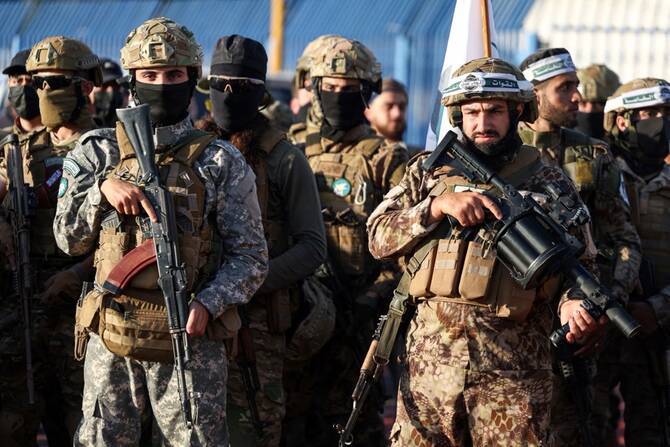
In major policy shift on Syria, UN Security Council lifts sanctions on Hayat Tahrir Al-Sham

Short Url
Updated 28 February 2026
Follow

In major policy shift on Syria, UN Security Council lifts sanctions on Hayat Tahrir Al-Sham

  • Move reflects evolving Syrian political landscape in the post-Assad era, ending a global freeze on assets, travel ban and arms embargo

NEW YORK CITY: The UN Security Council on Friday removed Al-Nusra Front, the militant group that evolved into Hayat Tahrir Al-Sham, from its so-called Daesh and Al-Qaeda Sanctions List.

The move signals a major shift in international policy toward Syria’s evolving political landscape in the post-Assad era, and ends a global freeze on assets, travel ban and arms embargo that have been imposed on the group since 2014.

Al-Nusra Front and Hayat Tahrir Al-Sham were led by Ahmad Al-Sharaa, formerly Abu Mohammed Al-Julani, who is now Syria’s president and was a leading figure in the offensive that toppled the Assad regime.

The consensus decision by the Security Council’s sanctions committee was announced by the UK, which holds the presidency of the Security Council this month and was acting in the absence of the chair of the committee. It followed a request by the new Syrian authorities to delist “Al-Nusrah Front for the People of the Levant.”

The decision means measures that were applied to Hayat Tahrir Al-Sham under Security Council Resolution 2734, adopted in 2024, no longer apply. As a result, UN member states are notrequired to freeze the group’s funds, restrict the movement of its representatives, or block the supply or transfer of arms and related materiel.

Al-Nusra Front was added to the sanctions list for its ties to Al-Qaeda and involvement in the financing and execution of militant activities during the war in Syria. The UN initially continued to treat the group’s successor organization, Hayat Tahrir Al-Sham, as a listed alias.

Al-Sharaa has said the group severed all prior transnational jihadist links and is now solely focused on local Syrian matters.

Airspace closed, flights canceled as US-Iran conflict flares

Updated 3 sec ago
Follow

Airspace closed, flights canceled as US-Iran conflict flares

  • Major carriers from the Middle East, Europe, Asia-Pacific and the US announced widespread cancelations
  • FlightAware said more than 19,000 flights had been delayed globally and more than 2,600 were canceled as of Sunday
PARIS: Thousands of flights have been delayed or canceled in the biggest disruption to global air transport since the Covid pandemic as airlines suspend services to the Middle East following the US and Israeli attacks on Iran.
Iran, Iraq, Israel, Syria, Kuwait and the United Arab Emirates all announced at least partial closures of their skies after Saturday’s strikes and Iran launching missiles at capital cities around the wealthy Gulf region.
Major carriers from the Middle East, Europe, Asia-Pacific and the United States announced widespread cancelations, leaving thousands of passengers stranded.
Notable airlines that canceled services included Emirates, Etihad, Air France, British Airways, Air India, Turkish Airlines, and Lufthansa.
According to aviation analytics company Cirium, of around 4,218 flights scheduled to land in Middle Eastern countries on Saturday, 966 (22.9 percent) were canceled, with the figure rising above 1,800 if also including outbound flights.
For Sunday, 716 flights out of 4,329 scheduled to the Middle East have been canceled, Cirium said.
Flight tracking website FlightAware meanwhile said more than 19,000 flights had been delayed globally and more than 2,600 were canceled as of 0230 GMT Sunday.
Airspace closures
Iran swiftly closed its airspace as the strikes began “until further notice,” said the spokesman of Iran’s Civil Aviation Organization, quoted by the Tasnim news agency.
Israel also closed its airspace to civilian flights, Transport Minister Miri Regev announced.
Qatar’s civil aviation authority said it had temporarily closed the Gulf state’s airspace.
Iraq shut down airspace, state media said.
The United Arab Emirates said it was closing its skies “partially and temporarily.”
Syria closed part of its airspace in the south along the border with Israel for 12 hours, the Civil Aviation Authority said.
Jordan’s air force was conducting drills to “defend the kingdom’s skies,” its military said.
Kuwait closed its airspace.
Middle East and North Africa airlines
Gulf carriers Emirates and Etihad canceled 38 percent and 30 percent of their flights respectively, Cirium said.
Qatar Airways suspended all flights from Doha. It canceled 41 percent of total flights, according to Cirium.
Syria Air, the country’s national carrier, canceled all flights until further notice.
Egypt’s national airline, EgyptAir, announced the suspension of its flights to cities across the Middle East, including Dubai, Doha, Manama, Abu Dhabi, Beirut and Baghdad among others.
European airlines
Russia’s air transport authority Rosaviatsia said all commercial flights to Israel and Iran were canceled “until further notice.”
Turkish Airlines canceled flights to Lebanon, Syria, Iraq, Iran, and Jordan until March 2.
Air France canceled its Dubai, Riyadh and Beirut flights for Saturday, and flights to Tel Aviv until Sunday.
British Airways said it was not flying to Tel Aviv and Bahrain until March 4, and canceled flights to the Jordanian capital Amman on Saturday.
Swiss International Air Lines suspended flights to and from Tel Aviv until March 7, and canceled flights from Zurich to Dubai scheduled for Saturday and Sunday.
Germany’s Lufthansa, which comprises Swiss and ITA Airways, canceled its flights to and from Tel Aviv, Beirut, Amman, Irbil and Tehran until March 7.
The airline group and its subsidiaries suspended flights to and from Dubai and Abu Dhabi until Sunday.
North America airlines
Delta Air Lines suspended New York-Tel Aviv flights until Sunday.
American Airlines “temporarily suspended” Doha-Philadelphia flights.
United flights to Tel Aviv are canceled until Monday, and flights to Dubai until Sunday.
Air Canada said it canceled flights from Canada to Israel until March 8 and to Dubai until March 3.
Asia-Pacific airlines
India’s two largest private carriers IndiGo and Air India suspended flights to all destinations in the Middle East.
Pakistan International Airlines, the flag carrier of the country that borders Iran, said it had suspended flights to the UAE, Bahrain, Doha and Kuwait.
Hong Kong’s Cathay Pacific suspended flights to Dubai and Riyadh.
Garuda Indonesia, Indonesia’s flag carrier, temporarily suspended flights to and from Doha “until further notice,” the company said in a statement Sunday.
Singapore Airlines and Singapore’s Scoot canceled six flight routes in the region until the end of Sunday, local media reported.
Philippine Airlines flights from Manila to Doha, Riyadh to Manila, and Dubai to Manila were canceled on Saturday, as well as one Doha-Manila flight on Sunday.
Other major airlines including Australia’s Qantas and Japan’s All Nippon Airways did not announce any flight cancelations.
Africa airlines
Ethiopian Airlines canceled its flights to Amman, Tel Aviv, Dammam, and Beirut.
Kenya Airways has suspended its flights to Dubai and Sharjah until further notice.