Cyprus votes for president with eyes on new peace push

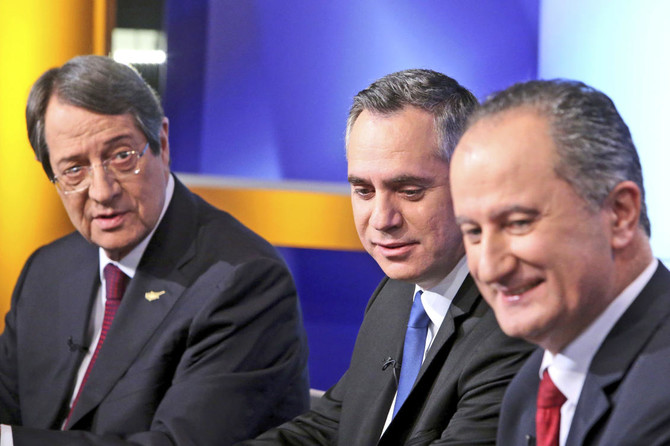
In this file photo dated Monday, Jan. 22, 2018, with the three front running presidential candidates, from left, Cyprus’ President Nicos Anastasiades, Nicolas Papadopoulos, and Stavros Malas, prior to their live televised debate in capital Nicosia, Cyprus. Cypriots will vote upcoming Sunday in presidential elections with critical topics including the reunification of the divided island and economic recovery, likely to be decisive in the vote. (AP/Petros Karadjias, FILE)
Updated 28 January 2018
Follow

Cyprus votes for president with eyes on new peace push

NICOSIA: Voters in Cyprus headed to the polls Sunday for a presidential election that could determine if the divided island makes another push to reunite after the collapse of talks last year.
After a lacklustre campaign, opinion polls put conservative incumbent Nicos Anastasiades, 71, ahead as he pledges to restart negotiations with the Turkish-backed north quickly after the vote.
The former lawyer — under the slogan “Steady Steps Forward” — has taken credit for an impressive recovery by the European Union’s most easterly member since a debilitating financial crisis in 2013.
But apathy appears to be growing and Anastasiades seems unlikely to win outright in the first round.
He is expected to face a February 4 run-off against either dovish communist-backed Stavros Malas or Nikolas Papadopoulos, a former president’s son who takes a tougher line on peace efforts.
“The economy is doing reasonably well — but for me the main criterion is still the Cyprus problem,” said university lecturer Andres Karageorghis after casting his ballot at a school in Nicosia.
“To carry on and hopefully find a solution.”
If the first round is not decisive there is set to be intense horse-trading, and analysts say a backroom deal between the opponents of Anastasiades could still deny him a second and final five-year term.

As always, the nearly 44-year division of the island between the internationally recognized Greek-majority Republic of Cyprus and a Turkish Cypriot statelet in the north looms large.
In July, two years of UN-backed talks between Anastasiades and Turkish Cypriot leader Mustafa Akinci came closer than ever to reunifying the island but collapsed in acrimony before a deal.
Despite the failure to bridge key issues, including the future of tens of thousands of Turkish troops in the north, Anastasiades insists he wants talks with Akinci to restart soon.
But there is deep skepticism among the international community over whether there is the political will to make a breakthrough.
During the campaign Anastasiades was attacked for being either too pliant or not keen enough to seal a deal.
Retired treasury worker George Georgallides said he voted for more hard-line Papadopoulos because he felt “Anastasiades gave up everything” at the negotiations.
“If we do restart talks then it needs to be from the very beginning again,” he said.
Signs are that the road to reunification will only get tougher as fatigue mounts after decades of failure.
For the first time ultra-nationalist party ELAM — fiercely opposed to the proposed reunification — is fielding a candidate.

While the “national problem” is ever present, this time around the economy has been a dominant issue.
When Anastasiades took over, the banking sector was in meltdown and he took a 10-billion-euro (more than $12-billion) bailout that entailed biting austerity measures.
That included a drastic haircut on accounts of over 100,000 euros held in the country’s biggest lender, Bank of Cyprus.
Since then the economy has rebounded faster than many expected and growth has been steady since 2015.
Tourism reached a record high last year and explorations are going on for oil and gas offshore.
But analysts warn there are major challenges left.
The economy is still smaller than it was before the crisis, unemployment is around 11 percent and banks are awash with bad loans.
“The recovery is relative,” said Fiona Mullen, director of Cyprus-based Sapienta Economics.
Polls close at 1600 GMT with final results expected late Sunday.


Bangladesh halts controversial relocation of Rohingya refugees to remote island

Updated 29 December 2025
Follow

Bangladesh halts controversial relocation of Rohingya refugees to remote island

  • Administration of ousted PM Sheikh Hasina spent about $350m on the project
  • Rohingya refuse to move to island and 10,000 have fled, top refugee official says

DHAKA: When Bangladesh launched a multi-million-dollar project to relocate Rohingya refugees to a remote island, it promised a better life. Five years on, the controversial plan has stalled, as authorities find it is unsustainable and refugees flee back to overcrowded mainland camps.

The Bhasan Char island emerged naturally from river sediments some 20 years ago. It lies in the Bay of Bengal, over 60 km from Bangladesh’s mainland.

Never inhabited, the 40 sq. km area was developed to accommodate 100,000 Rohingya refugees from the cramped camps of the coastal Cox’s Bazar district.

Relocation to the island started in early December 2020, despite protests from the UN and humanitarian organizations, which warned that it was vulnerable to cyclones and flooding, and that its isolation restricted access to emergency services.

Over 1,600 people were then moved to Bhasan Char by the Bangladesh Navy, followed by another 1,800 the same month. During 25 such transfers, more than 38,000 refugees were resettled on the island by October 2024.

The relocation project was spearheaded by the government of former Prime Minister Sheikh Hasina, who was ousted last year. The new administration has since suspended it indefinitely.

“The Bangladesh government will not conduct any further relocation of the Rohingya to Bhasan Char island. The main reason is that the country’s present government considers the project not viable,” Mizanur Rahman, refugee relief and repatriation commissioner in Cox’s Bazar, told Arab News on Sunday.

The government’s decision was prompted by data from UN agencies, which showed that operations on Bhasan Char involved 30 percent higher costs compared with the mainland camps in Cox’s Bazar, Rahman said.

“On the other hand, the Rohingya are not voluntarily coming forward for relocation to the island. Many of those previously relocated have fled ... Around 29,000 are currently living on the island, while about 10,000 have returned to Cox’s Bazar on their own.”

A mostly Muslim ethnic minority, the Rohingya have lived for centuries in Myanmar’s western Rakhine state but were stripped of their citizenship in the 1980s and have faced systemic persecution ever since.

In 2017 alone, some 750,000 of them crossed to neighboring Bangladesh, fleeing a deadly crackdown by Myanmar’s military. Today, about 1.3 million of them shelter in 33 camps in the coastal Cox’s Bazar district, making it the world’s largest refugee settlement.

Bhasan Char, where the Bangladeshi government spent an estimated $350 million to construct concrete residential buildings, cyclone shelters, roads, freshwater systems, and other infrastructure, offered better living conditions than the squalid camps.

But there was no regular transport service to the island, its inhabitants were not allowed to travel freely, and livelihood opportunities were few and dependent on aid coming from the mainland.

Rahman said: “Considering all aspects, we can say that Rohingya relocation to Bhasan Char is currently halted. Following the fall of Sheikh Hasina’s regime, only one batch of Rohingya was relocated to the island.

“The relocation was conducted with government funding, but the government is no longer allowing any funds for this purpose.”

“The Bangladeshi government has spent around $350 million on it from its own funds ... It seems the project has not turned out to be successful.”