
ALEPPO: Ramadan is a time of fasting and prayer, but it brings another beloved tradition: the much-anticipated TV drama series shot each year to be aired post-iftar during the holy month.
Syrian productions have, for decades, been seen as the gold standard in the region. And as the country emerges from 14 years of civil war, more than a year after insurgents brought the authoritarian Assad dynasty to an end, Syria’s TV industry is seeking its footing in the new order.
In the Assad years, when political expression was strictly curtailed, “television became the main sort of platform for freedom of expression and also for employment for artists and intellectuals,” said Christa Salamandra, a professor of anthropology at Lehman College and the City University of New York who has researched Syrian drama.

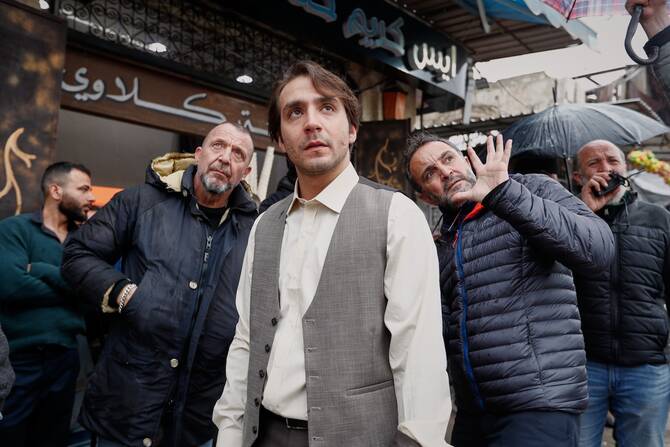
The crew filming 'Al-Souriyoun al-Aada' in Aleppo. (AP Photo)
In 2011, mass anti-government protests were met by a brutal crackdown and spiraled into civil war. After that, “the industry fractured,” Salamandra said. “Creatives went into exile — or they stayed, but it split.”
Since the fall of former president Bashar Assad, actors and directors once divided along political lines are working together again. Series about once-taboo topics, like torture in Assad’s notorious prisons, are being shot. But, like everything in the new Syria, the postwar trajectory of TV drama has been complicated.
On a chilly day in February, a week before Ramadan, a TV crew had transformed a street in central Aleppo into something magical. In the background, collapsed buildings were a reminder that the city had been a central battleground in Syria’s civil war, but the cameras had transported the street back to a more innocent age. Classic 1970s cars and a horse-drawn cart passed in front of a vendor wearing a tarboush hat and selling sahlep, a sweet drink of hot thickened milk and spices.
The series being shot — titled “Al-Souriyoun Al-Aada” (The Syrian Enemies) — is based on a novel of the same name that was banned during Assad’s reign because of its focus on dark moments in Syria’s history, including the Hama massacre of 1982.

Rita Nasra, an extra in the series, poses for a photograph during the filming of an episode of the TV series 'Al-Souriyoun Al-Aada.' (AP Photo)
At that time, the then-president, Hafez Assad — Bashar’s father, ordered an attack on the city of Hama to quell a rebellion. Between 10,000 and 40,000 people were killed or disappeared in the month-long assault and siege that left the city in ruins.
In the small-screen version, Yara Sabri, a prominent actor who left the country for years due to her opposition to the government, appears as the mother of a troubled young man from a rural village who will become a major player in the country’s oppressive security apparatus.
Wissam Rida, who plays her son, said that as a young actor starting out in Damascus, performing alongside exiled stars like Sabri once seemed an impossible dream.
“I used to watch them when I was younger and wish that I could work with them,” he said. After Assad’s fall, Rida said, “They came back with such beautiful energy you can’t imagine, and you can’t imagine how much we were in need of them.”
Still, production has not been without difficulties. The director, Allaith Hajjo, is known for shows including “Dayaa Dayaa” (A Lost Village), a comedy about life in a small mountain community, and “Intizar” (Waiting), a social drama about an impoverished Damascus suburb. He never left Syria.
“In the days of the (Assad) regime, we were always trying to put forward material that would go over the heads of the censors,” he said. Back then, “I dealt with actors who were a red line in the eyes of the regime,” he continued. “Now I am dealing with people who may be rejected (by the current authorities).”
The production has been attacked on social media because of the presence of some actors seen as close to Assad. Hajjo said politics should have no role in casting. The series, originally intended to air during Ramadan, has been delayed in production and will now likely air after the holy month finishes. Hajjo explained that the new authorities have little experience in dealing with artistic productions and that the work had run into “some problems” with censors.
“It’s their right to need some time to gain experience, but I hope this time won’t affect the quality and the level” of the output, he said.
The National Drama Committee, the government body responsible for reviewing scripts, did not respond to questions, but director Rasha Sharbatji, who shot the Ramadan series “Matbatkh Al-Medina” (The City’s Kitchen), said she had found the new authorities accommodating.
She added that she had met interim President Ahmad Al-Sharaa “and he is personally interested in drama and appreciates how important it is.”
But it remains to be seen if his government will permit TV dramas to talk openly about problems that have occurred post-Assad, including outbreaks of sectarian violence in which government forces were implicated.
Salamandra said creators likely will “make serials about the old atrocities with subtle references to the recent ones. Because that’s what they’ve always done.”
Jihad Abdo — a top actor in the 1990s and early 2000s who fled Syria in 2011 after voicing criticism of Assad but has now returned to Damascus — is currently appearing in the web series “Al-Meqaad Al-Akheer” (The Last Seat), a social drama airing during Ramadan, as a man struggling with Alzheimer’s. He also now leads Syria’s General Organization for Cinema, where he faces the daunting prospect of rebuilding the Syrian film industry with no budget.
Abdo said that “the margin of freedom is bigger” than in Assad’s time and the government has not told him that any subject is off limits.
“We’re not sure yet about how this margin of freedom will be shaped,” he said. “We are trying to make it as big as possible, because we need to address the problems in order to solve them.”
Abdo believes the TV industry has a role to play in Syria’s postwar reconciliation by telling human stories and by showing that those with different political views can work together.
“The wound is big. It’s bleeding. It is still open,” he said. “But it’s our responsibility — the people in entertainment, the intellectuals, prominent names — to bring everybody together again and to keep talking, no matter how different we are.”