

Turkish Cypriots vote in snap legislative polls

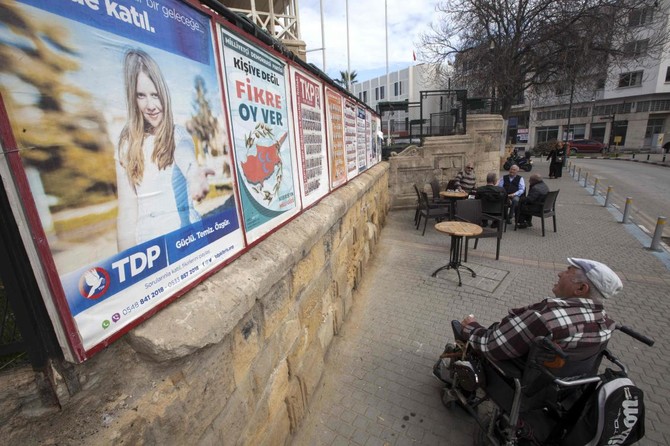
People sit next to campaign posters for parliamentary elections at a cafe in the northern part of Nicosia in the self-proclaimed Turkish Republic of Northern Cyprus (TRNC) which is only recognized by Turkey, on Jan. 3, 2018. (AFP/Birol Bebek)
Updated 07 January 2018
Follow

Turkish Cypriots vote in snap legislative polls

NICOSIA: Turkish Cypriots on Sunday voted in a snap parliamentary election overshadowed by last year’s failure to reach a peace deal for the divided island in UN-backed talks.
More than 190,500 people are registered to vote in the Turkish Republic of Northern Cyprus (TRNC), established in the wake of Turkey’s 1974 invasion of the island in response to an Athens-backed coup.
The vote comes ahead of presidential polls later this month in the internationally recognized Greek-majority Republic of Cyprus with peace efforts on hold until both sets of elections are over.
Polling stations opened at 0600 GMT and are to close at 1600 GMT.
The election in northern third of Cyprus comes six months after efforts to reunify the island collapsed at a UN-hosted peace summit in Switzerland over a number of disputes, including the withdrawal of Turkey’s 45,000 troops.
The TRNC, whose statehood is only recognized by Turkey, is currently governed by a coalition of the right-wing National Unity Party (UBP) and its junior partner the Democratic Party (DP).
Analysts say the DP of Serdar Denktas — son of late TRNC founder and hard-line leader Rauf Denktas — could fall under the five percent threshold due to intra-party disputes.
The UBP and the pro-solution Republican Turkish Party (CTP) are the other major parties in the election, followed by the Peoples’ Party (HP) of Kudret Ozersay — a former negotiator in peace talks with the Greek Cypriots.
The election, originally planned for July, were brought forward after tensions in the ruling coalition and the opposition pressed for snap polls.

Analysts say a coalition government is the most likely outcome because no one party is likely to win an absolute majority in the 50-seat parliament.
The Social Democracy Party (TDP) of Turkish Cypriot president Mustafa Akinci — regarded as strongly pro-solution — and the newly established far-right Rebirth Party (YDP) founded by settlers of Turkish origin are also running in the election.
Observers say, however, that the Cyprus problem has not played a central role in the campaign, which focused on bread-and-butter issues like the economy, with Turkish Cypriots still hugely dependent on Turkish assistance.
But a pro-solution government could give Akinci a better hand to play in any future talks with the Greek Cypriots while a harder line administration would deal a blow to his authority.
The personal life of UBP leader and prime minister Huseyin Ozgurgun came under the spotlight during the campaign, after he announced in December that he was getting divorced following reports he had an affair with a well-known Turkish Cypriot actress.
On January 28, the Republic of Cyprus is set to hold a presidential election in which conservative incumbent Nicos Anastasiades is the frontrunner.
Anastasiades has campaigned on a pro-peace ticket, vowing to try to revive talks with Akinci, despite the souring of their relationship after two years of tough and ultimately fruitless negotiations.


Cash-strapped Lebanon finds itself sitting on a gold mine, as precious metal prices surge

Updated 7 sec ago
Follow

Cash-strapped Lebanon finds itself sitting on a gold mine, as precious metal prices surge

  • Meanwhile, many Lebanese are crowding marketplaces to buy gold and silver in hopes of recovering some of their losses

BOURJ HAMMOUD: Tiny Lebanon sits on one of the largest gold reserves in the Middle East and its government is weighing whether it can use that stockpile to restore a crippled economy while its citizens are looking at gold as a way to protect their battered assets.
Lebanon’s economy hobbled into 2026 with ongoing inflation and state decay and no reforms to combat corruption in sight. Its banks collapsed in late 2019 in a crippling fiscal crisis that evaporated depositors’ savings and plunged about half its population of 6.5 million into poverty, after decades of rampant corruption, waste, and mismanagement. The country suffered some $70 billion in losses in its financial sector, further compounded by about $11 billion in the 2024 war between Israel and the Hezbollah militant group.
The price of gold recently soared to an all-time high of $5,354, before dropping back below $5,000, sparked by geopolitical instability and questions surrounding US President Donald Trump’s desire to lower interest rates that would ultimately devalue the dollar. Global central banks have been among the most avid buyers. Silver prices meanwhile have also surged due to industrial demand and the attractiveness of a much cheaper price than gold.
The central bank in Beirut has maintained a reserve of 286 tons of gold — some nine million ounces — since the 1960s. Only Saudi Arabia’s central bank holds more in the region.
The government is considering using some of its gold reserves to bail out the banks and pay back depositors who got wiped out. But doing so would not only go against historical precedent, but also violate a 1980s-era law. Meanwhile, those depositors would like to make up some of their losses by buying gold and silver, hoping that prices will bounce back from the downturn of recent days and hit new highs.
Lebanon’s untouchable asset
At one point the value of Lebanon’s gold reserves reached $50 billion — over double Lebanon’s own GDP. After years of economic crisis, and pushback against meaningful reforms to make the country viable again, some are again raising a sensitive question: Is it finally time to dig into this goldmine?
A senior banking official told The Associated Press that some banks are proposing to dig into the gold reserves to help pay back depositors whose money was lost during the country’s currency crisis, essentially partially bailing out the banks with the country’s only viable public asset. The officials spoke on condition of anonymity in line with regulations.
Lebanon banned the sale of its gold in 1986 in the middle of the country’s civil war to protect state assets during a time of extreme instability. The gold reserves have never been touched — not after 15-year civil war in 1990, and not after multiple wars with Israel.
Some economists have proposed using a small percentage of the gold, in tandem with wholesale reforms, to fix Lebanon’s ailing electricity sector or to breathe life back into the country’s devastated education and health care system for the public good.
Parliament would have to vote to allow the use of the gold reserves in any capacity. It’s a largely unpopular move that is not expected to be made anytime soon, especially months before general elections. When gold was brought up in a session last week, Speaker Nabih Berri quickly interjected to shut down the conversation. “Not feasible,” he said sternly.
A draft fiscal gap law that offers a framework of returning some depositors’ losses is languishing in parliament amid a debate over who would absorb the losses: Lebanon’s battered banks, largely reluctant to hold themselves accountable, or an indebted and wasteful state.
Most Lebanese distrust the authorities, who for years have dodged implementing meaningful reforms to fight corruption, reduce waste, and improve public services. Given that track record, many say the gold should remain untouched for future generations.
Softening the financial blow
While authorities debate the future of the country’s gold, many Lebanese depositors who lost most of their savings in the banks are now turning to gold and silver to own something more tangible while hoping it might even make up for some of their losses.
Crowds of people were lined up outside of Lebanon’s key metals trader on the northern outskirts of Beirut on a recent day, desperate to get inside and buy gold and silver coins, medallions, and bars.
They no longer trust the banks and are trying to get by in the middle of a messy cash economy beset with uncontrollable inflation and no meaningful reforms on the horizon.
“For those making up for losses, gold is not a safe haven — it’s the only haven,” said Chris Boghos, the managing director of Boghos SAL Precious Metals. Business is booming, as customers are now paying in advance to get their metal months later due to high demand.
Lebanon has had a troubled history in a volatile region, with numerous conflicts and economic shocks, and little trust that the structural issues will change.
“There has always been this propensity for the Lebanese people to go buy up gold in order to hedge against possible inflation, because this is a country that has seen multiple episodes of hyperinflation during its history,” said Sami Zoughaib, an economist at Beirut-based think tank The Policy Initiative.
Zoughaib says it’s an easy shift as well, given the long-tradition in the region of a groom or his family giving gold jewelry to the bride ahead of marriage as her own wealth, even among lower-income families. That tradition still largely continues even as many women have entered the workforce.
Outside one of Beirut’s gold markets Alia Shehade strolls along some of the storefronts. She says as a woman, her gold jewelry collection has made her feel safe in the middle of the financial crisis, referring to an Arabic saying that translates to “an adornment and treasure.”
“If a woman is in a tough situation ... she can sell her gold. And when gold prices go up, then she’s the winner,” she said. But she refuses to sell any of hers.
When looking at the reluctancy to sell gold among both the citizens and the authorities, Zoughaib said, “I think this just tells us just how important that gold is in the psychology of people.”
“They are not even able to imagine a use case for it beyond being a hedge,” he said.