UN calls on Myanmar for unhindered access to Rohingya camps

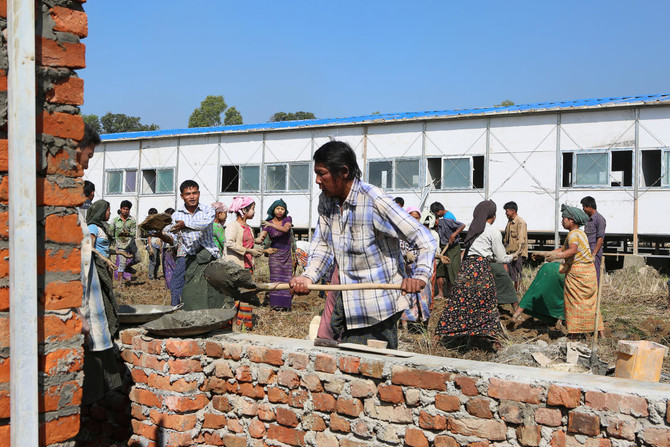
People work inside a camp, outside Maungdaw in the state of Rakhine, which was set up by Myanmar's Social Welfare, Relief and Resettlement Minister to prepare for the repatriation of displaced Rohingyas. (Reuters)
Updated 24 January 2018
Follow

UN calls on Myanmar for unhindered access to Rohingya camps

MAUNGDAW, Myanmar: The UN on Wednesday called on Myanmar to give aid agencies unhindered access to camps it has built for tens of thousands of Muslim Rohingya refugees before they can return after fleeing Myanmar military operations last year.
An international delegation advising Myanmar toured the Taung Pyo Letwe refugee camp outside the town of Maungdaw near the Bangladesh border. Video of the camp shows long, plywood houses set on a rocky field and surrounded by a wire mesh fence topped with barbed wire.
Bangladesh on Tuesday delayed the repatriation of the largely stateless Rohingya to Myanmar as the process of compiling and verifying the list of people to be sent back was incomplete.
But the UN said necessary safeguards for the refugees were still missing.
“Until the safety and wellbeing of any child returning to Myanmar can be guaranteed, talk of repatriation is premature,” UNICEF Deputy Executive Director Justin Forsyth said in a statement.
The UN Refugee Agency UNHCR said earlier “there are continued restrictions on access for aid agencies, the media and other independent observers” in Myanmar.
The UNHCR called on Myanmar “to allow the necessary unhindered humanitarian access in Rakhine State and create conditions for a genuine and lasting solution.”
More than 688,000 Muslim Rohingya and a few hundred Hindu Rohingya have fled to Bangladesh since Aug. 25 last year after the Myanmar military cracked down in the northern part of Rakhine state, amid witness reports of killings, looting and rape, in response to militant attacks on security forces.
Many in Buddhist-majority Myanmar regard the Rohingya community as illegal immigrants from Bangladesh. The UN described Myanmar’s crackdown as ethnic cleansing, which Myanmar denies.
Myanmar officials told a news conference on Tuesday that Bangladesh was not ready to send back the refugees as scheduled because the potential returnees had not completed the forms Myanmar provided attesting to their former residency in Myanmar.
“They also have to check with the UNHCR about whether it’s voluntary,” Minister of International Cooperation Kyaw Tin told the news conference.
“They need a lot of time to fill out the forms and to determine if they really want to come back.”
But a UNHCR spokesperson in Bangladesh said the agency had not been involved “in the bilateral discussions on repatriations or signed any agreements.”
“We would like to be part of the process and discussions to ensure the reparations are voluntary, safe and sustainable and that any returns are in line with international standards,” said Caroline Gluck, UNHCR’s senior public information officer, in Cox’s Bazar.
Myanmar and Bangladesh agreed earlier this month to complete a voluntary repatriation of the refugees in two years. Myanmar says it has set up two reception centers and the temporary Taung Pyo Letwe camp to receive the first arrivals.
The plan has sparked fears in refugee camps in Bangladesh that people may be forced to return despite a lack of guarantees around their security.
Late on Tuesday, US State Department spokeswoman Heather Nauert said the delay in the repatriations was a good idea and Washington was concerned about a lack of access for UN organizations.


China’s top diplomat to visit Somalia on Africa tour

Updated 6 sec ago
Follow

China’s top diplomat to visit Somalia on Africa tour

  • Stop in Mogadishu provides diplomatic boost after Israel became the first country to formally recognize breakaway Somaliland
  • Tour focusses on Beijing's strategic trade ​access across eastern and southern Africa
BEIJING: China’s top diplomat began his annual New Year tour of Africa on Wednesday, focusing on strategic trade ​access across eastern and southern Africa as Beijing seeks to secure key shipping routes and resource supply lines.
Foreign Minister Wang Yi will travel to Ethiopia, Africa’s fastest-growing large economy; Somalia, a Horn of Africa state offering access to key global shipping lanes; Tanzania, a logistics hub linking minerals-rich central Africa to the Indian Ocean; and Lesotho, a small southern African economy squeezed by US trade measures. His trip this year runs until January 12.
Beijing aims to highlight countries it views as model partners of President Xi Jinping’s flagship “Belt and Road” infrastructure program and to expand export markets, particularly in young, increasingly ‌affluent economies such ‌as Ethiopia, where the IMF forecasts growth of 7.2 percent this year.
China, ‌the ⁠world’s ​largest bilateral ‌lender, faces growing competition from the European Union to finance African infrastructure, as countries hit by pandemic-era debt strains now seek investment over loans.
“The real litmus test for 2026 isn’t just the arrival of Chinese investment, but the ‘Africanization’ of that investment. As Wang Yi visits hubs like Ethiopia and Tanzania, the conversation must move beyond just building roads to building factories,” said Judith Mwai, policy analyst at Development Reimagined, an Africa-focussed consultancy.
“For African leaders, this tour is an opportunity to demand that China’s ‘small yet beautiful’ projects specifically target our industrial gaps, ⁠turning African raw materials into finished products on African soil, rather than just facilitating their exit,” she added.
On his start-of-year trip in 2025, ‌Wang visited Namibia, the Republic of Congo, Chad and Nigeria.
His visit ‍to Somalia will be the first by a Chinese foreign minister since the 1980s and is ‍expected to provide Mogadishu with a diplomatic boost after Israel became the first country to formally recognize the breakaway Republic of Somaliland, a northern region that declared itself independent in 1991.
Beijing, which reiterated its support for Somalia after the Israeli announcement in December, is keen to reinforce its influence around the Gulf of Aden, the entrance ​to the Red Sea and a vital corridor for Chinese trade transiting the Suez Canal to Europe.
Further south, Tanzania is central to Beijing’s plan to secure access to Africa’s ⁠vast copper deposits. Chinese firms are refurbishing the Tazara Railway that runs through the country into Zambia. Li Qiang made a landmark trip to Zambia in November, the first visit by a Chinese premier in 28 years.
The railway is widely seen as a counterweight to the US and European Union-backed Lobito Corridor, which connects Zambia to Atlantic ports via Angola and the Democratic Republic of the Congo.
By visiting the southern African kingdom of Lesotho, Wang aims to highlight Beijing’s push to position itself as a champion of free trade. Last year, China offered tariff-free market access to its $19 trillion economy for the world’s poorest nations, fulfilling a pledge by Chinese President Xi Jinping at the 2024 China-Africa Cooperation summit in Beijing.
Lesotho, one of the world’s poorest nations with a gross domestic product of just over $2 billion, ‌was among the countries hardest hit by US President Donald Trump’s sweeping tariffs last year, facing duties of up to 50 percent on its exports to the United States.