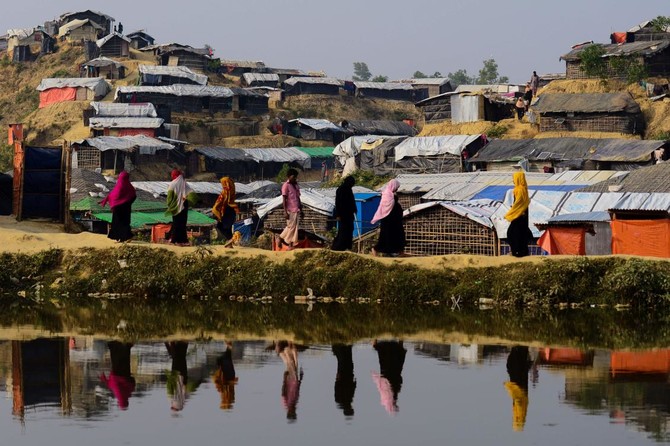
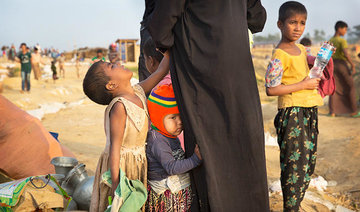
PALONG KHALI, Bangladesh: The UN refugee agency and other groups have urged a rethink of a plan to send Muslim Rohingya refugees back to Myanmar amid fears of forced repatriations without safeguards such as guaranteed citizenship after they fled to Bangladesh to escape bloodshed at home.
The calls come as Bangladesh delayed the repatriation of the largely stateless Rohingya to Myanmar that was set to begin on Tuesday, as the process of compiling and verifying the list of people to be sent back was incomplete.
“In order for the repatriation to be (done) right, to be sustainable, actually viable...you need to really address a number of issues that for the time being we have heard nothing about,” UNHCR head Filippo Grandi said in Geneva, noting that issues like citizenship had not been addressed.
More than 655,500 Muslim Rohingya fled to Bangladesh last year after the Myanmar military cracked down in the northern part of Rakhine state, amid witness reports of killings, looting and rape, in response to militant attacks on security forces on Aug. 25 last year.
Many people in Buddhist-majority Myanmar regard the Rohingya as illegal immigrants from Bangladesh. The United Nations described Myanmar’s crackdown as ethnic cleansing of the Rohingya, which Myanmar denies.
Grandi said it was important to set up a monitoring mechanism in Myanmar’s Rakhine state for those returning and noted that UNHCR currently did not have the ability to move freely and perform this role there.
Myanmar and Bangladesh agreed earlier this month to complete a voluntary repatriation of the refugees in two years. Myanmar says it has set up two reception centers and a temporary camp near the border in Rakhine state to receive the first arrivals.
Human Rights Watch, a non-government organization, said on Tuesday that Bangladesh should suspend the plan entirely as it “threatens the refugees’ security and well-being.”
The plan has sparked fears in refugee camps in Bangladesh that people may be forced to return despite a lack of guarantees around their security.
One Rohingya man detained on Monday by the Bangladeshi military at the Palong Khali refugee camp following a protest against repatriations remained in police custody on Tuesday and was still being interrogated, officials said.
“He was detained for instigating violence. He is in custody for interrogation,” local police chief Abul Khayer told Reuters by telephone.
A UNHCR official said the agency plans to bring up the detention with Bangladesh during their next meeting, as the refugees were only staging a peaceful protest.

Aid groups urge rethink of Rohingya repatriations without safeguards
Italian police fire tear gas as protesters clash near Winter Olympics hockey venue
- Police vans behind a temporary metal fence secured the road to the athletes’ village, but the protest veered away, continuing on a trajectory toward the Santagiulia venue
MILAN: Italian police fired tear gas and a water cannon at dozens of protesters who threw firecrackers and tried to access a highway near a Winter Olympics venue on Saturday.
The brief confrontation came at the end of a peaceful march by thousands against the environmental impact of the Games and the presence of US agents in Italy.
Police held off the violent demonstrators, who appeared to be trying to reach the Santagiulia Olympic ice hockey rink, after the skirmish. By then, the larger peaceful protest, including families with small children and students, had dispersed.
Earlier, a group of masked protesters had set off smoke bombs and firecrackers on a bridge overlooking a construction site about 800 meters (a half-mile) from the Olympic Village that’s housing around 1,500 athletes.
Police vans behind a temporary metal fence secured the road to the athletes’ village, but the protest veered away, continuing on a trajectory toward the Santagiulia venue. A heavy police presence guarded the entire route.
There was no indication that the protest and resulting road closure interfered with athletes’ transfers to their events, all on the outskirts of Milan.
The demonstration coincided with US Vice President JD Vance’s visit to Milan as head of the American delegation that attended the opening ceremony on Friday.
He and his family visited Leonardo da Vinci’s “The Last Supper” closer to the city center, far from the protest, which also was against the deployment of US Immigration and Customs Enforcement agents to provide security to the US delegation.
US Homeland Security Investigations, an ICE unit that focuses on cross-border crimes, frequently sends its officers to overseas events like the Olympics to assist with security. The ICE arm at the forefront of the immigration crackdown in the US is known as Enforcement and Removal Operations, and there is no indication its officers are being sent to Italy.
At the larger, peaceful demonstration, which police said numbered 10,000, people carried cardboard cutouts to represent trees felled to build the new bobsled run in Cortina. A group of dancers performed to beating drums. Music blasted from a truck leading the march, one a profanity-laced anti-ICE anthem.
“Let’s take back the cities and free the mountains,” read a banner by a group calling itself the Unsustainable Olympic Committee. Another group called the Association of Proletariat Excursionists organized the cutout trees.
“They bypassed the laws that usually are needed for major infrastructure project, citing urgency for the Games,” said protester Guido Maffioli, who expressed concern that the private entity organizing the Games would eventually pass on debt to Italian taxpayers.
Homemade signs read “Get out of the Games: Genocide States, Fascist Police and Polluting Sponsors,” the final one a reference to fossil fuel companies that are sponsors of the Games. One woman carried an artificial tree on her back decorated with the sign: “Infernal Olympics.”
The demonstration followed another last week when hundreds protested the deployment of ICE agents.
Like last week, demonstrators Saturday said they were opposed to ICE agents’ presence, despite official statements that a small number of agents from an investigative arm would be present in US diplomatic territory, and not operational on the streets.