Saudi Arabia, Pakistan to boost ties in different fields

1 / 2
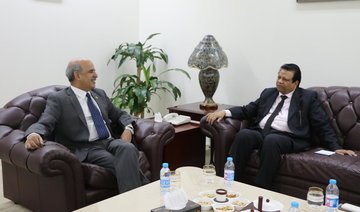
Majid bin Abdullah Al-Qasabi, Saudi minister of commerce and investment is seen attending a meeting at Islamabad on January 17, 2018. (SPA)
2 / 2
Mohammad Pervaiz Malik, Pakistani federal minister for commerce and textile is seen co-chairing a meeting at Islamabad on January 17, 2018. (SPA)
Updated 03 February 2018
Follow

Saudi Arabia, Pakistan to boost ties in different fields

ISLAMABAD: Pakistan and Saudi Arabia have agreed to enhance bilateral cooperation in a number of different fields.
The two sides signed and exchanged documents of protocol at the end of the two-day long 11th Saudi-Pakistan Joint Ministerial Commission (JMC) meeting in Islamabad on Wednesday.
In the closing session, Pakistan’s Minister of Commerce Pervaiz Malik invited Saudi Arabia to invest in renewable energy projects, and in the agriculture, oil exploration and livestock sectors.
“The launching of Vision 2030 in the Kingdom will surely usher in the creation of hundreds of thousands of new jobs in the construction and services sectors … I would like my Saudi brothers to increase the quota of jobs for Pakistani workers in those sectors,” said Malik.
He also suggested the Saudi government could establish a “Saudi-specific training sector” in Pakistan to teach the particular skills needed for the Saudi job market.
The head of Saudi Arabia’s delegation, Majid Al-Qassabi, minister for commerce and investment, said the Kingdom was keen to enhance strategic relations with “our brotherly country Pakistan.”
The Saudi minister admitted that the current volume of trade between the two countries is only “moderate.”
“We need to enhance communication, we need to identify opportunities,” he said. “We need to promote investment opportunities, from both ends. We need to clear all the obstructions, all the challenges, that (inhibit) the ease of doing business.”
The 34-member Saudi delegation included participants from 20 different government entities, the chamber of commerce, and the private sector.
“We are really keen to identify opportunities, we really need to work to establish a long strategic relationship,” Al-Qassabi said.
The minister also announced that Riyadh will host the Saudi-Pakistan Business Forum in the second half of this year. “Hopefully that will be the launching pad for new business and investment relations between the two countries,” he said.


SDAIA Academy opens registration for quantum computing boot camp

Updated 05 January 2026
Follow

SDAIA Academy opens registration for quantum computing boot camp

  • 5 hours of daily training offered, from Jan. 11-15

RIYADH: The SDAIA Academy has opened registration for a five-day quantum computing boot camp aimed at building national capabilities in one of the world’s most advanced and complex computing fields.

The boot camp will run from Jan. 11 to 15, offering five hours of daily training, according to the Saudi Press Agency.

It is organized by the Saudi Data and AI Authority, in collaboration with the King Fahd University of Petroleum and Minerals, and targets professionals and specialists in computer science and related disciplines.

According to the SDAIA, the program is designed to equip participants with a foundational understanding of quantum computing and its potential applications, as Saudi Arabia steps up investments in advanced and emerging technologies, aligned with Vision 2030.

Quantum computing differs fundamentally from classical computing by relying on quantum mechanics rather than binary logic.

While still an emerging field, it is widely expected to reshape areas such as cybersecurity, optimization, advanced simulation and data-intensive research.

The boot camp will introduce participants to the physical and mathematical principles that underpin quantum computing, including the behavior of qubits, quantum superposition and entanglement.

It will also examine how quantum systems differ from traditional computing architectures and where quantum approaches may offer advantages.

In addition to theory, the program places a strong emphasis on applied training.

Participants will receive hands-on exposure to designing and running quantum algorithms using industry-recognized tools and platforms, including Qiskit and CUDA-Q.

These tools are currently used in research and early-stage development environments worldwide.

Organizers say the practical component aims to prepare participants to engage with real-world quantum computing workflows rather than limiting training to conceptual knowledge.

The goal is to build early-stage technical readiness among Saudi professionals, as global interest in quantum technologies accelerates.

The collaboration with King Fahd University of Petroleum and Minerals reflects a broader push to link national digital initiatives with academic and research expertise.

KFUPM has played a central role in developing technical talent in engineering, computing and applied sciences, fields closely connected to quantum research.

The SDAIA has increasingly focused on capability-building programs that support Saudi Arabia’s long-term digital and data strategy.

Training initiatives in artificial intelligence, advanced analytics and emerging technologies are viewed as essential in reducing reliance on external expertise and strengthening local innovation ecosystems.

Officials say the quantum computing boot camp forms part of this wider effort to develop specialized skills that may not yet be widespread in the local labor market but are expected to become strategically important in the coming decade.

The program also aligns with the objectives of Vision 2030 related to human capital development and the transition toward a knowledge-based economy, particularly in high-value technology sectors.

Registration for the boot camp is open until Jan. 6. Applicants can register through the SDAIA’s official training platform.