

Pakistan stocks edge higher as export financing, industrial power tariffs are cut

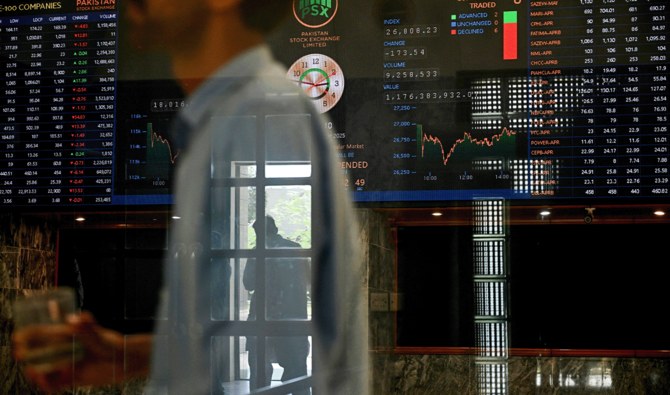
A stockbroker walks past share prices on a financial market board during a trading session at the Pakistan Stock Exchange (PSX) in Karachi on April 9, 2025. (AFP/File)
Short Url
Updated 30 January 2026
Follow

Pakistan stocks edge higher as export financing, industrial power tariffs are cut

  • KSE-100 index gained 1,836.36 points, or 1.01%, to close at 184,174.48
  • Rebound follows steep sell-off a day earlier amid regional geopolitical tensions

ISLAMABAD: Pakistan’s stock market rebounded on Friday, with the benchmark index gaining more than 1,800 points, as analysts pointed to cuts in export refinancing rates and lower electricity tariffs for industrial consumers as key drivers of the recovery.

The KSE-100 index rose 1,836.36 points, or 1.01%, to close at 184,174.48, up from 182,338.12 a day earlier, according to Pakistan Stock Exchange (PSX) data.

The uptick followed Prime Minister Shehbaz Sharif’s announcement of a Rs4.4 per unit cut in electricity tariffs for industrial consumers, alongside a reduction in the export refinance rate from 7.5% to 4.5%.

“Stocks staged an early recovery at the PSX on institutional buying in oversold scrips after the prime minister’s assurance to renegotiate the IMF deal, along with cuts in the export refinance rate to 4.5% and industrial power tariffs by Rs4.4 per unit,” Arif Habib Commodities Chief Executive Officer Ahsan Mehanti told Arab News.

He added that higher global crude oil prices and earnings-season speculation also acted as catalysts for bullish activity.

According to local media reports last week, Pakistan is seeking flexibility in IMF lending conditions for the 2026–27 budget and aims to renegotiate its agreement to complete the remaining $7 billion under the Extended Fund Facility (EFF) and a $1.4 billion Resilience and Sustainability Facility (RSF) by September 2027.

The rebound came a day after Pakistani stocks plunged 6,042.26 points on Thursday, a drop analysts attributed to heavy selling and heightened geopolitical tensions between Iran and the United States.

Those concerns intensified after US President Donald Trump warned Iran this week that “time is running out” to reach a deal on its nuclear program, amid a steady buildup of US military forces in the Gulf.


Pakistan says it engaged Iran, Saudi Arabia to limit Gulf escalation after US-Israel attacks

Updated 6 sec ago
Follow

Pakistan says it engaged Iran, Saudi Arabia to limit Gulf escalation after US-Israel attacks

  • Deputy PM Ishaq Dar says he reminded Iranian leadership about Pakistan’s defense pact with Saudi Arabia 
  • Saudi Arabia confirmed Iran launched attacks in Kingdom’s Riyadh, Eastern Province regions on Saturday 

ISLAMABAD: Pakistan’s Deputy Prime Minister Ishaq Dar said on Tuesday that Islamabad had mediated between Saudi Arabia and Iran to reduce tensions amid escalating tensions due to the ongoing conflict in the Middle East. 

Tensions in the Gulf skyrocketed on Saturday following coordinated strikes by the US and Israel against Iran, diminishing prospects of a peaceful settlement to Tehran’s long-running dispute with Western countries and Tel Aviv around its nuclear program.

Iran subsequently targeted American military bases in Gulf states, including the UAE, Bahrain, Qatar, Kuwait and Jordan, prompting their governments to issue condemnations. Saudi Arabia also confirmed Iran launched attacks in Riyadh and the Eastern Province, saying they were successfully intercepted. 

Dar, who also serves as foreign minister, told members of the National Assembly during a televised session that he reminded Iran about Pakistan’s Strategic Mutual Defense Agreement with Saudi Arabia when carried out strikes against Gulf nations. The pact, signed last year in September between Islamabad and Riyadh, states that aggression on one would be considered an attack against both. 

He said the Iranian leadership sought assurances from Saudi Arabia that its soil would not be used against Iran. The Pakistani minister said he conveyed those assurances from Riyadh to Tehran. 

“So, by the grace of god, you saw that what appears to be a minimum reaction at this point, has not been directed against Saudi Arabia and Oman,” Dar said. 

He said Iran carried out strikes against other Middle Eastern countries such as Jordan, Kuwait, UAE, Qatar and Bahrain. Dar added that these were sovereign countries and not bound to heed Pakistan’s advice. 

“I am grateful that they [Iran] understood my point and the assurance they sought was obtained and delivered by us accordingly,” he said. 

Speaking about Islamabad’s efforts to defuse tensions between Iran and the US, Dar said he took up Iran’s nuclear program with US Secretary of State Marco Rubio during their meeting in July last year. 

The Pakistani minister said Iran’s response was also “positive” on Washington’s demands to not pursue nuclear weapons, adding that Pakistan held talks with Iranian officials during President Masoud Pezeshkian’s visit to Islamabad in August 2025.

Dar said Pakistan had immediately condemned US-Israel attacks against Iran when they took place on Saturday, adding that he was directly in contact with Iran’s Foreign Minister Abbas Araghchi via WhatsApp. 

“We don’t need the longer routes of the foreign office,” he said. “We just message each other, we just talk to each other as soon as we see the messages.”

He said Islamabad would continue its efforts to de-escalate tensions between Washington and Tehran as regional tensions escalate.