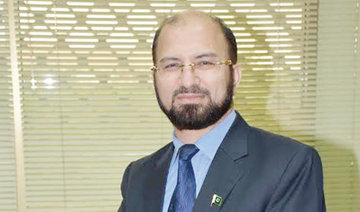
RIYADH: Pakistan has lent all support to Saudi Arabia while renewing its call for the solution to the regional conflicts in the Middle East, especially the crisis in war-torn Yemen and Syria, said Pakistan’s envoy to Saudi Arabia here on Sunday.
Speaking to Arab News on the occasion of Pakistan’s 70th Independence Day, Khan Hasham bin Saddique said Pakistan fully supports UN Security Council Resolution 2216, which refers to the legitimacy of President Abed Rabbo Mansour Hadi’s government for peace and security in Yemen.
He said that Pakistan also opposed the overthrow of a legitimate president and his government by the Houthi militias.
“We call upon the warring factions in Yemen to resolve their differences peacefully through dialogue in line with the Yemeni National Dialogue and Gulf Cooperation Council (GCC) initiative,” said the envoy.
In his wide-ranging interview, the ambassador gave an overview of the progressively growing Saudi-Pakistan relations. He also spoke about the regional conflicts in the Middle East, which have hampered all plans to restore peace and security in the region as well as in the extended neighborhood.
He said: “We support regional and international efforts for restoration of peace and stability in Yemen.”
He noted that Pakistan and Saudi Arabia enjoyed outstanding bilateral relations. “While political and security relations between the two countries continue to scale new heights, I am of the view there is a considerable scope to expand commercial and cultural ties.”
The diplomat said: “I am hopeful with the launch of Saudi Vision 2030 and CPEC (China-Pakistan Economic Corridor) in Pakistan both Pakistan and Saudi Arabia will look to exploit huge investment opportunities...”
On regional issues, Saddique said that Pakistan as a matter of principle supports peaceful resolution of conflicts through negotiations. “On Syria, we call for protecting the sovereignty and territorial integrity of the country, cessation of hostilities and violence by all sides,” he added.
He urged all parties “to exercise restraint and to ensure the safety of (Syrian) civilians.”
“Pakistan believes that solution to the Syrian crisis lies in a peaceful and inclusive process that meets the aspirations of the Syrian people, through a comprehensive political dialogue. We hope that all parties in Syria will act in accordance with the UN resolutions, fulfill their obligations, take the peace talks forward and launch political process,” he added.
On the Middle East peace process, he said: “Peace in the Middle East is of critical importance for global peace.”
“Pakistan has always supported the Palestine cause fully realizing the pain suffered by Palestinian brothers and sisters, as we feel that there are many similarities between the issues of Palestine and Kashmir,” he said.
Like Palestine, the Kashmir issue is one of the oldest unresolved issues on the UN agenda, he said.
Asked about the visit of Saudi and Pakistani officials, he said that the next meeting of the Pak-Saudi Joint Commission is scheduled in Islamabad later this year. From the Pakistani side, the Sialkot Chamber of Commerce and Industry is planning to bring a business delegation to the Kingdom in October to study the Saudi market, he added.
He said that the magnitude of commodities traded between Pakistan and Saudi Arabia is approximately $2.5 billion. Out of this, Pakistan’s exports to Saudi Arabia are worth about $0.5 billion. The total value of services traded between the two countries stands in the vicinity of $580 million, he added.


![]()

Saudi Arabia, Pakistan enjoy very cordial relations: Envoy
Saudi Arabia, Pakistan enjoy very cordial relations: Envoy


Latest updates


© 2026 SAUDI RESEARCH & PUBLISHING COMPANY, All Rights Reserved And subject to Terms of Use Agreement.