

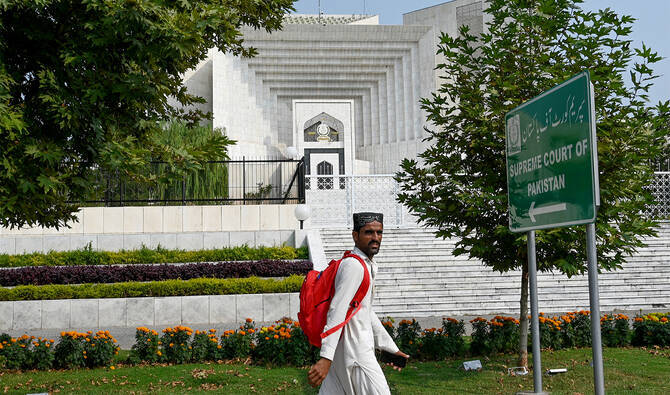

ISLAMABAD: Pakistan’s Supreme Court has ruled that the payment of dower, or haq mehr, recorded in a marriage contract is a binding legal obligation that husbands cannot avoid, state-run APP news agency reported on Friday, reinforcing women’s financial rights in a society where disputes over dower and dowry remain common.
The ruling addresses a longstanding legal and social issue in Pakistan, where dower — a mandatory payment promised by the husband at the time of marriage under Islamic law — is frequently delayed, disputed or not paid at all, often leaving women financially vulnerable in cases of separation or divorce.
During hearings on multiple petitions related to dowry and dower, Chief Justice Yahya Afridi said that a marriage contract (Nikahnama) created enforceable obligations for the husband.
“When a man marries a woman, he becomes legally bound to fulfill all conditions recorded in the Nikahnama, including the payment of haq mehr,” the chief justice said, according to Pakistan’s state news agency APP.
He emphasized that whatever amount is written in the dower section of the marriage contract must be paid in full, describing it as both a legal and moral responsibility.
The issue came into sharp focus during arguments in one case where the petitioner’s lawyer said the agreed dower of 40 tolas of gold was excessive and proposed that the husband was willing to pay 20 tolas instead.
In response, the chief justice remarked that paying a little more could help satisfy the wife, adding that it was the husband’s responsibility to keep his wife content, APP reported.
The chief justice also observed that courts could not interfere in personal and family matters that were based on mutual consent, noting that such issues were governed by the terms voluntarily agreed upon by both parties in the marriage contract.
“Courts cannot interfere in personal and family matters that are based on mutual consent, as such matters fall within the framework of the marriage contract agreed upon by both parties,” he said.
Following the hearing, the Supreme Court of Pakistan dismissed several petitions related to dowry and haq mehr.
Legal experts say the ruling could strengthen enforcement of dower payments across Pakistan, where women often face prolonged legal battles to recover amounts promised at marriage, particularly in conservative or economically disadvantaged settings.


