LONDON: Construction firm Carillion collapsed on Monday in one of the UK’s biggest corporate failures, leaving the future of some of its Middle Eastern projects unclear.
The British company was involved in a number of high profile construction projects across the Gulf region, including building part of the infrastructure for Qatar 2022 World Cup.
Auditors KPMG in July identified £845 million ($1.1 billion) of contract write-downs, with some of Carillion’s problems arising from payment delays in the Middle East. In light of this, it stated in its half-year financial report 2017 that it would try to exit certain markets, including Qatar, Saudi Arabia and Egypt.
In October, City A.M. reported that Carillion was owed £200 million ($275 million) for work carried out as part of the $5.5 billion Msheireb Downtown redevelopment of central Doha. It is unclear if the debt was outstanding at the time of Carillion’s collapse on Monday.
The future of projects in the UAE and Oman is still to be clarified by the company.
Carillion’s UAE partner, Al-Futtaim Carillion — which is 51 percent owned by Al-Futtaim in a longstanding arrangement — won contracts in 2017 for a series of schemes in Dubai, including three themed districts for Expo 2020, due for delivery in mid-2019.
In Oman, Carillion has a 50-50 venture with the Zawawi family, Carillion Alawi, which in November was named the preferred bidder for the New Sultan Qaboos Hospital in Salalah. Construction was due to start later this year. Neither Al-Futtaim Carillion nor Carillion Awawi were available for comment at the time of going to press.
Carillion stated in its half-year financial report 2017 that it was to now focus on winning contracts supported by UK Export Finance (UKEF), the UK government’s foreign investment body. UKEF has already provided support to Carillion projects in the Middle East in the form of loans and guarantees on bank loans, which help an overseas buyer purchase goods or services from a UK supplier.
When asked if outstanding projects in the Middle East would be affected by the Carillion collapse, UKEF told Arab News: “For the majority of Carillion projects that UKEF has supported, construction has been completed, and finance is now being repaid by the overseas buyer; in these cases, payments will continue as agreed.”
But the UK body added that for projects where construction is yet to be completed, UKEF is “working with the parties involved to find an appropriate solution.” The UKEF spokesperson was unable to elaborate further as to how these solutions were being sought, or which contracts in particular are outstanding.
Meanwhile in the UK, the demise of the 200-year-old business poses a headache for Theresa May’s government which had employed Carillion to work on 450 projects, including the building and maintenance of hospitals, prisons, defense sites and a high-speed rail line.
The government’s priority is to ensure that public services are not disrupted, said David Lidington, the minister in charge of the Cabinet Office which oversees the running of government, Reuters reported.
Some contracts handled by Carillion would go to alternative providers, he added. Lidington urged the company’s staff to continue to work and said the government would pay their salaries.
Although the UK government has promised to support workers and ensure contracts are delivered, it has stopped short of bailing out the company as it did with major banks during the financial crisis almost a decade ago.
Accountancy firm PwC has been appointed to oversee the liquidation of Carillion; it announced in a statement that its priority “is to ensure the continuity of public services while securing the best outcome for creditors. Unless told otherwise, all employees, agents and subcontractors are being asked to continue to work as normal and they will be paid for the work they do during the liquidations.”


![]()
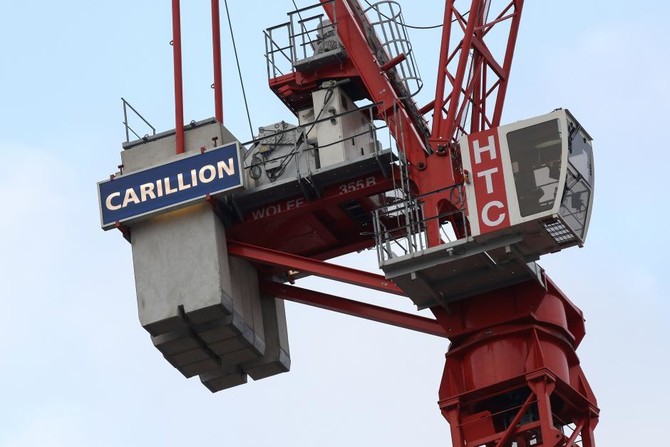
British construction firm linked to Qatar 2022 project collapses
British construction firm linked to Qatar 2022 project collapses

Latest updates


© 2026 SAUDI RESEARCH & PUBLISHING COMPANY, All Rights Reserved And subject to Terms of Use Agreement.