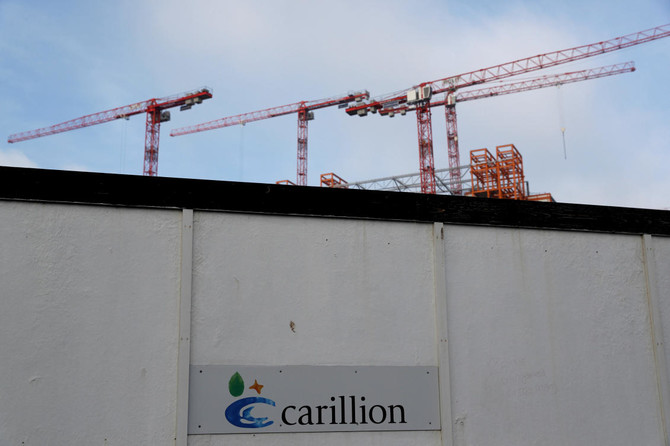
LONDON: British building and services company Carillion could enter administration on Monday unless Britain’s government backs a rescue plan, Sky News reported on Saturday, citing sources.
Carillion said on Friday it remained in “constructive discussions” with its creditors and suggestions that they had rejected its business plan were incorrect.
A collapse of Carillion, which provides services to government departments including justice, health and education, and has built hospitals, roads and rail lines, would be felt across Britain and also in Canada and the Middle East where the 200-year-old company has worked on landmark projects.
Carillion declined to comment on Saturday’s Sky News report, which said government officials are due to meet on Sunday to discuss the company’s future.
Shares in Carillion plunged almost 30 percent to a new low on Friday after Sky News reported it had put administrators on standby, while a person familiar with the matter told Reuters that creditors did not like the plan put forward.
Tensions over the future of Carillion have been rising for weeks and on Thursday ministers overseeing everything from justice to transport, health and education met to discuss how they should respond to the possible demise of a business that plays a central role in British public life.

Carillion could enter administration on Monday unless UK backs rescue
Snake milkers, ship welders earn up to $39k as Saudi jobs defy convention
RIYADH: Some jobs in Saudi Arabia transcend the ordinary, becoming a blend of adventure and hobby. A single gram of venom extracted by snake milkers can fetch up to SR37,000 ($10,000), and professional diving salaries can reach SR150,000 per month.
Danger is the price of professional success in these professions, where the lines between life and death intersect.
Al-Eqtisadiah newspaper conducted research into these professions, highlighting the work of snake milkers, who collect venom from poisonous snakes in specially designed glass containers for use in the production of antivenoms and other medications.
Not just anyone is capable of performing this job. Snake milkers are typically specialists in herpetology or zoology, and those working in this highly specialized field extract venom from snakes and other reptiles.
A snake milker can earn up to SR18k a month
According to the website “Snake Sunggles,” the average monthly income for a snake milker ranges between $2,500 and $5,000, equivalent to SR10,000 to SR18,000.
Naif Al-Maliki, a specialist and environmental activist, revealed to Al-Eqtisadiah that his entry into this field did not stem from raising snakes, as some might assume, but rather from his early interest in wildlife and biodiversity in Saudi Arabia.
Over time, he discovered that raising environmental awareness begins with correcting the public perception of these creatures and that toxicology is directly linked to public health, the production of antivenom, and medical research. This marked a turning point, as he began studying snake behavior and the characteristics of their venom to support scientific research and protect biodiversity.
Al-Maliki confirms that venom prices vary significantly depending on several factors, most notably the rarity of the species, the difficulty of raising it, the production volume, and the venom’s medical and scientific value.
The venoms of the king cobra, black mamba and some Australian species, such as the taipan, are among the most expensive in the world, especially neurotoxins, which are used in neurological research and pharmaceutical technologies and often command higher prices than hematotoxins.
Official scientific bodies and pharmaceutical companies are the main clients
Regarding the sale of venom, Al-Maliki said: “Sales are restricted to official and scientific bodies only, including antivenom manufacturers, universities, research centers, and biotechnology companies specializing in proteins and toxins, in addition to analytical laboratories and pharmaceutical industries.”
He pointed out that selling to individuals is strictly prohibited. He further explained that determining the venom’s price depends on several criteria, including its purity — whether raw or freeze-dried — its grade — neurotoxin, hematotoxin or rare protein compounds — and the protein content per milligram.
The extraction cost, which depends on the number of snakes, care and feeding, and the associated risks, is also a factor, as are the global market and the needs of pharmaceutical companies.
According to international markets, the price of one milligram of rare neurotoxins can range between $100 and $300.
Al-Maliki indicated that exporting venom is possible but subject to strict procedures, including approval from the Ministry of Environment and Wildlife, CITES permits for listed species, biosafety certificates, proof of scientific or serum-production use, rigorous customs procedures due to its high-risk nature, transport in approved refrigerated containers and the presence of a licensed importer.
International transport and changing regulations are among the most significant challenges.
The biggest financial risks facing snake farms include snake deaths due to disease or temperature changes, seasonal production declines, rising care and laboratory costs, and changes in regulations regarding the housing of venomous species as well as export cessations or regulatory changes in importing countries and the loss of rare species upon which production depends. He described this as "the most dangerous financial scenario.”
The price per gram varies between $1,000 and $10,000.
Globally, snake venom prices vary widely. Some neurotoxins can reach $1,000 per gram, while venom from rare Australian species can exceed $3,500 per gram. Proteins extracted from venom can surpass $10,000 per gram. Major global markets include the US, Germany, France and the UK, as well as India, South Africa and China.
The most prominent modern venom-extraction techniques include micro-milking to extract precise quantities without stressing the snake, lyophilization to freeze-dry venom for long-term preservation, protein fractionation to isolate high-value compounds, HPLC analysis, and 3D-printed immobilizers to ensure safe extraction.
Making skin creams from bee venom
Beekeeper and owner of Al-Thunayan Apiaries, Thunayan Al-Thunayan, shared details of his experience extracting bee venom. He said his journey began with a training course organized by the Ministry of Agriculture, covering beekeeping and venom-extraction methods, which opened the door to further specialization.
Al-Thunayan explained that bee venom is among the most valuable bee products but can weaken colonies, making continuous extraction inadvisable. Production should be limited to once or twice a year to safeguard bee health and ensure sustainability.
He outlined traditional extraction methods, which involve manually provoking bees to sting glass or leather surfaces — an exhausting process that often results in bee fatalities due to loss of stingers and venom glands.
Traditional uses of bee venom, prices reaching $300
Bees produce a venom known as apitoxin, a clear acidic fluid secreted to defend the colony. It contains proteins and enzymes such as melittin and histamine, with melittin comprising about 50 percent of its dry weight.
Studies published in the scientific journal Nature suggest melittin has promising medicinal properties, though its therapeutic use requires extreme caution due to the risk of severe allergic reactions.
Modern methods now rely on electrically stimulated glass plates that allow bees to release venom without harm. The venom is then collected, frozen and purified. Producing one gram of dry venom requires hundreds of thousands of stings.
Al-Thunayan said global demand for bee venom remains high, while local demand is weak due to limited recognition by authorities, the absence of research laboratories and a lack of cooperation with pharmaceutical companies.
Bee venom is used in the West to treat conditions for which conventional medicine offers limited solutions and is also incorporated into cosmetics and skin creams, though therapeutic doses typically do not exceed one gram.
It can be administered through prepared formulations or direct stings, both of which have shown effectiveness in some cases, including eczema, sciatica and inflammatory conditions, he said.
Regarding the commercial aspect, Al-Thunayan explained that the lack of official licenses and the lack of cooperation from pharmaceutical companies have led some to use the venom in the production of therapeutic and cosmetic creams sold directly to consumers.
The price of one gram of venom ranges from $30 to $300, depending on the quality, purity, and extraction method. A single bee produces only a few micrograms, while producing one gram requires collecting the venom of thousands of bees over an extended period.
Al-Thunayan pointed out that beekeeping within the Kingdom is limited to Saudis only, while other Arab countries, most notably Egypt, produce large quantities of bee venom due to the lower costs of honey and bee colonies, and the cooperation between pharmaceutical companies and beekeepers, which has helped Egypt become the leading Arab country in this field.
In the same vein, a Saudi diver’s passion for the sea began as a personal pursuit, a search for tranquility and discipline, before evolving into a comprehensive career path encompassing training, expedition leadership, commercial activities, and consulting on marine projects.
Ahmed Al-Jaber, the diver, affirms that his passion ultimately led him to establish his company, Alpha OMQ, specializing in marine services. He says this step “represents part of his dream to serve a Saudi maritime sector experiencing unprecedented growth.”
Salaries of professional divers: from $3.9k to $39.9k
Al-Jaber explained that income in the sector varies depending on specialization and experience.
He noted that a newly graduated commercial diver typically starts with a salary of around SR15,000 per month, while salaries increase significantly with specialization.
For example, a specialized diver, such as a welder, starts at SR30,000, and a highly experienced inspection diver can earn up to SR45,000. A saturation diver’s income can exceed SR150,000, depending on the project, depth, and working conditions.
The diver believes the sector faces several challenges, most notably the inherent dangers of working at great depths and high pressure, the required physical fitness, and the high costs associated with specialized equipment, decompression chambers, and training programs.
Demand also fluctuates depending on the activity of offshore projects and the oil and gas sector. Furthermore, there is a shortage of qualified local professionals, as these positions require advanced training and a significant investment of time.
No risks from foreign competition, future opportunities present
Regarding competition from foreign companies and individuals, the diver affirms that while competition exists, it is not an obstacle but rather a catalyst for development, especially with the significant expansion of coastal projects such as NEOM and the Red Sea projects.
He points out that the demand for commercial divers includes the inspection and maintenance of ports and marine facilities, the installation and inspection of underwater pipes, and work on new coastal cities and resorts, in addition to the maintenance of ships and offshore platforms.
Al-Jaber emphasizes that Jeddah and the Red Sea coast offer vast investment opportunities in commercial diving, maintenance, inspection, and support services, driven by oil and gas projects, ports, and future cities.
He believes that the diving sector — in both its tourism and commercial aspects — is poised for even greater growth, supported by the Kingdom’s Vision 2030 projects and the development of marinas, yacht centers, and marine environments.
This, he says, places Saudi Arabia at a “historic” maritime juncture, noting that the most attractive marine areas for local and foreign tourists are Yanbu, Jeddah, the Farasan Islands, Umluj, and the Red Sea projects.
The diver describes the Saudi market as the fastest growing in the region, surpassing Gulf countries with a longer history in marine tourism and confirms that Saudi Arabia leads commercial diving globally without any real competition in the size of projects.