AMMAN: Israel’s actions have sabotaged the landmark Oslo peace accords of the 1990s, the Palestinian President Mahmoud Abbas said on Sunday.
“There is no Oslo,” Abbas told a meeting of Palestinian leaders in Ramallah called to discuss the recognition by US President Donald Trump of Jerusalem as Israel’s capital. “Israel ended Oslo.”
Abbas told the 28th session of the Palestinian Central Council: “We said ‘no’ to Trump and we will not accept his project. The deal of century is the slap of century and we will not accept it.
“We do not take instructions from anyone and we say ‘no’ to anyone if it is about our destiny, our cause, our country and our people.”
The president said he regretted that there were no delegates at the meeting from Hamas in Gaza.
“What made me upset was that our brothers did not participate in this meeting because the place was not suitable for making fateful decisions,” he said.
“Where, in their opinion, is the place to make crucial decisions? We meet here to defend and protect Jerusalem, and there can be no argument from anyone that the place is not suitable. We are at a crucial moment and our future at stake.”
Abbas Zaki, a member of the Fatah central committee, told Arab News that Hamas leaders were afraid of participating in any effort to rewrite Palestinian liberation strategy.
“We are at the stage of coming up with a new strategy and we want all Palestinians to help us come up with a joint agreement because we know that such strategies require a level of sacrifice.”
Zaki said he hoped even those with differences of opinion would attend and express their ideas.
“We are holding our session in Palestine and the Council can accept all points of view.”
However, Zaki said he was worried that Hamas wanted the current Palestinian effort to fail.
“They want free gifts without having to work for them. They are waiting for the Palestinian National Authority to fail so that they can take over,” he said.
Zaki said all Palestinians rejected Trump’s position and wanted Arab countries to react in a strong way.
“Arab summits in Amman, Baghdad and Cairo all resolved unanimously that Arab countries would cut off relations with any country that moves its embassy to Jerusalem. It is time for our Arab brothers to act according to their own resolutions.”
Salim Zanoun, speaker of the Palestine National Council, said the US had opposed its own allies and ignored Palestinian rights with the aim of removing the issue of Jerusalem from final status talks, and had thus forfeited its role as a peace mediator.
“We are therefore asked to come up with a review of the recognition of Israel until it recognizes Palestine, with East Jerusalem as its capital,” he said.
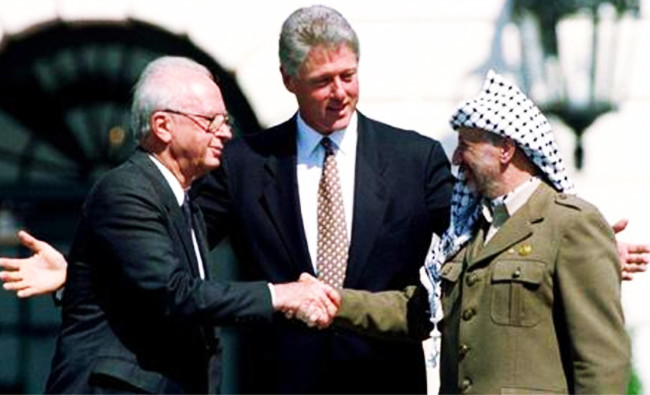
Speaking on Palestine TV, Jamal Muhaisen, a member of the Fatah central committee, said the 1993 mutual recognition between the PLO and Israel should be withdrawn.
“We want to withdraw the recognition of Israel and not to suspend the recognition. When they are ready to recognize us we will recognize them,” he said.
Muhaisan, who is in charge of Fatah recruitment and enlisting, called on all Palestinians “including ministers and government employees” to participate in the popular struggle against the occupation.
The Palestine Central Council is the intermediary body between the Palestinian parliament in exile, the Palestine National Council and the Executive Committee.
Analysts say it is likely that the Palestine National Council, which was last held in Gaza in April 1996, will meet again this year to formulate a new Palestinian strategy.


Israel has sabotaged Oslo peace accords, Palestinian leader says

Israel has sabotaged Oslo peace accords, Palestinian leader says



Iran says any US attack including limited strikes would be ‘act of aggression’
- Foreign ministry spokesman said any state would react to an act of aggression as part of its inherent right of self-defense
- Trump said Friday he was considering a limited strike if Tehran did not reach a deal with the US
TEHRAN: Iran said Monday that any US attack, including limited strikes, would be an “act of aggression” that would precipitate a response, after President Donald Trump said he was considering a limited strike on Iran.
“And with respect to your first question concerning the limited strike, I think there is no limited strike,” foreign ministry spokesman Esmaeil Baqaei said at a briefing in Tehran attended by an AFP journalist.
“An act of aggression would be regarded as an act of aggression. Period. And any state would react to an act of aggression as part of its inherent right of self-defense ferociously so that’s what we would do.”
Trump said Friday he was considering a limited strike if Tehran did not reach a deal with the United States.
“I guess I can say I am considering that,” he replied following a question from reporters.
The two countries concluded a second round of indirect talks in Switzerland on Tuesday under Omani mediation, against the backdrop of a major US military build-up in the region.
Further talks, confirmed by Iran and Oman but not by the United States, are scheduled for Thursday.
Foreign Minister Abbas Araghchi is leading the negotiations for Iran, while the United States is represented by envoy Steve Witkoff and Trump’s son-in-law Jared Kushner.
Trump is wondering why Iran has not “capitulated” in the face of Washington’s military deployment, Witkoff said in an interview with Fox News broadcast on Sunday.
Baqaei responded Monday by saying that Iranians had never capitulated at any point in their history.


