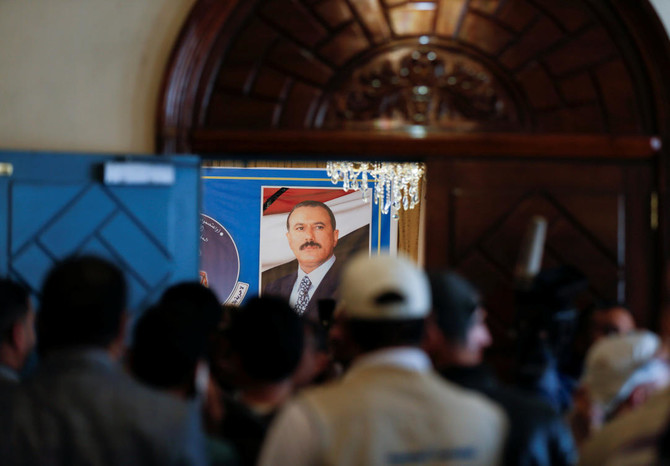
CAIRO: The nephew of former president Ali Abdullah Saleh has resurfaced in the south of the country and has called for an end to the Yemen war, in his first public appearance since his uncle was killed by his former Houthi allies last month.
Brigadier-General Tareq Mohammed Saleh, who led a brigade of an elite Yemeni army unit before his uncle was forced to step down in 2012, had been expected to help lead Saleh's supporters in a fresh fight against the Iran-aligned Houthis, who control most of northern Yemen, including the capital Sana'a.
Addressing supporters in the southern Shabwa province where he had travelled to offer condolences to the family of Aref Al-Zouka, who was killed along with Saleh in the attack on Saleh's residence in Sana'a, Tareq said he remained committed to his uncle's quest for peace in Yemen.
"We are with what the leader had willed, especially his demand to stop the war, lifting the siege from our people," said Tareq, who survived the attack by Houthi forces.
"We also extend our hands to our brothers, particularly the kingdom of Saudi Arabia, to work to end the war and to restore stability and security to Yemen," he added.
Initial reports said Tareq was killed in the fighting that erupted after Saleh called on the Saudi-led coalition to end the war, a move interpreted by the Houthis as a betrayal.
But it later emerged that he had survived and had made his way to a safe location. Zouka was the secretary-general of Saleh's General People's Congress party.
The Saudi-led coalition intervened in the Yemen war in March 2015 to try to restore President Abd-Rabbu Mansour Hadi to power after the Houthis, backed by Saleh's supporters, forced him into exile.
The Yemen war has so far killed more than 10,000 people.

Yemen: Saleh nephew seeks peace in cooperation with Saudi Arabia
Death toll in Iran protests rises to more than 500, rights group says
DUBAI/JERUSALEM: Unrest in Iran has killed more than 500 people, a rights group said on Sunday, as Tehran threatened to target US military bases if President Donald Trump carries out threats to intervene on behalf of protesters.
With the Islamic Republic’s clerical establishment facing the biggest demonstrations since 2022, Trump has repeatedly threatened to intervene if force is used on protesters.
According to its latest spreadsheet — based on activists inside and outside Iran, US-based rights group HRANA said it had verified the deaths of 490 protesters and 48 security personnel, with more than 10,600 people arrested.
Reuters was unable to independently verify the tolls.
Iranian Parliament Speaker Mohammad Baqer Qalibaf, speaking in parliament on Sunday, warned the United States against “a miscalculation.”
“Let us be clear: in the case of an attack on Iran, the occupied territories (Israel) as well as all US bases and ships will be our legitimate target,” said Qalibaf, a former commander in Iran’s elite Revolutionary Guards.
Authorities intensify crackdown
The protests began on December 28 in response to soaring prices, before turning against the clerical rulers who have governed since the 1979 Islamic Revolution.
Authorities accuse the US and Israel of fomenting unrest. Iran’s police chief Ahmad-Reza Radan said security forces had stepped up efforts to confront “rioters.”
The flow of information from Iran has been hampered by an Internet blackout since Thursday.
Footage posted on social media on Saturday from Tehran showed large crowds marching along a street at night, clapping and chanting. The crowd “has no end nor beginning,” a man is heard saying.
In footage from the northeastern city of Mashhad, smoke can be seen billowing into the night sky from fires in the street, masked protesters, and a road strewn with debris, another video posted on Saturday showed. Explosions could be heard.
Reuters verified the locations.
State TV aired footage of dozens of body bags on the ground at the Tehran coroner’s office on Sunday, saying the dead were victims of events caused by “armed terrorists.”
Three Israeli sources, who were present for Israeli security consultations over the weekend, said Israel was on a high-alert footing for the possibility of any US intervention.
An Israeli military official said the protests were an internal Iranian matter, but Israel’s military was monitoring developments and was ready to respond “with power if need be.” An Israeli government spokesperson declined to comment.
Israel and Iran fought a 12-day war in June last year, which the United States briefly joined by attacking key nuclear installations. Iran retaliated by firing missiles at Israel and an American air base in Qatar.
US ready to help, says Trump
Trump, posting on social media on Saturday, said: “Iran is looking at FREEDOM, perhaps like never before. The USA stands ready to help!!!“
In a phone call on Saturday, Israeli Prime Minister Benjamin Netanyahu and US Secretary of State Marco Rubio discussed the possibility of US intervention in Iran, according to an Israeli source present for the conversation.
Reza Pahlavi, the exiled son of Iran’s last shah and a prominent voice in the fragmented opposition, said Trump had observed Iranians’ “indescribable bravery.” “Do not abandon the streets,” Pahlavi, who is based in the US, wrote on X.
Maryam Rajavi, president-elect of the National Council of Resistance of Iran, a Paris-based Iranian opposition group, wrote on X that people in Iran had “asserted control of public spaces and reshaped Iran’s political landscape.”
Her group, also known as Mujahideen-e-Khalq (MEK), joined the 1979 revolution but later broke from the ruling clerics and fought them during the Iran-Iraq war in the 1980s.
Netanyahu, speaking during a cabinet meeting, said Israel was closely monitoring developments. “We all hope that the Persian nation will soon be freed from the yoke of tyranny,” he said.
With the Islamic Republic’s clerical establishment facing the biggest demonstrations since 2022, Trump has repeatedly threatened to intervene if force is used on protesters.
According to its latest spreadsheet — based on activists inside and outside Iran, US-based rights group HRANA said it had verified the deaths of 490 protesters and 48 security personnel, with more than 10,600 people arrested.
Reuters was unable to independently verify the tolls.
Iranian Parliament Speaker Mohammad Baqer Qalibaf, speaking in parliament on Sunday, warned the United States against “a miscalculation.”
“Let us be clear: in the case of an attack on Iran, the occupied territories (Israel) as well as all US bases and ships will be our legitimate target,” said Qalibaf, a former commander in Iran’s elite Revolutionary Guards.
Authorities intensify crackdown
The protests began on December 28 in response to soaring prices, before turning against the clerical rulers who have governed since the 1979 Islamic Revolution.
Authorities accuse the US and Israel of fomenting unrest. Iran’s police chief Ahmad-Reza Radan said security forces had stepped up efforts to confront “rioters.”
The flow of information from Iran has been hampered by an Internet blackout since Thursday.
Footage posted on social media on Saturday from Tehran showed large crowds marching along a street at night, clapping and chanting. The crowd “has no end nor beginning,” a man is heard saying.
In footage from the northeastern city of Mashhad, smoke can be seen billowing into the night sky from fires in the street, masked protesters, and a road strewn with debris, another video posted on Saturday showed. Explosions could be heard.
Reuters verified the locations.
State TV aired footage of dozens of body bags on the ground at the Tehran coroner’s office on Sunday, saying the dead were victims of events caused by “armed terrorists.”
Three Israeli sources, who were present for Israeli security consultations over the weekend, said Israel was on a high-alert footing for the possibility of any US intervention.
An Israeli military official said the protests were an internal Iranian matter, but Israel’s military was monitoring developments and was ready to respond “with power if need be.” An Israeli government spokesperson declined to comment.
Israel and Iran fought a 12-day war in June last year, which the United States briefly joined by attacking key nuclear installations. Iran retaliated by firing missiles at Israel and an American air base in Qatar.
US ready to help, says Trump
Trump, posting on social media on Saturday, said: “Iran is looking at FREEDOM, perhaps like never before. The USA stands ready to help!!!“
In a phone call on Saturday, Israeli Prime Minister Benjamin Netanyahu and US Secretary of State Marco Rubio discussed the possibility of US intervention in Iran, according to an Israeli source present for the conversation.
Reza Pahlavi, the exiled son of Iran’s last shah and a prominent voice in the fragmented opposition, said Trump had observed Iranians’ “indescribable bravery.” “Do not abandon the streets,” Pahlavi, who is based in the US, wrote on X.
Maryam Rajavi, president-elect of the National Council of Resistance of Iran, a Paris-based Iranian opposition group, wrote on X that people in Iran had “asserted control of public spaces and reshaped Iran’s political landscape.”
Her group, also known as Mujahideen-e-Khalq (MEK), joined the 1979 revolution but later broke from the ruling clerics and fought them during the Iran-Iraq war in the 1980s.
Netanyahu, speaking during a cabinet meeting, said Israel was closely monitoring developments. “We all hope that the Persian nation will soon be freed from the yoke of tyranny,” he said.
© 2026 SAUDI RESEARCH & PUBLISHING COMPANY, All Rights Reserved And subject to Terms of Use Agreement.