Saudi-led coalition intensifies Yemen air strikes after Saleh’s death

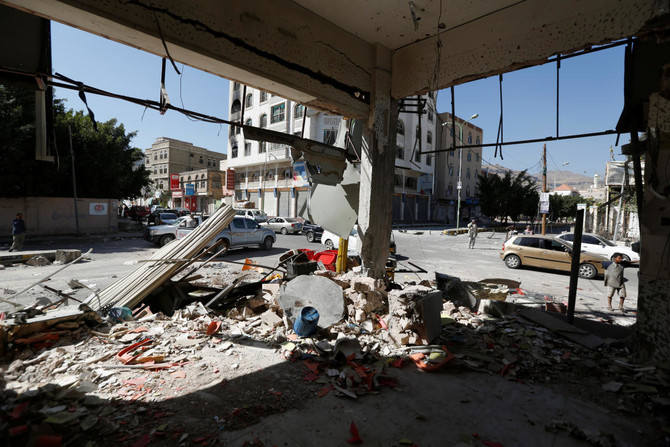
A view of damage on a street where Houthis have recently clashed with forces loyal to slain Yemeni former president Ali Abdullah Saleh in Sanaa, Yemen Dec. 6, 2017. (Reuters/Khaled Abdullah)
Updated 06 December 2017
Follow

Saudi-led coalition intensifies Yemen air strikes after Saleh’s death

ADEN: A Saudi-led coalition intensified air strikes on Yemen early on Wednesday as the armed Houthi terrorist movement tightened its grip on the capital after it killed former president Ali Abdullah Saleh, who switched sides in the civil war.
Saudi Arabia and its allies struck a day after Saleh’s son vowed to lead a campaign against the Iran-aligned Houthis.
The intervention by Ahmed Ali, a former leader of the elite Republican Guard once seen as a likely successor to his father, gives the anti-Houthi movement a potential figurehead after a week of fighting that saw the Houthis rout Saleh’s supporters in the capital.
Yemen’s war, pitting the Iran-allied Houthis militias, who control Sanaa, against a Saudi-led military alliance backing a government based in the south, has brought what the United Nations calls the world’s worst humanitarian crisis.
Saleh had helped the Houthis win control of much of the country’s north, including Sanaa, and his decision to switch allegiances and abandon the Houthis in the past week was the most dramatic change on the battlefield in years.
But the Houthis swiftly crushed the pro-Saleh uprising in the capital and killed him.
Coalition fighter jets carried out dozens of air strikes, both sides said, bombing Houthi positions inside Sanaa and in other northern provinces.
Yemen’s pro-Houthi Al Masirah television station said the coalition bombed Saleh’s residence and other houses of his family members.
Residents told Reuters loud explosions were heard in downtown Sanaa.
Masirah said air strikes also hit northern provinces including Taiz, Hajja, Midi and Saada. There was no immediate word on casualties.
In a sign of support and defiance, tens of thousands of Houthi supporters staged a rally in Sanaa on Tuesday to celebrate the death of Saleh. 

 

Lebanon PM Nawaf Salam says he will not allow anyone to drag the country into new conflicts

Updated 6 sec ago
Follow

Lebanon PM Nawaf Salam says he will not allow anyone to drag the country into new conflicts

  • Salam said Hezbollah can threaten to become further involved between Iran, Israel and the US, but the Lebanese government has full control

DUBAI: Lebanon’s Prime Minister Nawaf Salam said that Lebanon has had enough ventures in the past and that he would not allow anyone to drag the country into new conflicts.

Speaking at the World Governments Summit on Tuesday, Salam said Lebanon has been involved in the war on Gaza over the last couple of years, and the damage it has cost them has been massive.

Salam said Hezbollah can threaten to become further involved between Iran, Israel and the US, but the Lebanese government has full control over the southern region and will not allow further involvement. 

“For the first time since 1996, the Lebanese government through the Lebanese Armed Forces … has full control over the south of the country,” he said.

“No one is ready to involve the country in further adventures which could cost us more and will not engage in further ventures and conflicts,” he added.

“We are aware that we are in one of the most tense regions in the world. We need to fortify ourselves by working on restoring the decision on peace and war in Lebanon,” he added.

Salam said Lebanon’s goal was to reform its sovereignty and attract global investment.

“People only focus on reforms in financial institutions, but reforms are much wider than that for my government, which of course means financial reform, but administrative reforms are also important and needed,” he added.

Salam said that attracting investment requires achieving a sense of security in the country, not only for the Lebanese people but for the world.

“Reform and sovereignty go hand in hand. We need to restore the Lebanese state and the confidence in our people,” he explained.

Salam emphasized his country’s position in achieving judicial, security and financial reforms and said he will not allow anyone to do their work for them. 

“All we want from our brothers here is to support our journey, but not take our place or play our role,” he said, referring to countries of the Gulf Cooperation Council.

The minister said there would be a conference soon to support the Lebanese Armed Forces, and he invited all Arab leaders to participate in this event, adding that it was a way to enhance Lebanon’s security.