First visit to China by Saudi justice minister boosts legal ties

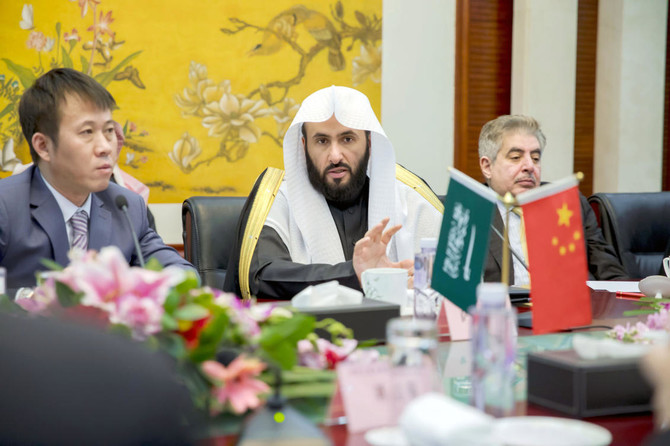
Saudi Justice Minister Walid Al-Samaani, center, speaks during a meeting with Zhang Jun, the Chinese justice minister, left, in Beijing on Tuesday. (SPA)
Updated 10 January 2018
Follow

First visit to China by Saudi justice minister boosts legal ties

JEDDAH: Zhang Jun, the Chinese justice minister, received on Tuesday in Beijing his counterpart Walid Al-Samaani, chairman of the Supreme Judicial Council — the first visit by a Saudi justice minister to China.
The meeting, in the presence of Turki Al-Madhi, the Saudi ambassador to China, was the start of a visit to develop relations and judicial cooperation between the two countries.
Jun welcomed the Saudi justice minister and his entourage, and stressed the development witnessed in Saudi Arabia. He praised discussions for the signing of an agreement for judicial cooperation between the two countries and a new era of collaboration.
Al-Samaani noted that China was one of the most popular countries among Saudi investors, and the trade exchange between the two countries was huge. He said that the judicial agreement was important for enhancing security and assurance in commercial transactions, and for exchanging judicial and legal expertise.
Recent visits by King Salman and Crown Prince Mohammed bin Salman had encouraged a strategic agreement reviving the ancient Silk Road, a symbol of trade between China and the Arabian Peninsula through the ages. This intersected with Vision 2030, which aims to use the Kingdom’s strategic location for economic development and prosperity.
Al-Samaani presented an overview of the Saudi justice system and guarantees complying with internationally recognized fair trial standards.
He explained that adjudication of trade disputes had two tracks. The first track was settlement through the commercial judiciary represented by the Specialized Commercial Court, which was recently assigned in line with the Kingdom’s steps toward improving and expediting the commercial justice system to conform to Vision 2030 projects.
The second track was settlement through commercial arbitration, as the Kingdom had recently established the Saudi Center for Commercial Arbitration, which would enable swift dispute settlement and procedural flexibility and effectiveness.
Al-Samaani said that commercial judicial work was governed by many laws characterized by flexibility, efficiency and constant refining due to the speed and development required in commercial cases since time was important for traders.
“Regarding the enforcement of rulings, the Kingdom has established special courts to enforce various judicial rulings, commercial papers and documents recognized as execution writs under the enforcement code and its executive regulations,” he said. “These courts guarantee swift enforcement and restoration of rights via several methods they are empowered to adopt.”


Arab, Islamic youth explore Saudi heritage, holy sites, progress 

Updated 4 sec ago
Follow

Arab, Islamic youth explore Saudi heritage, holy sites, progress 

  • Participants in Holy Sites Journey program tour Makkah, Madinah, and Jeddah, witnessing world-class pilgrim services

JEDDAH: The 11th Holy Sites Journey Program recently concluded in Jeddah, with more than 114 youth from 33 Arab and Islamic countries participating.

The 10-day program was organized by the Ministry of Sport, in cooperation with the Organization of Islamic Cooperation and the League of Arab States.

Participants traveled across Makkah, Madinah, and Jeddah, exploring sacred sites, performing Umrah, and witnessing the Kingdom’s exemplary Hajj organizational practices.

They also visited historical landmarks, experienced modern sports facilities, and observed urban development projects, gaining insights into Saudi Arabia’s rich heritage, spirituality, and progress.

At a closing event in Jeddah on Thursday, Ahmed Al-Ghamlas, assistant deputy minister of sports for youth affairs, praised the participants and emphasized the Kingdom’s commitment to hosting programs that empower the next generation.

He also encouraged those taking part to serve, on returning to their home countries, as ambassadors conveying the Kingdom’s advancements in services for pilgrims.

Al-Ghamlas added: “The program aimed to strengthen cultural and youth communication between Arab and Islamic countries, highlight the Kingdom's leading role in serving Islam and Muslims, and empower youth by building their capabilities.”

Ambassador Tarig Ali Bakheet, assistant secretary-general for humanitarian, cultural, and social affairs at the Organization of Islamic Cooperation, praised Saudi Arabia's efforts in organizing the program for young people from Arab and Muslim countries, noting it as a step to promote cultural dialogue among youth from Islamic nations.

Participants expressed their appreciation and gratitude for the opportunity to be part of the journey, witness the Kingdom’s transformative projects and world-class facilities, and pledged to share the knowledge, experiences, and insights they gained with peers in their home countries.

Bilal Jabiro, head of the Syrian Ministry of Youth delegation, told Arab News: “It was a great journey, and I enjoyed every minute of it. We sincerely thank Saudi Arabia for giving us this opportunity to strengthen our ties with youth from other Islamic nations and to see firsthand the great services and facilities the Kingdom offers to visitors and pilgrims.”

Youssef Issa Al-Sharifi, a member of the Supreme Council for Algerian Youth, praised the program’s objectives, saying: “Participation is an opportunity for every Arab Muslim.”

Meanwhile, Hussain Saeed from Oman told Arab News that he was happy to see the expansion of the Two Holy Mosques, adding: “It was a very informative and educational journey.”

Syrian influencer Azam Al-Khaldi said the program combined worship, knowledge, and history.

“It was an amazing journey, and I had the pleasure of showing my followers every step of the 10-day program,” he added.