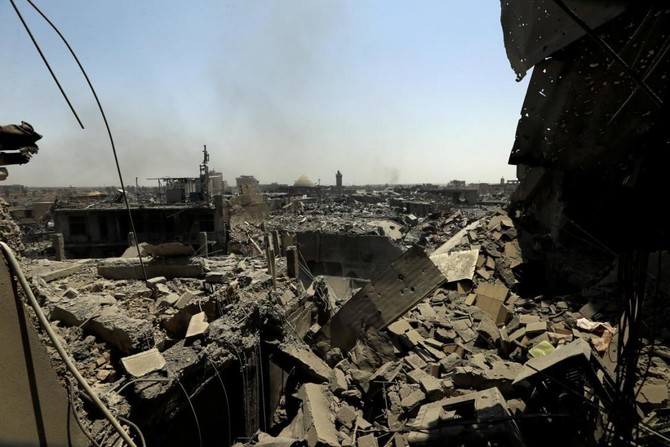
KUWAIT CITY: Kuwait will host an international conference in February on the reconstruction of war-torn Iraq, in cooperation with the World Bank and private companies, it said Monday.
Deputy Foreign Minister Khaled Al-Jarallah said that despite “past wounds” — a reference to Iraq’s 1990 invasion of Kuwait — his country had a “moral, humanitarian and Arab” duty to support its neighbor.
“The stability of Iraq is the stability of Kuwait and the region,” he said.
Iraqi forces have regained swathes of territory from the Daesh group since the jihadists seized a third of Iraq and large parts of Syria in 2014.
In December, Baghdad declared victory over the group following three years of war.
The Kuwait conference, from February 12-14, will devote its second day to the role of the private sector and civil society organizations in reconstruction, Jarallah said.
Mehdi Al-Alaq, the secretary general of Iraq’s Council of Ministers, said Baghdad and the World Bank had estimated reconstruction would cost at least $100 billion (84 billion euros).
“ISIS displaced 5 million people,” he said, speaking alongside Jarallah in Kuwait City.
“We succeeded in returning half to their areas, but we need international support to return the rest of the displaced.”
The International Organization for Migration said last week that by the end of 2017, more than 3.2 million Iraqis had returned home, but 2.6 million remained displaced.
Nearly one third are reported to have returned to houses that have been significantly or completely damaged, it said.
Alaq said heavy damage had also affected oil, electricity, transport, communications and manufacturing infrastructure as well as basic services such as water and sanitation.
Some Iraqis have complained of delays by central authorities in launching reconstruction efforts.
Baghdad has argued that the world “owes” it a program similar to the United States’ multi-billion dollar post-war Marshall Plan for Europe.

Kuwait to host Iraq reconstruction summit
Iran Guards vow ‘stronger’ response than in January if new protests erupt
- The warning comes two weeks into Iran’s war with the United States and Israel
TEHRAN: Iran’s Revolutionary Guards, the ideological arm of the country’s military, warned on Friday that any new protests against the authorities would be met with a stronger response than in January, when several thousand people were killed.
“The evil enemy, failing to achieve its field battle goals, is once again pursuing the instillation of fear and street riots,” the Guards said in a statement broadcast on TV, promising “a stronger blow than on January 8” in the event of new unrest.
The warning comes two weeks into Iran’s war with the United States and Israel in which Israeli Prime Minister Benjamin Netanyahu says one of the aims is to “create, for the Iranian people, the conditions to bring down” the Iranian government.
US President Donald Trump has also called for Iranians to rise up and overthrow their government.
In December, protests against the high cost of living in Iran turned into a broad protest movement against the authorities.
It reached its peak on January 8 with what Iranian authorities called “riots” blamed on “terrorists” working on behalf of Israel and the United States.
The official death toll from Iranian authorities stands at more than 3,000, with the government saying the vast majority were members of security forces or passers-by.
NGOs based abroad have accused the security forces of deliberately firing on demonstrators.
The Human Rights Activists News Agency, based in the United States, says more than 7,000 people were killed.
Iran became an Islamic republic in 1979.
“The evil enemy, failing to achieve its field battle goals, is once again pursuing the instillation of fear and street riots,” the Guards said in a statement broadcast on TV, promising “a stronger blow than on January 8” in the event of new unrest.
The warning comes two weeks into Iran’s war with the United States and Israel in which Israeli Prime Minister Benjamin Netanyahu says one of the aims is to “create, for the Iranian people, the conditions to bring down” the Iranian government.
US President Donald Trump has also called for Iranians to rise up and overthrow their government.
In December, protests against the high cost of living in Iran turned into a broad protest movement against the authorities.
It reached its peak on January 8 with what Iranian authorities called “riots” blamed on “terrorists” working on behalf of Israel and the United States.
The official death toll from Iranian authorities stands at more than 3,000, with the government saying the vast majority were members of security forces or passers-by.
NGOs based abroad have accused the security forces of deliberately firing on demonstrators.
The Human Rights Activists News Agency, based in the United States, says more than 7,000 people were killed.
Iran became an Islamic republic in 1979.
© 2026 SAUDI RESEARCH & PUBLISHING COMPANY, All Rights Reserved And subject to Terms of Use Agreement.