

What’s happening with Iran’s ongoing protests?

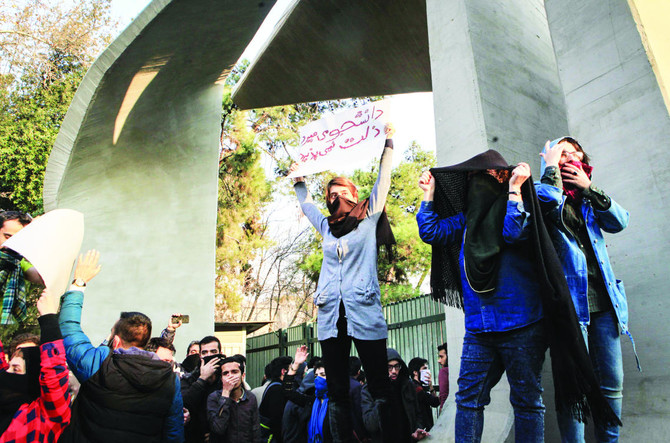
Iranian students stage a protest at the University of Tehran on Dec. 30. (AFP)
Updated 02 January 2018
Follow

What’s happening with Iran’s ongoing protests?

DUBAI: Iran has seen its largest anti-government protests since the disputed presidential election in 2009, with thousands taking to the streets in several cities in recent days.
Travel restrictions and moves by the government to shut down social media networks have limited the ability of journalists to cover the ongoing unrest, which Iranian state television says has killed 12 people.

Here’s what we know so far:

How did the protests start?
The demonstrations began on Thursday in Mashhad, Iran’s second-largest city and the home of a famous shrine. The city is a conservative bastion and a stronghold of Ebrahim Raisi, a cleric who unsuccessfully challenged President Hassan Rouhani in last year’s election. Analysts suggest conservatives began the protests there as a means to pressure Rouhani. The protests then rapidly spread throughout the rest of the country of 80 million people.

What do protesters want?
Demonstrators initially focused on Iran’s flagging economy. Despite now being able to sell oil on the international market after the 2015 nuclear deal, Iran faces rising inflation and high unemployment. A recent increase in egg and poultry prices by as much as 40 percent, which a government spokesman has blamed on a cull over avian flu fears, appears to have sparked the protests. Protesters have chanted against Rouhani as well as Supreme Leader Ayatollah Ali Khamenei. Some have criticized Iran’s military support of Syrian President Bashar Assad, while others have praised the US-backed shah, who fled into exile in 1979 and died of cancer the following year.
Who is leading the protests?
So far, no central leadership has emerged. That’s in contrast to the 2009 Green Movement demonstrations, which protested hard-line President Mahmoud Ahmadinejad’s re-election amid widespread allegations of voter fraud. Those protests, Iran’s biggest since 1979, prompted a crackdown by Iran’s paramilitary Revolutionary Guard and its affiliates that saw thousands detained, dozens killed and others tortured. Its leaders remain under house arrest years later. While leaderless, these new protests have been fanned in part by an exiled journalist named Roohallah Zam using a mobile phone messaging app called Telegram .

How has the regime responded?
Iran says it temporarily shut down access to both Telegram and the photo-sharing app Instagram to “maintain peace,” limiting protesters’ ability to share images and publicize rallies. Facebook and Twitter are already banned. Uniformed and plainclothes police are in the streets, as are motorcycle-riding members of the Basij, a volunteer force under the Revolutionary Guard that helped carry out the 2009 crackdown. Rouhani himself has said Iran allows protests, and authorities often tolerate smaller, limited demonstrations and labor strikes. But Rouhani and other officials have warned that the government won’t hesitate to crack down on those it considers lawbreakers.

Has there been violence?
At least 12 people have been reported killed so far. Iranian state television said on Monday that security forces repelled “armed protesters” who tried to take over police stations and military bases, without elaborating. Pictures published by semi-official Iranian news agencies have shown water cannons being used on protesters in Tehran, as well as damage done by demonstrators to public property. Several hundred people reportedly have been arrested, though police say they’ve released many. Some videos circulated online show protesters welcoming police officers and demonstrating peacefully.
How has the world reacted?
US President Donald Trump has tweeted several times in support of the protests. The State Department has accused Iran’s leaders of turning “a wealthy country with a rich history and culture into an economically depleted rogue state whose chief exports are violence, bloodshed and chaos.” Rouhani has dismissed Trump’s criticisms, while many Iranians remain angry with the American president over his travel bans barring them from getting US visas, as well as his refusal to re-certify the nuclear deal.

Is Iran a democracy?
Elected representatives pass laws and govern on behalf of their constituencies. However, the supreme leader has the final say on all state matters. The Guardian Council, a 12-member panel half selected by the supreme leader and half nominated by the judiciary and approved by parliament, must approve all laws. The council also approves all presidential and parliamentary candidates, barring anyone who challenges the political system itself or advocates dramatic reform. Security forces answering only to the supreme leader, like the Revolutionary Guard, routinely arrest dual nationals and foreigners, using them as pawns in international negotiations.

What will happen next?
Demonstrators have called for more protests in the days ahead. While Rouhani has said the regime allows demonstrations, all so far have been held without police permission, which is illegal. Ultimately, the supreme leader will decide how to respond. As Cliff Kupchan at the Eurasia Group wrote in an analysis on Sunday: “When it comes to the regime’s survival, Khamenei calls the shots. And he’s got a lot of loyal and ruthless troops at his disposal.”


Deaths mount in Gaza as ceasefire frays and key agreements stall

Updated 9 sec ago
Follow

Deaths mount in Gaza as ceasefire frays and key agreements stall

JERUSALEM: As the bodies of two dozen Palestinians killed in Israeli strikes arrived at hospitals in Gaza on Wednesday, the director of one asked a question that has echoed across the war-ravaged territory for months.
“Where is the ceasefire? Where are the mediators?” Shifa Hospital’s Mohamed Abu Selmiya wrote on Facebook.
At least 556 Palestinians have been killed in Israeli strikes since a US-brokered truce came into effect in October, including 24 on Wednesday and 30 on Saturday, according to Gaza’s Health Ministry. Four Israeli soldiers have been killed in Gaza in the same period, with more injured, including a soldier whom the military said was severely wounded when militants opened fire near the ceasefire line in northern Gaza overnight.
Other aspects of the agreement have stalled, including the deployment of an international security force, Hamas’ disarmament and the start of Gaza’s reconstruction. The opening of the Rafah border crossing between Gaza and Egypt raised hope of further progress, but fewer than 50 people were allowed to cross on Monday.
Hostages freed as other issues languish
In October, after months of stalled negotiations, Israel and Hamas accepted a 20-point plan proposed by US President Donald Trump aimed at ending the war unleashed by Hamas’ Oct. 7, 2023, attack into Israel.
At the time, Trump said it would lead to a “Strong, Durable, and Everlasting Peace.”
Hamas freed all the living hostages it still held at the outset of the deal in exchange for thousands of Palestinian prisoners held by Israel and the remains of others.
But the larger issues the agreement sought to address, including the future governance of the strip, were met with reservations, and the US offered no firm timeline.
The return of the remains of hostages meanwhile stretched far beyond the 72-hour timeline outlined in the agreement. Israel recovered the body of the last hostage only last week, after accusing Hamas and other militant groups of violating the ceasefire by failing to return all of the bodies. The militants said they were unable to immediately locate all the remains because of the massive destruction caused by the war — a claim Israel rejected.
The ceasefire also called for an immediate influx of humanitarian aid, including equipment to clear rubble and rehabilitate infrastructure. The United Nations and humanitarian groups say aid deliveries to Gaza’s 2 million Palestinians have fallen short due to customs clearance problems and other delays. COGAT, the Israeli military body overseeing aid to Gaza, has called the UN’s claims “simply a lie.”
Ceasefire holds despite accusations
Violence has sharply declined since the ceasefire paused a war in which more than 71,800 Palestinians have been killed, according to the Gaza Health Ministry. The ministry is part of the Hamas-led government and maintains detailed records seen as generally reliable by UN agencies and independent experts.
Hamas-led militants killed some 1,200 people in the initial October 2023 attack and took around 250 hostage.
Both sides say the agreement is still in effect and use the word “ceasefire” in their communications. But Israel accuses Hamas fighters of operating beyond the truce line splitting Gaza in half, threatening its troops and occasionally opening fire, while Hamas accuses Israeli forces of gunfire and strikes on residential areas far from the line.
Palestinians have called on US and Arab mediators to get Israel to stop carrying out deadly strikes, which often kill civilians. Among those killed on Wednesday were five children, including two babies. Hamas, which accuses Israel of hundreds of violations, called it a “grave circumvention of the ceasefire agreement.”
In a joint statement on Sunday, eight Arab and Muslim countries condemned Israel’s actions since the agreement took effect and urged restraint from all sides “to preserve and sustain the ceasefire.”
Israel says it is responding to daily violations committed by Hamas and acting to protect its troops. “While Hamas’ actions undermine the ceasefire, Israel remains fully committed to upholding it,” the military said in a statement on Wednesday.
“One of the scenarios the (military) has to be ready for is Hamas is using a deception tactic like they did before October 7 and rearming and preparing for an attack when it’s comfortable for them,” said Lt. Col. Nadav Shoshani, a military spokesperson.
Some signs of progress
The return of the remains of the last hostage, the limited opening of the Rafah crossing, and the naming of a Palestinian committee to govern Gaza and oversee its reconstruction showed a willingness to advance the agreement despite the violence.
Last month, US envoy Steve Witkoff, who played a key role in brokering the truce, said it was time for “transitioning from ceasefire to demilitarization, technocratic governance, and reconstruction.”
That will require Israel and Hamas to grapple with major issues on which they have been sharply divided, including whether Israel will fully withdraw from Gaza and Hamas will lay down its arms.
Though political leaders are holding onto the term “ceasefire” and have yet to withdraw from the process, there is growing despair in Gaza.
On Saturday, Atallah Abu Hadaiyed heard explosions in Gaza City during his morning prayers and ran outside to find his cousins lying on the ground as flames curled around them.
“We don’t know if we’re at war or at peace,” he said from a displacement camp, as tarpaulin strips blew off the tent behind him.