Ryanair hit with first ever pilots strike

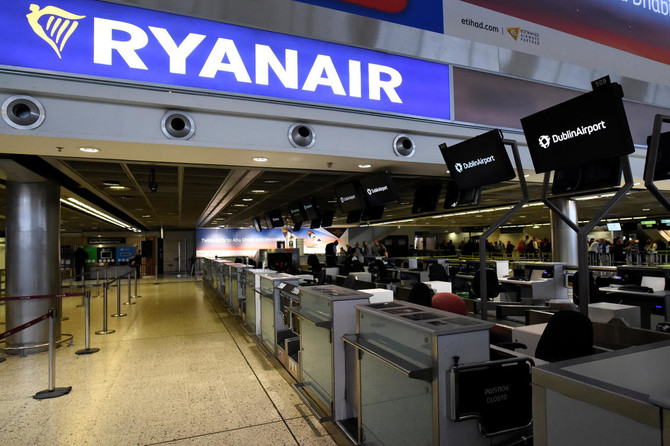
Above, an empty Ryanair check-in section of the departures area is seen at Dublin airport in Dublin. The Irish budget carrier had been seeking to avert a series of threatened strikes across Europe over Christmas last week by giving up its long-held opposition to recognizing unions. (Reuters)
Updated 22 December 2017
Follow

Ryanair hit with first ever pilots strike

BERLIN: Ryanair’s efforts to avert its first ever pilots strike collapsed on Friday as pilots in Germany held a four-hour walkout although airports said there had been little impact on flights.
The Irish budget carrier had sought to avert a series of threatened strikes across Europe over Christmas last week by giving up its long-held opposition to recognizing unions.
However, Germany’s Vereinigung Cockpit (VC) union said it would stage a brief walkout as it did not believe Ryanair was serious about recognizing unions or sincere in talks.
“This was a warning shot and we started small. However, there is potential for much more,” union spokesman Markus Wahl said, ruling out further strikes until after Dec 26.
The strike ran from 0401 GMT to 0759 GMT when only 16 flights were scheduled.
“All in all there are no significant effects,” a spokesman for Berlin airports said, noting that five of seven flights had departed, with one delayed.
Cologne/Bonn airport said two of three scheduled flights had taken off and the third was delayed. Frankfurt airport said four of six scheduled flights had taken off.
Ryanair was not available for immediate comment. Management had urged pilots to work to get passengers home for Christmas.
But the VC union said after a first meeting that it did not believe Ryanair genuinely wanted to recognize unions and said it wanted to send a message that their pilots were serious about industrial action.
VC said Ryanair had refused to accept two members of a delegation that the union nominated to hold talks with management. One of the pilots was a contractor and one a direct employee, but Ryanair has ended both of their contracts, VC said.
“This has shown us that nothing has changed with Ryanair’s management style or how it handles workers’ rights,” VC President Ilja Schulz told reporters on Thursday.
Ryanair pilots mobilized in September after the carrier announced the cancelation of around 20,000 flights, which it blamed on a rostering problem sparked by a change in Irish regulations.


Saudi stock market opens its doors to foreign investors

Updated 06 January 2026
Follow

Saudi stock market opens its doors to foreign investors

RIYADH: Foreigners will be able to invest directly in Saudi Arabia’s stock market from Feb. 1, the Kingdom’s Capital Market Authority has announced.

The CMA’s board has approved a regulatory change which will mean the capital market, across all its segments, will be accessible to investors from around the world for direct participation.

According to a statement, the approved amendments aim to expand and diversify the base of those permitted to invest in the Main Market, thereby supporting investment inflows and enhancing market liquidity.

International investors' ownership in the capital market exceeded SR590 billion ($157.32 billion) by the end of the third quarter of 2025, while international investments in the main market reached approximately SR519 billion during the same period — an annual rise of 4 percent.

“The approved amendments eliminated the concept of the Qualified Foreign Investor in the Main Market, thereby allowing all categories of foreign investors to access the market without the need to meet qualification requirements,” said the CMA, adding: “It also eliminated the regulatory framework governing swap agreements, which were used as an option to enable non-resident foreign investors to obtain economic benefits only from listed securities, and the allowance of direct investment in shares listed on the Main Market.”

In July, the CMA approved measures to simplify the procedures for opening and operating investment accounts for certain categories of investors. These included natural foreign investors residing in one of the Gulf Cooperation Council countries, as well as those who had previously resided in the Kingdom or in any GCC country. 

This step represented an interim phase leading up to the decision announced today, with the aim of increasing confidence among participants in the Main Market and supporting the local economy.

Saudi Arabia, which ‌is more than halfway ‍through an economic plan ‍to reduce its dependence on oil, ‍has been trying to attract foreign investors, including by establishing exchange-traded funds with Asian partners in Japan and Hong Kong.