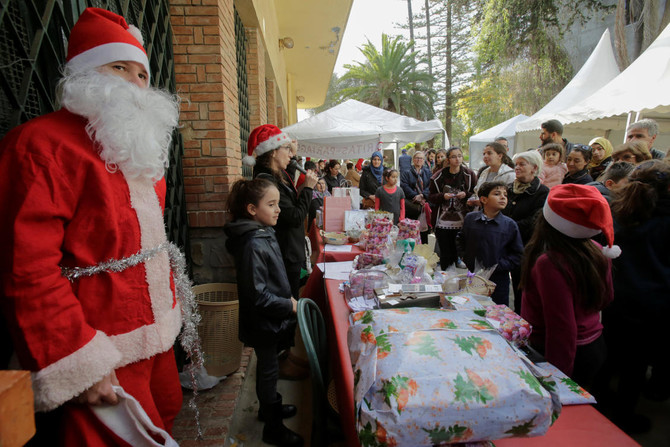
ALGIERS: A small Christmas market has opened in Algeria’s capital, catering to a rising number of Christian African migrants as well as diplomats and locals in the overwhelmingly Muslim country.
Around 99 percent of Algeria’s population is Sunni Muslim but the number of Christians has been rising due to an influx of migrants from sub-Saharan countries such as Mali, Niger and Burkina Faso.
The market, organized by the Caritas charity, is also a sign of stable security in a country that has rebounded from a decade of Islamist militant violence during which 200,000 people died.
Diplomats used to hunker down in fortified embassies, rarely venturing out, but now live alongside Algerians in residential quarters. No militant attack has been reported in Algiers for more than 10 years.
Caritas staged a similar Christmas market last year but kept it low profile. This year it advertised the market in advance, calling for a “living together” between Christians and Muslims.
No official figure is available for the number of African migrants, but some estimates put it at around 100,000.
“It is not about making money, but rather about using the money to help the most vulnerable, whether Algerians, African migrants or Syrians,” Caritas Algeria director Maurice Pilloud said.
Veiled Muslim women mix with foreigners at the market in Algiers’ El Biar district, where honey, chocolate, cakes, jewelry and trinkets are sold. Many donations came from Muslims, said Pilloud.
The market offers the chance for young people to make a contribution to society in a political system where the ruling party has dominated all aspects of the oil-producing North African state since independence in 1962.
“Charitable work remains most attractive for a majority of young Algerians who shun political action because it doesn’t bring change,” said Cherif Lounes, 47, who was visting the market along with his mother.
“We need 50 Caritas associations in Algeria to help the vulnerable, whether Algerians or migrants,” added Saida, his 79-year-old mother.

Christmas market opens in Algerian capital
Producer Zainab Azizi hopes ‘Send Help’ will be a conversation starter
DUBAI: Afghan American film producer Zainab Azizi cannot wait for audiences to experience Sam Raimi’s new horror comedy “Send Help.”
In an interview with Arab News, the president at Raimi Productions kept returning throughout her interview to one central theme: the communal thrill of horror.
“I started watching horror from the age of six years old. So, it’s kind of ingrained in my brain to love it so much,” she said, before describing the formative ritual that still shapes her work: “What I loved about that was the experience of it, us cousins watching it with the lights off, holding hands, and just having a great time. And you know, as an adult, we experience that in the theater as well.”
Asked why she loves producing, Azizi was candid about the mix of creativity and competition that drives her. “I’m very competitive. So, my favorite part is getting the film sold,” she said. “I love developing stories and characters, and script, and my creative side gets really excited about that part, but what I get most excited about is when I bring it out to the marketplace, and then it becomes a bidding war, and that, to me, is when I know I’ve hit a home run.”
Azizi traced the origins of “Send Help” to a 2019 meeting with its writers. “In 2019 I met with the writers, Mark and Damien. I was a fan of their works. I’ve read many of their scripts and watched their films, and we hit it off, and we knew we wanted to make a movie together,” she said.
From their collaboration emerged a pitch built around “the story of Linda Little,” which they developed into “a full feature length pitch,” and then brought to Raimi. “We brought it to Sam Raimi to produce, and he loved it so much that he attached to direct it.”
On working with Raimi, Azizi praised his influence and the dynamic they share. “He is such a creative genius. So, it’s been an incredible mentorship. I learned so much from him,” she said, adding that their collaboration felt balanced: “We balance each other really well, because I have a lot of experience in packaging films and finding filmmakers, so I have a lot of freedom in the types of projects that I get to make.”
When asked what she hopes audiences will take from “Send Help,” Azizi returned to the communal aftermath that first drew her to horror: “I love the experience, the theatrical experience. I think when people watch the film, they take away so many different things. ... what I love from my experience on this film is, especially during test screenings, is after the film ... people are still thinking about it. Everybody has different opinions and outlooks on it. And I love that conversation piece of the film.”