Algeria stops almost 300 would-be migrants at sea

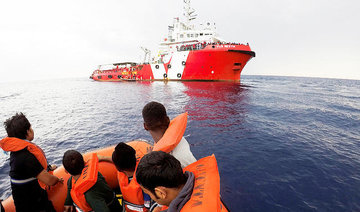
A migrant tries to board a boat of the German NGO Sea-Watch in the Mediterranean Sea on November 6, 2017. Algeria's coast guard has picked up 286 illegal migrants heading across the Mediterranean to Europe by boat, the Defense Ministry said on Sunday, Nov. 19, 2017. (AFP / Alessio Paduano)
Updated 19 November 2017
Follow

Algeria stops almost 300 would-be migrants at sea

ALGIERS: Algeria’s coast guard has intercepted almost 300 Algerians off the North African nation’s coast as they tried to reach Europe on several boats, the Defense Ministry said.
From Thursday to Saturday, the coast guard “intercepted and rescued a total of 286 Algerian citizens” attempting the perilous crossing on flimsy vessels, it said in a statement.
Media reports said 200 of the Algerians were stopped at sea off the western coastal city of Oran.
A 2009 law provides for up to six months in jail for those who attempt to leave the Algerian territory illegally. People smugglers can face up to 20 years in jail, according to the law. But the law has done little to deter would-be migrants.
According to press reports, the Italian coast guard stopped 165 Algerian migrants to the south of Sardinia in late September.
Apart from the migrant crisis, the country is also facing a growing threat from radical elements in the region.
On Wednesday, Algerian Foreign Minister Abdelkader Messahel said that North Africa is under threat from foreign fighters escaping Daesh’s defeats in Iraq and Syria.
Messahel spoke at a news conference in Cairo after a meeting with his Egyptian and Tunisian counterparts, Sameh Shoukry and Khemaies Jhinaoui, over Libya.
“The region is threatened... with the return of foreign fighters,” said Messahel. “The signs and reports say the return will be in our region.”
The ministers also met to discuss Libya in February in Tunisia and again in June in Algeria, as the three countries push for a solution in Libya.
The priority is “preserving Libya’s unity and stability and territorial integrity, and maintaining dialogue and Libyan political agreement as the sole basis for settling the Libyan crisis,” Egypt’s Foreign Ministry said in a statement.
Libya has been rocked by chaos since the 2011 fall and killing of former Muammar Qaddafi, with rival administrations and militias vying for power.
Militants, arms dealers and people traffickers have since taken advantage of the chaos to gain a foothold in the oil-rich North African country.
“What is happening in Libya threatens its security and stability and it has become a refuge for a number of terrorist groups,” Tunisia’s Jhinaoui said.


Hamas to hold leadership elections in coming months: sources

Updated 13 January 2026
Follow

Hamas to hold leadership elections in coming months: sources

  • A Hamas member in Gaza said Hayya is a strong contender due to his relations with other Palestinian factions, including rival Fatah, which dominates the Palestinian Authority, as well as his regional standing

GAZA CITY, Palestinian Territories: Hamas is preparing to hold internal elections to rebuild its leadership following Israel’s killing of several of the group’s top figures during the war in Gaza, sources in the movement said on Monday.
“Internal preparations are still ongoing in order to hold the elections at the appropriate time in areas where conditions on the ground allow it,” a Hamas leader told AFP.
The vote is expected to take place “in the first months of 2026.”
Much of the group’s top leadership has been decimated during the war, which was sparked by Hamas’s unprecedented attack on Israel in October 2023.
The war has also devastated the Gaza Strip, leaving its more than two million residents in dire humanitarian conditions.
The leadership renewal process includes the formation of a new 50-member Shoura Council, a consultative body dominated by religious figures.
Its members are selected every four years by Hamas’ three branches: the Gaza Strip, the occupied West Bank and the movement’s external leadership.
Hamas prisoners in Israeli prisons are also eligible to vote.
During previous elections, held before the war, members across Gaza and the West Bank used to gather at different locations including mosques to choose the Shoura Council.
That council is responsible, every four years, for electing the 18-member political bureau and its chief, who serves as Hamas’s overall leader.
Another Hamas source close to the process said the timing of the political bureau elections remains uncertain “given the circumstances our people are going through.”
After Israel killed former Hamas chief Ismail Haniyeh in Tehran in July 2024, the group chose its then-Gaza chief Yahya Sinwar as his successor.
Israel accused Sinwar of masterminding the October 7 attack.
He too was killed by Israeli forces in the southern Gaza city of Rafah, three months after Haniyeh’s assassination.
Hamas then opted for an interim five-member leadership committee based in Qatar, postponing the appointment of a single leader until elections are held and given the risk of being targeted by Israel.
According to sources, two figures have now emerged as frontrunners to be the head of the political bureau: Khalil Al-Hayya and Khaled Meshaal.
Hayya, 65, a Gaza native and Hamas’s chief negotiator in ceasefire talks, has held senior roles since at least 2006, according to the US-based NGO the Counter-Extremism Project (CEP).
Meshaal, who led the Political Bureau from 2004 to 2017, has never lived in Gaza. He was born in the West Bank in 1956.
He joined Hamas in Kuwait and later lived in Jordan, Syria and Qatar. The CEP says he oversaw Hamas’s evolution into a political-military hybrid.
He currently heads the movement’s diaspora office.
A Hamas member in Gaza said Hayya is a strong contender due to his relations with other Palestinian factions, including rival Fatah, which dominates the Palestinian Authority, as well as his regional standing.
Hayya also enjoys backing from both the Shoura Council and Hamas’s military wing, the Ezzedine Al-Qassam Brigades.
Another source said other potential candidates include West Bank Hamas leader Zaher Jabarin and Shoura Council head Nizar Awadallah.