

Philippine forces on alert after clash with communist rebels

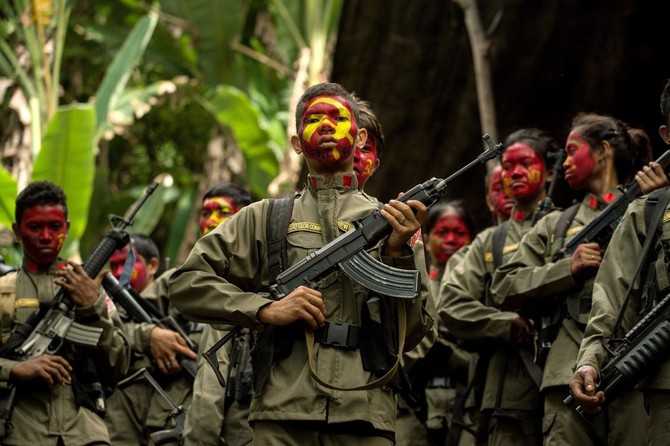
This file photo taken on July 30, 2017 shows guerrillas of the New People’s Army (NPA) in formation in the Sierra Madre mountain range, located east of Manila. (AFP)
Updated 29 November 2017
Follow

Philippine forces on alert after clash with communist rebels

MANILA: Philippine security forces claim to have thwarted a major attack by communist insurgents following clashes that left 14 New People’s Army (NPA) guerillas dead in Nasugbu, Batangas province, south of the country’s capital, on Tuesday night.

The clashes erupted after President Rodrigo Duterte scrapped peace negotiations with the National Democratic Front — Communist Party of the Philippines — New People’s Army (NDF-CPP-NPA) rebels.

Brig. Gen. Arnulfo Burgos, Jr., commander of the 202nd Infantry Brigade, told Arab News the rebels were in full battle gear with bandoliers and high-powered firearms, which — he claimed — meant they were “up to something.”

“They were going to conduct a major tactical offensive, which we were able to preempt,” he said.

Burgos noted that “if (the rebels) use civilian vehicles for administrative movement, usually they hide their weapons and will not wear bandoliers. Last night, they were even the first to fire at our troops which means they were ready.”

According to a Nasugbu police report, the first encounter took place around 8:30 p.m. when government forces patrolling the Sitio Pinamantasan checkpoint received information about the presence of armed men in the area.

They were able to intercept a jeep and a van, but the rebels opened fire. A gun battle ensued, resulting in the death of five communist rebels and the wounding of two others.

Government forces chased the NPA guerillas and engaged them roughly 2 km away from the site of the first clash. The second encounter left another nine Maoist rebels dead.

Twelve high-powered firearms were recovered from the rebels. The wounded NPA fighters were taken to hospital. Five soldiers, including two officers, were also injured in the clashes.

The military said the rebels are believed to be members of the same NPA group that suffered heavy casualties during an encounter with soldiers in September.

Burgos said that after the president ended talks with the rebels, the military leadership directed all units on the ground to intensify military operations against the rebels. He added, though, that security forces in the region had already stepped up their counter-insurgency operations to put an end to the NPA’s extortion activities and preempt any hostile actions by the communist group.

Maj. Gen. Rhoderick Parayno, commander of the Army’s 2nd Infantry Division, meanwhile, said “all available assets, including aircraft, are on red alert.”

Arsenio Andolong, Department of National Defense (DND) spokesperson, said the NPA attacks were significant for many reasons.

“It is now evident that, from the onset of the peace talks, they never had any intention of being part of a peaceful resolution to the decades-long conflict with the Philippine government,” he told Arab News.

Partly, he added, this is because the rebels have realized “they have become irrelevant” in the reforms currently underway in the Philippines.

He also warned that the rebels often “step up their terroristic activities” around December 26, the date on which the CPP was founded in 1968.


 

Indonesia sets rules limiting use of AI for schoolchildren

Updated 4 sec ago
Follow

Indonesia sets rules limiting use of AI for schoolchildren

  • Indonesian children spend about 7.5 hours daily on tablets, smartphones
  • Gen Zs make up the majority of AI users in the country of 280m people

JAKARTA: The Indonesian government introduced on Thursday a new policy regulating the use of digital technology in education, limiting access to artificial intelligence for students.

Generation Alphas and Gen Zs make up almost half of Indonesia’s online population, which reached nearly 230 million people in 2025, according to a survey conducted by the Association of Indonesian Internet Service Providers.

As Indonesian children clock around 7.5 hours of daily screen time, the joint ministerial decree seeks to boost the benefits of digital technology and AI in formal and informal educational institutions, while also protecting the youth from risks in digital spaces.

“There are a lot of factors but the number of teenagers with mental health issues are high and continue to increase, and one of the suspected triggers — that have been proven academically — is the uncontrolled, unmitigated use of digital technology,” said Pratikno, Indonesia’s Coordinating Minister for Human Development and Cultural Affairs.

“The effects on education are also concerning, such as how it weakens brain activity due to dependence on digital technology tools and reduces critical thinking and cognitive and reflective abilities. This is what we have to regulate.”

Among Indonesia’s 280 million population, around a quarter of internet users are already using AI, with Gen Zs making up about 43 percent of that segment.

The joint decree, which Pratikno described as “comprehensive” and encompasses early childhood education to higher education, was signed in Jakarta by seven ministers, including Higher Education, Science and Technology Minister Brian Yuliarto and Primary and Secondary Education Minister Abdul Mu’ti.

“This decree seeks to ensure that our children are not controlled by technology but become the masters of technology for good, that is our goal. (It prioritizes) digital wellness, (for tech to be used) wisely and intelligently,” Pratikno said.

The policy is important to support young Indonesians, many of whom are internet users from adolescence, said Communication and Digital Affairs Minister Meutya Hafid, who also signed the ministerial decree.

“Indonesia has a significant number of children using the internet. Therefore, we must ensure that they are not only a target market for the technology industry, but also able to utilize technology according to their readiness,” she said.

“Every kind of technological advance has to consider the readiness of its users, especially children.”