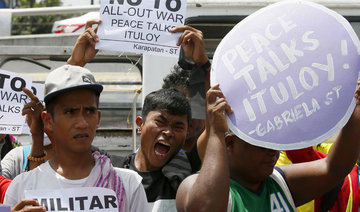
MANILA: Philippine President Rodrigo Duterte said on Friday he has terminated intermittent peace talks with Maoist-led rebels and would consider them “terrorists” because hostilities had continued during negotiations.
Ending the nearly half-century long conflict with the communists, in which more than 40,000 people have been killed, was among Duterte’s priorities when he took office in June last year.
Duterte said he would consider the political arm of the Maoists a “terrorist group” and was demanding that dozens of rebel leaders he freed last year in order to restart talks turn themselves in.
“I am ordering those I have released temporarily to surrender or face again punitive action,” Duterte in a speech to soldiers.
“Let it not be said that I did not try to reach out to them,” he said.
Duterte on Thursday signed a proclamation ending the peace talks, which started in August last year and were brokered by Norway. Talks have been intermittent since 1986.
“We find it unfortunate that their members have failed to show their sincerity and commitment in pursuing genuine and meaningful peaceful negotiations,” Duterte’s spokesman, Harry Roque, said in a statement late on Thursday.
In May, government negotiators canceled a round of formal talks with the Maoist-led rebels in the Netherlands as the guerrillas stepped up attacks in the countryside.
The rebels had no choice but to intensify guerrilla warfare in rural areas, Jose Maria Sison, chief political consultant of the National Democratic Front of the Philippines (NDF), said in a statement.
The NDF, the political arm of the Maoist guerrillas, said it regretted the unilateral cancelation of talks on such vital social and economic reforms.
Government troops were advised to stay alert on the movements of the estimated 3,800 leftist guerrillas, said military spokesman Maj. Gen. Restituto Padilla.
Government forces are also battling Islamist fighters in the south of the largely Christian country, some of whom recently occupied a town for several months in the biggest battle in the Philippines since World War Two.

Philippines’ Duterte terminates peace process with Maoist rebels
Top Australian writers’ festival canceled after Palestinian author barred
SYDNEY: One of Australia’s top writers’ festivals was canceled on Tuesday, after 180 authors boycotted the event and its director resigned saying she could not be party to silencing a Palestinian author and warned moves to ban protests and slogans after the Bondi Beach mass shooting threatened free speech.
Louise Adler, the Jewish daughter of Holocaust survivors, said on Tuesday she was quitting her role at the Adelaide Writers’ Week in February, following a decision by the festival’s board to disinvite a Palestinian-Australian author.
The novelist and academic Randa Abdel-Fattah said the move to bar her was “a blatant and shameless act of anti-Palestinian racism and censorship.”
Prime Minister Anthony Albanese on Tuesday announced a national day of mourning would be held on January 22 to remember the 15 people killed in last month’s shooting at a Jewish Hanukkah celebration on Bondi Beach.
Police say the alleged gunmen were inspired by the Islamic State militant group, and the incident sparked nationwide calls to tackle antisemitism, and prompted state and federal government moves to tighten hate speech laws.
The Adelaide Festival board said on Tuesday its decision last week to disinvite Abdel-Fattah, on the grounds it would not be culturally sensitive for her to appear at the literary event “so soon after Bondi,” was made “out of respect for a community experiencing the pain from a devastating event.”
“Instead, this decision has created more division and for that we express our sincere apologies,” the board said in a statement.
The event would not go ahead and remaining board members will step down, it added.
Former New Zealand Prime Minister Jacinda Ardern, British author Zadie Smith, Australian author Kathy Lette, Pulitzer Prize-winning American Percival Everett and former Greek finance minister Yanis Varoufakis are among the authors who said they would no longer appear at the festival in South Australia state, Australian media reported.
The festival board on Tuesday apologized to Abdel-Fattah for “how the decision was represented.”
“This is not about identity or dissent but rather a continuing rapid shift in the national discourse around the breadth of freedom of expression in our nation following Australia’s worst terror attack in history,” it added.
Abdel-Fattah wrote on social media that she did not accept the apology, saying she had nothing to do with the Bondi attack, “nor did any Palestinian.”
Adler earlier wrote in The Guardian that the board’s decision to disinvite Abdel-Fattah “weakens freedom of speech and is the harbinger of a less free nation, where lobbying and political pressure determine who gets to speak and who doesn’t.”
The South Australian state government has appointed a new festival board.