Slovak PM shooting suspect named as 71-year-old writer; aides say Fico now out of danger

1 / 3
Rescue workers take Slovak Prime Minister Robert Fico, who was shot and injured, to a hospital in the town of Banska Bystrica, central Slovakia, onMay 15, 2024. (TASR via AP)
2 / 3
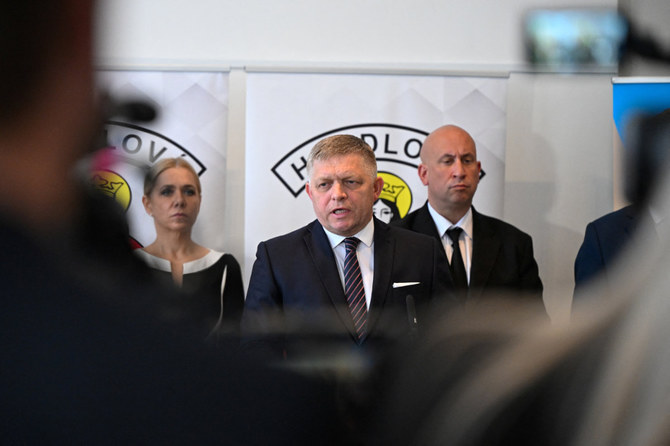
Slovak Prime Minister Robert Fico speaks during a press conference, before a shooting incident where he was wounded, in Handlova, Slovakia, on May 15, 2024. (REUTERS)
3 / 3
Slovak Defense Minister Robert Kalinak, flanked by Interior Minister Matus Sutaj Estok, reacts during a press conference at F.D. Roosevelt University Hospital, where Slovak Prime Minister Robert Fico was taken after he was wounded in a shooting incident in Handlova, in Banska Bystrica, Slovakia, on May 15, 2024. (REUTERS)
Short Url
Updated 16 May 2024
Follow

Slovak PM shooting suspect named as 71-year-old writer; aides say Fico now out of danger

  • The assassination attempt happened while Fico visited the central Slovak town of Handlova
  • Slovak media say the suspect is the founder of the DUHA (Rainbow) Literary Club and was from the town of Levice
  • The attack comes as political campaigning heats up three weeks ahead of Europe-wide elections to choose lawmakers for the European Parliament

BRATISLAVA: A suspect detained for shooting Slovakia Prime Minister Robert Fico is a 71-year-old writer from the center of the European nation, the interior minister said Wednesday, after media identified the man.
“I think I can confirm this, yes,” Interior Minister Matus Sutaj Estok told reporters when asked about reports identifying the man detained at the scene of the shooting in the town of Handlova.

A grey haired suspect was seen being handcuffed on the ground just after Fico was shot several times after a government meeting in Handlova.

The populist prime minister was shot multiple times and gravely wounded Wednesday, but his deputy prime minister said he believed Fico would survive.
The prime minister had been greeting supporters at an event when the attempted assassination took place, shocking the small country and reverberating across Europe weeks before an election.
“I guess in the end he will survive,” Tomas Taraba told the BBC, adding: “He’s not in a life threatening situation at this moment.”

Doctors fought for Fico’s life several hours after the pro-Russian leader, 59, was hit in the abdomen, Defense Minister Robert Kalina told reporters at the hospital where Fico was being treated.”
Five shots were fired outside a cultural center in the town of Handlova, nearly 140 kilometers (85 miles) northeast of the capital, government officials said. Fico was shot while attending a meeting of his government in the town of 16,000 that was once a center of coal mining.
A suspect was in custody, and an initial investigation found “a clear political motivation” behind the assassination attempt, Interior Minister Matus Sutaj Estok said as he briefed reporters alongside the defense minister.

Media reports said the suspect was a founder of the DUHA (Rainbow) Literary Club and was from the town of Levice.
The reports, which also named him, said he has written three poetry collections and is a member of the official Association of Slovak Writers.
The association confirmed on Facebook that the man had been a member since 2015, adding that if his identity as the suspected shooter was confirmed “the membership of this despicable person will be immediately canceled.”
The suspect’s son told Slovak news site aktuality.sk that he had “absolutely no idea what father was thinking, what he was planning, why it happened.”
He said his father was a legally registered gun owner.
When asked if he felt any hatred toward Fico, the son said: “I’ll tell you this: he didn’t vote for him. That’s all I can say about it.”
Vlasta Kollarova, head of a local library in the man’s hometown told Dennik N daily: “He was rebellious when he was young, but not aggressive.”
Several political statements by the man, who AFP has chosen not to name, could be found on social media.
“The world is full of violence and weapons. People seem to be going crazy,” he said in a video eight years ago posted online.
In the video, he also spoke about concern over immigration and “hatred and extremism” and said European governments “have no alternative to this chaos.”
He also said in the video that he had founded a “Movement Against Violence” in Levice.
The movement, which also has its Facebook page, defines itself as “an emerging political party whose goal is to prevent the spread of violence in society. To prevent war in Europe and the spread of hatred.”

Divisive figure

Fico has long been a divisive figure in Slovakia and beyond, but his return to power last year on a pro-Russian, anti-American message led to even greater worries among fellow European Union members that he would lead his country further from the Western mainstream.
Kicking off his fourth term as prime minister, his government halted arms deliveries to Ukraine, and critics worry that he will lead Slovakia — a nation of 5.4 million that belongs to NATO — to abandon its pro-Western course and follow in the footsteps of Hungary under populist Prime Minister Viktor Orbán.
Thousands have repeatedly rallied in the capital and across Slovakia to protest Fico’s policies.
A message posted to Fico’s Facebook account said he was taken to a hospital in Banská Bystrica, 29 kilometers (17 miles) from Handlova, because it would take too long to get to the capital, Bratislava.
The attack comes as political campaigning heats up three weeks ahead of Europe-wide elections to choose lawmakers for the European Parliament. Concern is mounting that populist and nationalists similar to Fico could make gains in the 27-member bloc.
But politics as usual were put aside as the nation faced the shock of the attempt on Fico’s life.
“A physical attack on the prime minister is, first of all, an attack on a person, but it is also an attack on democracy,” outgoing President Zuzana Caputova, a political rival of Fico, said in a televised statement. “Any violence is unacceptable. The hateful rhetoric we’ve been witnessing in society leads to hateful actions. Please, let’s stop it.”
President-elect Peter Pellegrini, an ally of Fico, called the shooting “an unprecedented threat to Slovak democracy. If we express other political opinions with pistols in squares, and not in polling stations, we are jeopardizing everything that we have built together over 31 years of Slovak sovereignty.”
The recent elections that brought Fico and his allies to power have underlined deep social divisions, exacerbated by the war in Ukraine, Slovakia’s neighbor to the east.
Gábor Czímer, a political journalist at Slovakian news outlet Ujszo.com, said Fico’s return to power had uncovered signs that “Slovak society is strongly split into two camps” — one that is friendly toward Russia and another that pushes for stronger connections with the EU and the West.
“At the same time, I couldn’t imagine that it would lead to physical violence,” Czímer said.
Estok, the Slovak interior minister, told reporters outside the hospital that the country was “on the edge of a civil war” from the political tension.
“Such hateful comments are being made on social networks today, so please, let’s stop this immediately,” he said.
US President Joe Biden said he was alarmed by the assassination attempt. “We condemn this horrific act of violence,” he said in a statement.
NATO Secretary-General Jens Stoltenberg posted on the social media platform X that he was “shocked and appalled” by the attempt on Fico’s life. European Commission President Ursula von der Leyen called it a “vile attack.”
Ukrainian President Volodymyr Zelensky denounced the violence against a neighboring country’s head of government.
“Every effort should be made to ensure that violence does not become the norm in any country, form or sphere,” he said.
Slovakia’s Parliament was adjourned until further notice. The major opposition parties, Progressive Slovakia and Freedom and Solidarity, canceled a planned protest against a controversial government plan to overhaul public broadcasting that they say would give the government full control of public radio and television.
Progressive Slovakia leader Michal Simecka called on all politicians “to refrain from any expressions and steps which could contribute to further increasing the tension.”
Czech Prime Minister Petr Fiala wished the premier a swift recovery. “We cannot tolerate violence, there’s no place for it in society.”
The Czech Republic and Slovakia formed Czechoslovakia until 1992.


Zelensky reaffirms his refusal to cede land to Russia as he rallies European support

Updated 4 sec ago
Follow

Zelensky reaffirms his refusal to cede land to Russia as he rallies European support

  • “Undoubtedly, Russia insists for us to give up territories. We, clearly, don’t want to give up anything. That’s what we are fighting for,” Zelensky says

ROME: Ukrainian President Volodymyr Zelensky has reaffirmed his strong refusal to cede any territory, resisting US pressure for painful concessions to Russia as he moved ahead Tuesday to rally more European support for his country.
“Undoubtedly, Russia insists for us to give up territories. We, clearly, don’t want to give up anything. That’s what we are fighting for,” Zelensky told reporters in a WhatsApp chat late Monday.
“Do we consider ceding any territories? According to the law we don’t have such right,” he said. “According to Ukraine’s law, our constitution, international law, and to be frank, we don’t have a moral right either.”
In an interview with Politico released Tuesday, US President Donald Trump pressed Zelensky to accept the US proposal that Ukraine cede territory to Russia, arguing Moscow has the “upper hand” in its nearly 4-year-old invasion, and that Zelensky’s government must “play ball.”
Zelensky met in Rome with Italian Premier Giorgia Meloni, discussing the progress of the peace process, her office said. They emphasized the importance of US and European unity and of solutions “that will have repercussions on the continent’s security,” the statement said.
They also discussed “developing robust security guarantees to prevent future aggression and maintaining pressure on Russia to join the negotiating table in good faith,” it said.
Earlier, Zelensky met with Pope Leo XIV at Castel Gandolfo, a papal residence outside Rome. The Vatican said Leo reiterated the need for continuing dialogue and “expressed his urgent desire that the current diplomatic initiatives bring about a just and lasting peace.”
The Holy See has tried to stay neutral in the war while offering solidarity and assistance to what it calls the “martyred” people of Ukraine. Leo has met three times with Zelensky and has spoken by telephone at least once with Russian President Vladimir Putin, calling for a ceasefire and urging Moscow to make gestures promoting peace.
On Monday, Zelensky held talks in London with British Prime Minister Keir Starmer, French President Emmanuel Macron and German Chancellor Friedrich Merz to strengthen Ukraine’s hand amid mounting impatience from Trump.
Ukraine faces US pressure
US and Ukrainian negotiators completed three days of talks Saturday aimed at trying to narrow differences on the Trump administration’s peace proposal.
A major sticking point is the suggestion that Kyiv must give up control of the Donbas region of eastern Ukraine to Russia, which occupies most but not all of the territory. Ukraine and its European allies firmly resist the idea of handing over land.
“You know, a lot of people are dying,” Trump told Politico on Monday, claiming that other Ukrainian officials that he identified only as Zelensky’s “lieutenants, his top people” agree with the US administration.
Other than Zelensky’s comments Monday, Ukrainian negotiators have said little in public about the content of the US proposal or their attitude toward it.
Speaking to reporters again Tuesday on WhatsApp, Zelensky said three documents were being discussed with American and European partners — a 20-point framework document that is constantly changing, a document on security guarantees and a document about Ukraine’s recovery.
Zelensky told reporters that Ukraine’s updated version of the proposal would be given to the US on Wednesday.
Russia, Trump said, is too powerful for Ukraine to continue fighting.
“I give the people of Ukraine and the military of Ukraine tremendous credit for the, you know, bravery and for the fighting and all of that,” he said. “But you know, at some point, size will win, generally.”
Trump also repeated his call for Ukraine to hold a presidential election even though martial law doesn’t allow it and Zelensky, elected in 2019, had his five-year term extended because of the war. Trump’s position on Ukraine’s failure to hold an election mirrors frequent statements on the subject by Putin.
Responding to Trump’s remarks, Zelensky asked for help from the US and possibly Europe “to ensure security for the elections” and suggested that Ukraine could be ready to hold balloting in 60 to 90 days.
In past comments, Zelensky has declined to hold elections until a ceasefire is declared and martial law lifted, and Ukrainians have largely supported that decision.
European leaders repeat support for Kyiv
Starmer, Macron and Merz strongly backed Kyiv, with the UK leader saying Monday that the push for peace was at a “critical stage” and stressing the need for “a just and lasting ceasefire.”
Merz, meanwhile, said he was “skeptical” about some details in documents released by the US “We have to talk about it. That’s why we are here,” he said. “The coming days … could be a decisive time for all of us.”
European leaders are working to ensure that any ceasefire is backed by solid security guarantees both from Europe and the US to deter Russia from attacking again. Trump has not given explicit guarantees in public.
Zelensky and his European allies have repeatedly accused Putin of slow-walking the talks to press ahead with the invasion.
Both sides exchange aerial strikes
Ukraine’s air force said Russia fired 110 drones across the country overnight. While air defenses neutralized 84 drones, 24 more struck their targets.
Several regions of Ukraine faced emergency blackouts Tuesday due to Russian attacks on energy infrastructure, according to Ukraine’s national energy operator, Ukrenergo.
UN deputy humanitarian chief Joyce Msuya said Tuesday only 65 percent of the $278 million required to fund a winter response plan in Ukraine has been received, forcing cuts to services like cash assistance, heating support, mental health care and protection for women and girls.
This means families are facing freezing temperatures without heating, women and girls are losing access to “safe spaces” and older people in front-line areas are left without the means to evacuate, she told the UN Security Council.
The UK Defense Ministry said a member of the British military died Tuesday of his injuries from an accident while observing Ukrainian troops test a defensive system away from the front lines — the first UK servicemember to die in Ukraine in the war. It was not immediately clear what role he was serving or where the accident occurred.
The UK military has said a small of number of personnel are in Ukraine to protect British diplomats and support Ukrainian troops.
Ukraine also continued its drone attacks on Russia.
Russia said it destroyed 121 drones in various regions and in the Crimean Peninsula, which Moscow illegally annexed from Ukraine in 2014. In Chuvashia, a region about 900 kilometers (about 560 miles) northeast of the Ukrainian border, an attack damaged residential buildings and injured nine people, Gov. Oleg Nikolayev said.
Ukraine’s Security Service carried out a drone attack on a liquefied gas terminal at the port of Temryuk in Russia’s Krasnodar region on Dec. 5, according to an official with knowledge of the operation who spoke to The Associated Press.
The official, who spoke on condition of anonymity because he was not authorized to comment publicly, said the strike sparked a fire at the facility, with more than 20 storage tanks set ablaze for over three days.