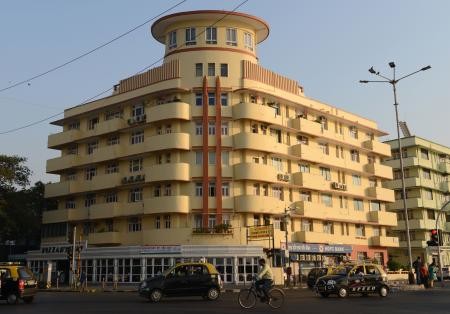
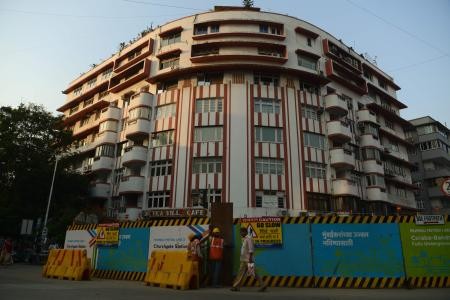
MUMBAI: The seafront is lined with brightly colored buildings boasting curved corners, stylish balconies and exotic motifs but this isn’t Miami’s famous Art Deco district — it’s Mumbai.
Bombay, as the Indian city was formerly called, is known more for its Victorian Gothic edifices than the sleeker architectural designs that swept Europe and America during the 1920s and ‘30s.
But now, a group of enthusiasts are making Mumbai’s hundreds of Deco structures, which include residential properties, commercial offices, cinemas and even hospitals, as famous as their 19th century counterparts.
The ambitious Art Deco Mumbai project aims to document every single one and educate residents about the buildings’ origins to ensure the “style moderne” architectural legacy of India’s financial capital is preserved.
“Bombay has one of the largest collections of Art Deco buildings in the world. It’s an incredible heritage,” Atul Kumar, keen conservationist and founder of Art Deco Mumbai, tells AFP.
Palm trees blow gently along the three-kilometer Marine Drive promenade where Soona Mahal, a symmetrical, yellow-painted building with orange vertical lines and elaborate turret, sits proudly on the street corner.
“It’s an iconic building that looks like a ship pushing through waves,” says 70-year-old Mehernosh Sidhwa proudly. He is the third generation of his family to live in it after his grandfather had it built in 1937.
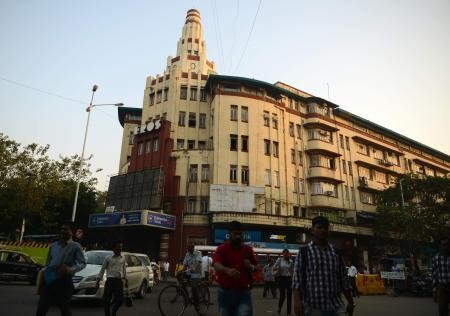
Around the corner, five-story buildings sporting elegant Deco fonts, marble floors and spiral staircases line the Oval Maidan playing field while nearby are the popular Eros and Regal cinemas.
The areas make up the heart of Mumbai’s Art Deco precinct which in 2012 was submitted to UNESCO for world heritage recognition. A short distance up the coast is Breach Candy hospital, also in Deco style.
“There’s an interesting amalgamation of classical European Art Deco and Bombay Deco. You have ziggurats, rounded locomotive balconies, tropical images, streamlining, speed lines and Egyptian motifs as well as Indian designs,” enthuses Kumar.
The buildings were constructed between the early 1930s and early 1950s after wealthy Indians sent their architects to Europe to come up with modern designs different to those of their colonial rulers.
They visited as Deco was taking the West by storm following the 1925 Paris exposition.
“Mumbai’s Deco buildings have always lived in the shadow of the Victorian Gothic structures built by the British,” such as the main railway station, museum and high court, says Kumar.
“But Art Deco is no less. It’s a colorful, vibrant, free, sophisticated style that represented the aspirations of a whole new class. India was under oppressive colonial rule and this was a very unique statement through architecture.”
Tour guides are fond of telling foreign visitors to Mumbai that only Miami has more Deco structures internationally. Local legend says the coastal Indian city has 200 such buildings.
Kumar and his small team, which is not-for-profit, are working hard to come up with a precise tally for the first time by documenting the entire city and adding all the Deco buildings to a Google map on their website.
“We want to establish the accurate number and therefore position Bombay’s relevance correctly across the world,” explains Kumar, who says they’ve already counted 136 in 18 months, with several neighborhoods left to investigate.
“It’s definitely going to be way more than 200,” adds the finance professional confidently, before cautiously speculating that the final number could be around 300.
The team talk to owners to establish which structures are Deco. They record building and architect names, dates of construction, coordinates and Deco features.
Key specifics and photos are then uploaded to an inventory on www.artdecomumbai.com. Images with captions are also published on Twitter and Instagram.
“We have 100 percent accuracy. If we are doubtful then we don’t include the building,” says Kumar, who also organizes walking tours to spread the word.
He laments that a lack of awareness has led many Deco buildings to be demolished or compromised by alterations. Property developers offering lucrative sums to replace them with luxury apartments have also caused destruction.
“Ultimately our objective is to conserve this tremendous collection. As we talk to people they become fiercely proud and that translates into a desire to preserve,” concludes Kumar.


![]()
![]()
![]()
![]()

India’s ‘Miami:’ Putting Mumbai’s Art Deco on the map
India’s ‘Miami:’ Putting Mumbai’s Art Deco on the map

Latest updates


© 2026 SAUDI RESEARCH & PUBLISHING COMPANY, All Rights Reserved And subject to Terms of Use Agreement.