A symbol of the Palestinian cause: Artists pay tribute to Naji Al-Ali

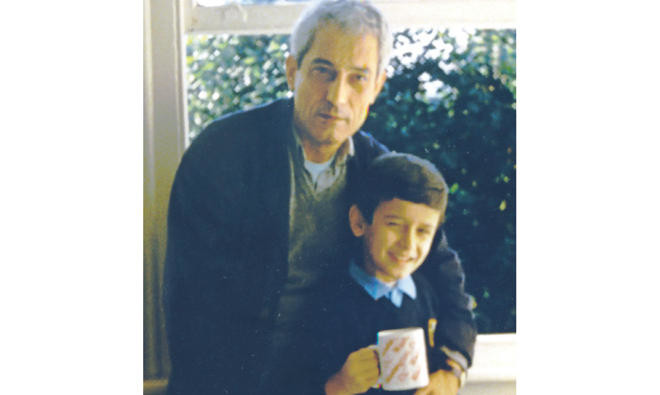
Naji Al-Ali with his youngest son Osama in London in 1986.
Updated 28 October 2017
Follow

A symbol of the Palestinian cause: Artists pay tribute to Naji Al-Ali

LONDON: The incisive pen strokes of cartoonist Naji Al-Ali were feted at a British Library event on Friday which paid tribute to the artist’s enduring legacy in Palestine and beyond.
Al-Ali continues to serve as an inspiration for young artists and activists hoping to represent the struggle of the Palestinian people, the event heard.
By the time Al-Ali was assassinated in London 30 years ago, his iconic adolescent character Handala had become a well-known symbol for the Palestinian people’s suffering and the world’s silence surrounding it.
“He represents Palestine, very simple,” political artist Hafez Omar said of the Handala character. Al-Ali’s young, barefoot boy who observes caricatured tableaux of Palestinian life, appeared in many of the artist’s 40,000 cartoons.
Omar, who spoke at Thursday’s event alongside The Guardian’s cartoonist Steve Bell, said that generations of artists born after Al-Ali’s death use Handala as an emblem for the Palestinian cause.
“When you want to talk about Palestine, when you want to talk about what everyone in Palestine believes in as a political project, Handala sums it up very simply: To return, self-determination, and for the liberation of Palestinians,” he said.
Today, the character is as likely to appear in digital form on Facebook walls as be graffitied on the barriers dividing the West Bank and Gaza from Israel. Handala, an avatar for Al-Ali himself, has become a potent symbol in part because he is not tied to any political party or ideology, representing instead the people directly affected by occupation.
Naji Al-Ali, who was forced to flee his village in the “Nakba,” or catastrophe of 1948, did not spare Arab leaders from his ballpoint indictments, often caricaturing their seeming indifference to the lived reality of the Palestinian people. A prescient critique, Omar says, repeated by Palestinians today who feel politicians don’t always have their interests at heart.
“Whenever you go to the camps and you see Handala, you know what these people are looking for. It’s not the politicians, it’s not the parties — they have their own agendas and tricks,” he said, remarking on how often the character appears spray-painted on the walls of Palestinian refugee settlements.
Today, as the two main Palestinian factions struggle to reconcile and Israeli settlement-building expands, Omar said Naji Al-Ali serves as a sort of moral compass for activists, a reminder to stay grounded and focused on the Palestinian people.
“That’s what we learned from him, as political artists and political cartoonists, that it’s our duty whenever things are going backward to step forward and to try to lead and to try to light the way for our people.”
Karma Nabulsi, a professor of international relations at Oxford University, also spoke at the tribute, extolling Al-Ali as a “a quintessential hero of freedom of expression, free speech, always in the cause of the marginalized and the downtrodden.”
A “revolutionary in the fullest sense of the world,” Al-Ali and the character Handala “embodied the ideals of challenging the status quo,” Nabulsi told the audience.
Al-Ali’s images depicting the dispossession of Palestinians have transcended both time and geography, added Steve Bell, whose own pro-Palestine cartoons have landed him in hot water on occasion. “When the state of Israel was set up there was a crime committed and it’s never been acknowledged,” he told Arab News.
“Al-Ali’s stuff challenges us with that view. What’s the world going to do?
“His work speaks across borders, it’s wonderful visually, wonderfully simple but also incredibly powerful. We all aspire to be like that, I think,” Bell added.
Ultimately, Al-Ali paid with his life when an unknown assailant shot him in Knightsbridge, London, as he was walking to his office at the newspaper Al-Qabas in 1987. Police have recently reopened the case, hoping that new witnesses will emerge.
Omar reflected on the “sacrifice” made by Al-Ali.
“When you’re an artist under pressure, under threat, either from the Israelis, the occupation, or from the Palestinian government, you think of Naji. Naji gave his life for the cause, as an artist.”


Syrian church marks Christmas and reaffirms faith months after deadly attack

Updated 15 min 26 sec ago
Follow

Syrian church marks Christmas and reaffirms faith months after deadly attack

  • The June attack was blamed on a Daesh cell, which authorities said had also planned to target a Shiite shrine

DWEIL’A: At a church in Syria where a suicide attack killed 25 people in June, hundreds of worshippers gathered before Christmas to remember those they lost and reaffirm their faith.
With a small detail of security forces standing guard outside, members of Mar Elias Church held Mass on Tuesday evening and lit an image of Christmas tree made of neon lights on the wall of the courtyard outside. The tree was hung with pictures of those who were killed in the attack.
They include three men the congregation hails as heroes for tackling the bomber, potentially averting a much higher death toll in the June 22 attack.
A man opened fire then detonated an explosive vest inside the Greek Orthodox church in Dweil’a on the outskirts of Damascus as it was filled with people praying on a Sunday.
Before he detonated the vest, brothers Boutros and Gergis Bechara and another congregant, Milad Haddad, tackled the shooter and pushed him out of the center of the church, congregants said.
“If it weren’t for the three of them, maybe not one person would remain out of 400 people,” said Imad Haddad, the brother of Milad Haddad, who attended Tuesday’s Christmas tree lighting.
He hasn’t decorated for Christmas or put up a tree at home, but gathering at the church was “is a message of peace and love” and a message that “we are believers and we are strong and we are steadfast in spite of everything,” he said.
Thana Al-Masoud, the widow of Boutros Bechara, recalled searching frantically for her husband after the explosion but she never found him, alive or dead. His body had been ripped apart by the blast.
“There’s no holiday, neither this year nor next year nor the one after it,” she said.
She takes comfort in the belief that her husband and the two other men who confronted the attacker are martyrs for their faith.
“Our Lord chose them to be saints and to spread His word to all the world,” she said. “But the separation is difficult.”
Attack stoked Christian fears
The attack on the church was the first of its kind in Syria in years and came as a new Sunni militant- dominated government in Damascus sought to win the confidence of religious minorities following the ouster of former President Bashar Assad.
Interim President Ahmad Al-Sharaa has struggled to exert authority across the country, even in the ranks of allied groups. There have been several deadly outbreaks of sectarian violence in the country in the past year.
While the new government has condemned attacks on minorities, many accuse it of failing to act to control the armed factions it is trying to absorb into the new state army and security forces.
The June attack was blamed on a Daesh cell, which authorities said had also planned to target a Shiite shrine. Daesh did not claim responsibility for the attack, while a little-known group called Saraya Ansar Al-Sunna said one of its members had carried out the attack. The government said the group was a cover for Daesh.
Christians made up about 10 percent of Syria’s population of 23 million before mass anti-government protests in 2011 were met by a brutal government crackdown and spiraled into a brutal 14-year civil war that saw the rise of IS and other extremist groups.
Hundreds of thousands of Christians fled during the war, during which there were sectarian attacks on Christians including the kidnapping of nuns and priests and destruction of churches. Now many are once again seeking to leave.
Solidifying faith and seeking peace
Since losing her husband in the church attack, Juliette Alkashi feels numb.
The couple had been sweethearts before she left Syria with her mother and brother to emigrate to Venezuela. In 2018, when Emile Bechara asked her to marry him, Alkashi moved back to Syria even though it was still in the midst of a civil war.
“Whatever is going to happen will happen, and I’ve surrendered to it,” she said. “If one goes to pray and dies in the church — whatever God has written is what will be.”
The only thing that matters now, Alkashi said, is that she and her 3-year-old son remain together.
Some congregants said the attack only strengthened their faith.
“I saw a column of smoke rising from the ground to the ceiling, and I heard a voice saying, ‘I will not forsake you and I will not leave you,’” said Hadi Kindarji, who described an intense spiritual experience in the moment of the explosion.
He believes today that even the seemingly senseless violence was part of God’s plan.
“Our God is present, and He was present in the church,” he said.
Yohanna Shehadeh, the priest of Mar Elias church, acknowledged many in the congregation are afraid of more deadly violence.
“Fear is a natural state. I’m not going to tell you there is no fear, and I’m not only talking about the Christians but about all the Syrian people, from all sects,” Shehadeh said.
As Christmas approaches, he said, they are praying for peace.