

Saudi Arabia surpasses $400bn in investment volume, minister announces

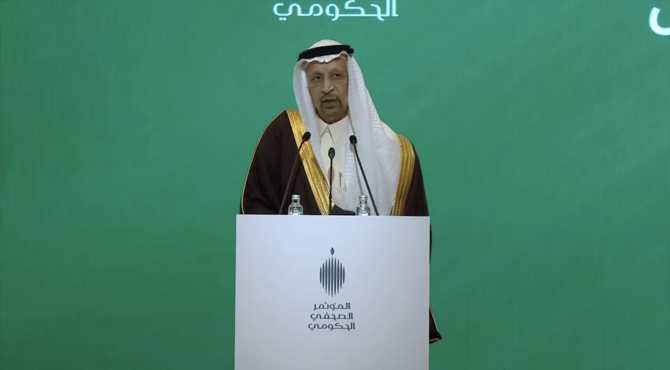
Minister of Investment Khalid Al-Falih speaking at a press conference. Screenshot
Short Url
Updated 26 January 2026
Follow

Saudi Arabia surpasses $400bn in investment volume, minister announces

RIYADH: Saudi Arabia’s total investment volume surpassed SR1.5 trillion ($400 billion) for the first time in 2025, the Kingdom’s minister of investment has announced.

Speaking at the Government Press Conference in Riyadh, Khalid Al-Falih highlighted unprecedented growth across the financial landscape, with foreign capital inflows playing a central role.

The Kingdom is aiming to attract $100 billion in annual foreign direct investment by the end of the decade as part of its Vision 2030 economic diversification plan. 

“We expect foreign investment flows into Saudi Arabia in 2025 to range between SR140 billion and SR150 billion,” Al-Falih said, noting that this projection represents a five-fold increase from the SR28 billion recorded in 2017, a sign of rising global investor confidence.

The surge in international business activity is further reflected in the number of foreign companies operating in the Kingdom. Al-Falih revealed that licensed foreign firms have reached 62,000, a dramatic increase from just 6,000 in 2016.

Furthermore, the nation has attracted more than 700 regional headquarters for leading global corporations, solidifying its position as a premier commercial hub for the Middle East and North Africa.

The investment boom is creating substantial opportunities for Saudis. The minister highlighted that 800,000 new jobs have been created in the Saudi economy, with private sector wages rising by 45 percent. He also noted that women’s labor force participation has doubled, marking a significant societal shift.

The domestic entrepreneurial spirit remains robust, with the number of active commercial registrations held by Saudi investors reaching 1.86 million by the end of 2025.

Al-Falih also stated that 500,000 Saudis have been employed out of 1.5 million workers in foreign companies, and that three major companies have begun automobile manufacturing in the Kingdom.

The economic outcomes cited by Al-Falih are direct results of the nation’s Vision 2030 reform agenda. This transformation is being accelerated by the systematic opening of Saudi Arabia’s capital markets. 

On Feb. 1, the Capital Market Authority will allow all foreign investors direct access to the Main Market, eliminating previous qualification barriers. This follows a period of rapid growth in international participation, with foreign ownership exceeding SR590 billion by the third quarter of 2025. 

On this, the minister said that Tadawul is “prideworthy,” noting that it’s now one of the biggest 10 stock markets worldwide. He stated that the old restrictions on foreign investors were found to limit market access for all international investors. He confirmed that the new rules, which will be announced soon, are designed to be “balanced.”


Reforms target sustained growth in Saudi real estate sector, says Al-Hogail

Updated 26 January 2026
Follow

Reforms target sustained growth in Saudi real estate sector, says Al-Hogail

RIYADH: The Real Estate Future Forum opened its doors for its first day at the Four Seasons Riyadh, with prominent global and local figures coming together to engage with one of the Kingdom’s most prospering sectors.

With new regulations, laws, and investments underway, 2026 is expected to be a year of momentous progress for the real estate sector in the Kingdom.

The forum opened with a video highlighting the sector’s progress in the Kingdom, during which an emphasis was placed on the forum’s ability to create global reach, representation, as well as agreements worth a cumulative $50 billion

With the Kingdom now opening up real estate ownership to foreigners, this year’s Real Estate Future Forum is placing a great deal of importance on this new milestone and its desired outcomes and impact on the market. 

Aside from this year’s forum’s unique discussions surrounding those developments, it will also be the first of its kind to launch the Real Estate Excellence Award and announce its finalist during the three-day summit.

Minister of Municipalities and Housing and Chairman of the Real Estate General Authority Majed Al-Hogail took to stage to address the diverse audience on the real estate market’s achievements thus far and its milestones to come.

Of those important milestones, he underscored “real estate balance” as a key pillar of the sector’s decisions to implement regulatory tools “with the aim of constant growth which can maintain the vitality of this sector.” He pointed to examples of those regulatory measures, such as the White Land Tax.

On 2025’s progress, the minister highlighted the jump in Saudi family home ownership, which went from 47 percent in 2016 to 66 percent in 2025, keeping the Kingdom’s Vision 2030 goal of 70 percent by the end of the decade on track.

He said the opening of the real estate market to foreigners is an indicator of the sector’s maturity under the leadership of Crown Prince Mohammed bin Salman. He said his ministry plans to build over 300,000 housing units in Riyadh over the next three years.

Speaking to Arab News,  Al-Hogail elaborated on these achievements, stating: “Today, demand, especially local demand, has grown significantly. The mortgage market has reached record levels, exceeding SR900 billion ($240 billion) in mortgage financing, we are now seeing SRC (Saudi Real Estate Refinance Co.) injecting both local and foreign liquidity on a large scale, reaching more than SR54 billion”

Al-Hogail described Makkah and Madinah as unique and special points in the Kingdom’s real estate market as he spoke of the sector’s attractiveness.

 “Today, the Kingdom of Saudi Arabia has become, in international investment indices, one that takes a good share of the Middle East, and based on this, many real estate investment portfolios have begun to come in,” he said. 

Al-Ahsa Gov. Prince Saud bin Talal bin Badr Al-Saud told Arab News the Kingdom’s ability to balance both heritage sites with real estate is one of its strengths.

He said: “Actually the real estate market supports the whole infrastructure … the whole ecosystem goes back together in the foundation of the real estate; if we have the right infrastructure we can leverage more on tourism plus we can leverage more on the quality of life … we’re looking at 2030, this is the vision … to have the right infrastructure the time for more investors to come in real estate, entertainment, plus tourism and culture.”