

Artists find their voice in Turkey’s ‘difficult’ climate

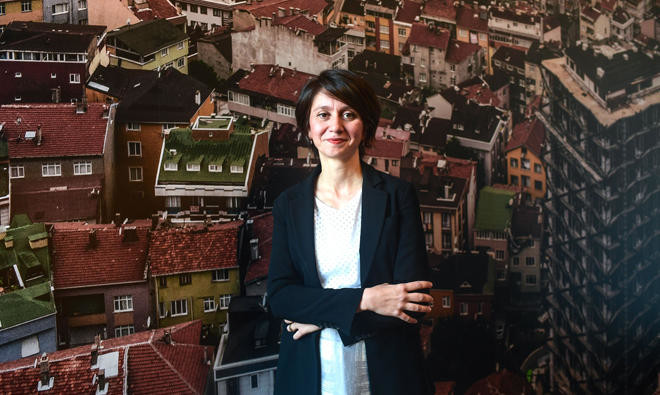
Bige Orer, director of the Istanbul Biennal, poses during an interview in Istanbul on Monday. (AFP)
Updated 21 November 2017
Follow

Artists find their voice in Turkey’s ‘difficult’ climate

ISTANBUL: A mute Syrian boy, using just body movements, gives a harrowing description of life under in Syria. A crowd gathers of passionate activists.
And a galaxy of white ceramic CCTV cameras keeps a Big Brother-like watch over a city.
These are just some of the images from this season’s contemporary exhibitions in Istanbul as artists grapple with issues of censorship and political turbulence in Turkey and raging violence across the border in Syria.
And while critics of President Recep Tayyip Erdogan say the government is riding roughshod over freedom of expression, many artists are openly defying the trend by tackling big issues head-on in a still punchy scene.
Almost immediately after the failed coup against Erdogan last year, Turkish authorities launched widespread purges which opponents say have gone beyond suspected coup plotters and are affecting intellectual and artistic circles.
Some artists have self-censored or even left the country. But others have sought to develop new ways of addressing the situation.
“The artistic scene in Istanbul is not in the process of shrinking — it is in the process of becoming more interesting,” said artist Safak Catalbas.
“The difficult circumstances make us more creative,” she added.
This year’s Istanbul Biennial, the most important contemporary art event in Turkey, did not shy away from controversial topics like the refugee crisis or conflicts in Syria and Iraq.
The event, which was curated by Scandinavian duo Michael Elmgreen and Ingar Dragset and closed its doors on Nov. 12, also contained more than just coded references to the current situation in Turkey.

Turkish artist Erkan Ozgen, a Kurd, presented the video installation of the Syrian mute boy, Mohammed, in a short video entitled “Wonderland.”
A spectacular wall mural by French-Moroccan designer Latifa Echakhch showed the crowd of protesters in a reference to anti-government rallies in Turkey crushed in 2013.
Another example came from Turkish artist Burcak Bingol, who used ceramic CCTV cameras scattered across the city to recall the inquisitive eyes of the authorities in a country which has been living under a state of emergency for more than a year.
“All exhibitions must, in one way or another, address the local political-social context to be relevant,” said Biennial director Bige Orer.
“We have tried to find a new language to deal with the current context,” she added. “We felt that a new energy was emerging.”
Few dispute that the climate in Istanbul has changed greatly since 2005, when in the early days of Erdogan’s rule Newsweek magazine famously dubbed the Turkish metropolis “the coolest city in the world.”
The repression of the spring protest movement in 2013 — which many artists were involved in — marked the end of a certain carefree attitude in the country.
At least eight people were killed and more than 8,000 injured by police during anti-government protests against plans to build on land occupied by Gezi Park in central Istanbul, according to Turkish NGOs.
Asli Sumer, who runs a gallery in the waterside district of Karakoy, said, however, that instead of criticizing the authorities directly, artists are interested in ways of overcoming these hardships.
“An artist with whom I work is especially interested in plants and their capacity to grow back by being more resistant,” she said.
In addition to the Biennial, the international contemporary art fair in Istanbul welcomed more than 80,000 visitors between Sept. 14 and 17, a turnout that also showed the resilience of the Turkish arts scene.
This year, one of the main exhibits on display was the “Box of Democracy” by Bedri Baykam, one of the seminal modern works of Turkish three-dimensional art.
The exhibit — a kind of large telephone box inside which the viewer is able to enjoy a totally free space — was created in 1987 to criticize the years of repression inherited from the 1980 military coup.
Maintaining such creative freedom is made possible through the financing of contemporary art by private funds without fear of state meddling.
The Istanbul Biennial is organized by the privately-run Istanbul Foundation For Culture and Arts (IKSV) and funded primarily by family-run industrial conglomerate Koc Holding.
“As a result, the state has little leverage to use pressure,” said Orhan Esen, an expert on urban history and Istanbul’s art scene.

Trump says change of power in Iran would be ‘best thing’

Updated 14 February 2026
Follow

Trump says change of power in Iran would be ‘best thing’

  • Trump’s comments were his most overt call yet for the toppling of Iran’s clerical establishment
  • USS Gerald R. Ford — the world’s largest warship — would be “leaving very soon” for the Middle East

WASHINGTON: US President Donald Trump said Friday that a change of government in Iran would be the “best thing that could happen,” as he sent a second aircraft carrier to the Middle East to ratchet up military pressure on the Islamic republic.

Trump’s comments were his most overt call yet for the toppling of Iran’s clerical establishment, and came as he pushes on Washington’s arch-foe Tehran to make a deal to limit its nuclear program.

At the same time, the exiled son of the Iranian shah toppled in the 1979 Islamic revolution renewed his calls for international intervention following a bloody crackdown on protests by Tehran.

“Seems like that would be the best thing that could happen,” Trump told reporters at the Fort Bragg military base in North Carolina when a journalist asked if he wanted “regime change” in Iran.

Trump declined to say who he would want to take over in Iran from supreme leader Ayatollah Ali Khamenei, but he added that “there are people.”

He has previously backed off full-throated calls for a change of government in Iran, warning that it could cause chaos, although he has made threats toward Khamenei in the past.

Speaking earlier at the White House, Trump said that the USS Gerald R. Ford — the world’s largest warship — would be “leaving very soon” for the Middle East to up the pressure on Iran.

“In case we don’t make a deal, we’ll need it,” Trump said.

The giant vessel is currently in the Caribbean following the US overthrow of Venezuela’s Nicolas Maduro. Another carrier, the USS Abraham Lincoln, is one of 12 US ships already in the Middle East.

‘Terribly difficult’

When Iran began its crackdown on protests last month — which rights groups say killed thousands — Trump initially said that the United States was “locked and loaded” to help demonstrators.

But he has recently focused his military threats on Tehran’s nuclear program, which US forces struck last July during Israel’s unprecedented 12-day war with Iran.

The protests have subsided for now but US-based Reza Pahlavi, the son of Iran’s last shah, urged international intervention to support the Iranian people.

“We are asking for a humanitarian intervention to prevent more innocent lives being killed in the process,” he told the Munich Security Conference.

It followed a call by the opposition leader, who has not returned to his country since before the revolution, for Iranians at home and abroad to continue demonstrations this weekend.

Videos verified by AFP showed people in Iran this week chanting anti-government slogans as the clerical leadership celebrated the anniversary of the Islamic revolution.

Iran and the United States, who have had no diplomatic relations since shortly after the revolution, held talks on the nuclear issue last week in Oman. No dates have been set for new talks yet.

The West fears the program is aimed at making a bomb, which Tehran denies.

The head of the UN nuclear watchdog, Rafael Grossi, said Friday that reaching an accord with Iran on inspections of its processing facilities was possible but “terribly difficult.”

Reformists released

Trump said after talks with Israeli Prime Minister Benjamin Netanyahu earlier this week that he wanted to continue talks with Iran, defying pressure from his key ally for a tougher stance.

The Israeli prime minister himself expressed skepticism at the quality of any agreement if it didn’t also cover Iran’s ballistic missiles and support for regional proxies.

According to the US-based Human Rights Activists News Agency, 7,008 people, mostly protesters, were killed in the recent crackdown, although rights groups warn the toll is likely far higher.

More than 53,000 people have also been arrested, it added.

The Norway-based Iran Human Rights (IHR) NGO said “hundreds” of people were facing charges linked to the protests that could see them sentenced to death.

Figures working within the Iranian system have also been arrested, with three politicians detained this week from the so-called reformist wing of Iranian politics supportive of President Masoud Pezeshkian.

The three — Azar Mansouri, Javad Emam and Ebrahim Asgharzadeh — were released on bail Thursday and Friday, their lawyer Hojjat Kermani told the ISNA news agency.