

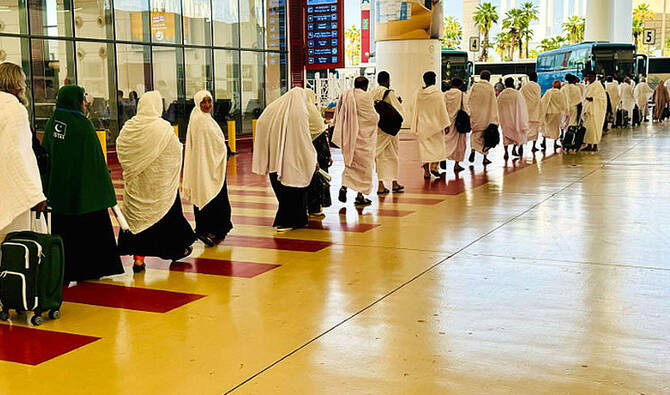

ISLAMABAD: Pakistan has prepared contingency arrangements for the safe return of its Hajj pilgrims in case fighting between Iran and the United States resumes and disrupts regional air travel, the country’s religious affairs minister said on Tuesday.
The conflict between Washington and Tehran, which began on Feb. 28 and has remained paused under a ceasefire since April 8, disrupted flights across parts of the Middle East and raised fears over shipping and energy supplies through the Strait of Hormuz, a vital global oil transit route.
Pakistan is among the world’s largest contributors of Hajj pilgrims, sending tens of thousands of Muslims to Saudi Arabia each year under both government-run and private schemes. This year, more than 179,000 Pakistanis are expected to perform the pilgrimage, with over 60,000 already in the Kingdom.
“First of all, we pray to Allah Almighty to keep the region peaceful. However, if, God forbid, any unfortunate situation arises, we already have a contingency plan ready,” Pakistan’s Religious Affairs Minister Sardar Muhammad Yousaf told Arab News in an interview, adding the plan had been prepared in coordination with Saudi authorities.
“If required, we will implement the emergency plan to ensure the safe return and protection of Pakistani pilgrims.”
Yousaf said Pakistan’s foreign ministry and its embassy in Riyadh were coordinating with Saudi Arabia’s civil aviation, interior and foreign affairs authorities regarding the arrangements, and a meeting on the issue was expected soon.
“But we do have an emergency plan in place to get Pakistanis out,” Yousaf said. “Wherever required, we will coordinate with the Saudi government too.”
Pakistan began its pre-Hajj flight operation on April 29, which is scheduled to continue through May 21.
Most Pakistani pilgrims this year are traveling under Saudi Arabia’s Route to Makkah Initiative, which allows travelers to complete immigration and customs procedures before departure from Pakistan, enabling them to bypass arrival processing in Saudi Arabia and proceed directly to their accommodations in Makkah or Madinah.
The initiative, previously available only in Islamabad and Karachi, was expanded to Lahore this year.
Yousaf said Pakistan was also in talks with Saudi authorities to extend the program to the northwestern city of Peshawar and the southwestern city of Quetta.
“Discussions are ongoing regarding its expansion to Peshawar and Quetta, and they are considering it under the required criteria,” he said.
“We hope it can be extended there in the future as well.”
The minister said Islamabad was also seeking an increase in Pakistan’s Hajj quota to 230,000 pilgrims in the future, arguing that the country’s large Muslim population justified a higher allocation.
“Pakistan’s Muslim population is approximately 230 million, and under the formula, our quota comes to around 230,000 pilgrims,” Yousaf said.
“We have already discussed this issue with the Saudi authorities. They will consider it, and if they decide to increase quotas globally, we are hopeful that Pakistan’s quota will also be increased.”


